

Please Enjoy my Travel, Music & Ancestry Books on Amazon – FREE on Kindle Unlimited https://bit.ly/bookneal
This chapter is taken from my first French travel book ‘First Time we Saw Paris’ and appears also in the compilation ‘Off the Autoroute’.
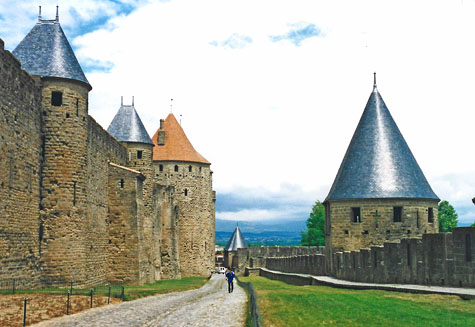
We also had the opportunity one day in our first week in France to visit the cité of Carcassonne. My only recollection prior to visiting this medieval, heavily restored fortress cité is of having watched the English TV chef Keith Floyd exercising his culinary skills in a vineyard outside of the walls, a glorious view of the cité as a backdrop.
I cannot remember at all what he cooked.
I always recall that behind him you had the dazzling reflection of the bright sun reflecting on the roofs of the cité, roofs that always seemed to appear as having been just re-roofed with a European Union repair grant. One unavoidable feature about Carcassonne though is that it does always divide opinion regarding the results of this restoration. Certainly, there are many aficionados that do like their ruins to be just that – ruins.
Others may lean more to wanting to see an authentic restoration taking it back to how it originally looked. These are the ones that are of the strong opinion that Walt Disney had a serious hand in Carcassonne’s restoration. That can be discounted as definitely not the case as this cité was restored by the architect Eugene Viollet-Le-Duc in 1853. He also worked on the restoration of Notre Dame on the Ile de la Cité in Paris and on Mont Saint-Michel. With his plans for Carcassonne I cannot help but feel he was ahead of his time, somehow having had the foresight to appreciate that one day there would be throngs of people that would have access to fast transport and this would be the time that they would flock here in droves.
He also seems to have realized that one day Carcassonne would look fabulous on film.
His restoration design seems to have been produced with that in mind and yes, you certainly can argue it is a bit like a theme park in places, but it is surely better than being a ruin and despite all the touristy cafés and shops you are able to quietly escape the crowds and drink in the atmosphere of this incredible citadel.

Anyway, all the delights of Carcassonne are for later in the day, for our journey along the way was an interesting experience in itself.
We had not travelled on our tour bus far beyond Perpignan and into the countryside. Hungry passengers soon indicated they wanted a breakfast stop quite soon after leaving the coastal area. The bus was winding its way down a very picturesque valley soon narrowing towards rocky cliffs. At the meeting point of which there was a small village that looked down into the river from its square with an ancient stone bridge spanning the ravine.
At the top corner of the square, a square that was probably larger than the village itself, was a café. Slightly unnervingly, parked just in front of the café there were several army vehicles. The French Foreign Legion has headquarters in these parts, but these were regular troops. There were around twenty-five of us on this trip, most probably more numerous than the village population.
As we all filed into the café for a coffee and croissant, I got the distinct impression that the owner would usually only be used to serving 3 or 4 people at a time. For a small village café this could have been viewed as a cause for celebration, a whole week of takings to be gleaned in one hour and an ideal chance to rip off the British who were still coming to terms with how much the currency is worth.
The lady owner stood silently behind the old bar. Her face though looked far from happy, in fact it was a face that reflected the sheer terror of thinking how she could possibly deal with this merry crowd of tourists. The simple fact was that she could not and rather than immediately taking our orders it was clear that she really wanted to show us a freshly displayed closed sign hoping we would leave.
A huddle of uniformed men and women were quietly observing and comprehending the situation. It was then that the French army, as represented by this small group quietly sipping their coffee, their AK-47s on the back of their chairs currently not required for use on the English, swung into action.
We watched in amazement as the soldiers all moved into the cramped space behind the bar, grabbing cups and plates and laying them out on top of the bar. I think the owner was not aware she had that much crockery. The coffee machine went into meltdown and one of the soldiers soon returned from the village boulangerie laden with warm croissants and other pastries. I am not entirely sure if one of them stayed behind to look after the weapons while all this was going on. Within a truly short period of time we were all contentedly served. The beaming owner, who had in fact done absolutely nothing to assist these volunteer sous chefs, mopped her rosé brow and counted the takings. The variety of training soldiers get these days is obviously quite remarkable and once they have finished their careers shooting people then a restaurant in Paris would surely be their pathway to riches. Fantastic job boys and girls.
We most satisfied customers all left in a real spirit of entente cordial with much hand shaking and back slapping and really we could just have gone straight back home then as that was probably enough excitement for the day but on the bus went towards Carcassonne.
Whatever may be your take on the restoration of the cité of Carcassonne you cannot be other than impressed on seeing the outline of the cité come into view for the first time. It is magnificent and the roofs really do look extremely modern. I expected them to be thatched. It is a very impressive sight.
That first initial impact about the architecture is diffused to some extent when you approach the main gate and pass through into the small courtyard. Then your senses are assaulted by all the Cathar themed shops in the extremely narrow street in front of you. It is almost compulsory to be carrying a plastic sword or a crusaders helmet while wearing a Knights Templars tee shirt emblazoned with a red cross. All the children love it but at this point I must agree with the detractors that the ambiance all seems a bit contrived and like a Cathar Disneyland.
On the left of the impossibly narrow street is a café that does crepes in an ‘ancient style’ – you tell me. Beyond that we have a Musee du chapeau and as much as I love history I not sure that a hat museum is a big attraction, but it does also sell hats, presumably the ones no one wants to look at anymore. Beyond the hat museum is La Taverne Medievale, in fact there seems to be one of those on both sides of the street. I assume by now that you have got the impression that this place really does try to trade on its past and that is a very violent past, one that resulted in the virtual wiping out of the culture and the resident people of this region. So, it seems a rather incongruous subject to now turn into mass tourism with a theme park twist.

You must smile at the beginning of the street where there is set of traffic lights that change all day long as usual, waiting to control the rush of traffic. It is quite a funny sight to see as the actual chances of even getting the tiniest Smart car up a street so densely packed with tourists are non-existent.
If you happen to be a history or architecture buff it is perhaps advisable to avert your eyes from street level and look up and then you can begin to get a feel for how this cité used to look. It is here that the restoration is more sympathetic to history. Once you arrive at the top of this street after you have had your Crusader burger and Cathar ice cream the cité starts to open up, exploring it becomes a pleasure. It is true that once again there are souvenir shops, but they become fewer and farther between and you start to come across higher quality little shops and cafés. Flower arrangements in the streets and terraces become more abundant and there is finally space to breath.
Here there are restaurants with attractive terraces and the whole place becomes extremely pleasant with interest around every corner. You get an awareness of the size and strength of the ramparts and the solidity of the buildings inside the cité that once served as a protection back in the Middle Ages and earlier. Most of these walls were still mostly intact at the time of the restoration so all seems more in tune with history as you explore further into the cité.
You become so far removed from the tourist traps that you even come across a five-star hotel, Hotel de la Cité. It is evident that here is indeed an oasis of calm and luxury within the fortifications, although with us feeling slightly underdressed, we simply stare inside for a moment and move swiftly on. Though please do not let me stop you hammering your credit cards if you are passing one day.
We as mere poor peasants from Lancashire find a crepe café and have a simple lunch of savoury and sweet crepes. The medieval theme is to be seen everywhere in this small café. You do feel you could be in real danger if one of the eBay purchased ancient artefacts were to fall from the walls or ceiling. It is pleasant petit lunch served with a smile and you cannot ask for more than that.
One bizarre thing about the meal was that the rosé wine was served in what I can only describe as glass candle holders; you know the type that only have a stem and are housed in a type of metal candelabra structure. That is how it was presented to us on the table, but it did mean that you had to hold your glass at all times as you could not put it down on the table. All you could do was slip it back into the candle holder but then you couldn’t drink, could you? You would soon empty your wine glass if you forgot that it had no base to it.
It was an extremely sweltering day with cloudless skies, and we were glad of these more open spaces in the interior of the cité and the taller buildings do offer some degree of shade. It was very pleasant to stroll around the labyrinth of streets and then find once again more space and air.
In one of the lovely small shop windows was something that I really desired but I ultimately decided that because of the size of it and the distance we were from home not to buy it. For all these years since I have regretted doing so. The object was the most beautiful chess set and board with the pieces designed in what I can only describe as a very French Middle Ages style, but the craftsman had done it in a way that did not appear tacky or cheap. The set was quite colourfully finished with all the pieces appearing to be painted or done in enamelled pewter. It really was calling me but on this occasion my head ruled my heart, but it was wrong to do so – I should have bought it. I am now playing chess with my granddaughter and regret it even more.
To the other extreme then, one purchase that my son did make turned out to be completely useless, however. On this occasion I am not sure which part of his body told him to buy it. This was a watch, and I can safely say that despite paying a considerable sum for this timepiece the watch was never worn. I think it went down the eBay route about 15 years later having resided all those years in a drawer well out of sight.
How can I describe this truly dreadful piece of design that somehow my son for at least a moment in time found attractive?
It was large, it was brutally metallic and angular but square at the same time. It had a little glass phial on a very tiny chain that clicked into place in a holder at the bottom of the watch face. The phial would not contain much whisky or brandy. I can only assume that it was for a powdery substance. What was he thinking? In a short space of time, I think he was hoping for a refund from the Bank of Dad though he was not getting one on this occasion, he would have to live this one down for quite a while.
With all this retail therapy turning out to be quite stressful, we went back through the gates to be outside the internal walls. You can walk between these and the external walls as if walking on an old dry moat. If your thing is really history and architecture, then this is the part of Carcassonne that will really appeal to you. This space between the imposing walls is quite wide and you do feel small as you walk around the walls taking in the detail and grandeur of this citadel fortress. The restoration seen from here seems very much in tune with the original purpose of the fortress except perhaps the roof which once again I still cannot feel is authentic to the original. But despite that I have to admit it is an exceptionally fine example of the roofers art.
The finest view of Carcassonne I still feel is ultimately from a distance away from the walls. It is here that you can get a sense of the scale of the cité and appreciate with a little more empathy the planning and efforts of Viollet-le-Duc. Perhaps we can forgive him the liberties he may have taken in restoring it in a way that maybe is not faithful, but it does without a doubt appeal to the hordes of modern visitors.
On the journey back to Canet Plage the driver pulled into Limoux, a town famous for the local wine but especially its sparking Blanquette de Limoux. This fizz is made in a similar method to Champagne. Although, of course, they are unable to call it that, Blanquette de Limoux is just as famous in these parts as its exclusive Northern counterpart.
We had some time to spare to browse the main street in Limoux and find a wine producer with a shop outlet that was willing to give us a tasting – a degustation. Being always happy to partake of a free wine tasting we settled down to try a few examples of this regions wine, including the Blanquette. It is a sparkling wine that really is remarkably like Champagne and on our future travels we would find many of these sparkling wines made outside the Champagne region such as in the Loire Valley and in Northern Burgundy. For being unable to be associated directly with the Champagne name they are superb value as are genuine champagnes from smaller lesser-known champagne producers located outside of the main centres such as Reims and Epernay. I discover and discuss more about that in my French wine book – French Wine Uncorked.
We purchased a couple of bottles of sparkling Blanquette and made our way back on to the bus. If I had known beforehand the route the driver intended to take on the way back to Canet Plage then I would have had something much stronger to drink. It would prove to be a memorable and spectacular experience though, one not to have been missed.
For reasons best known to himself he travelled back to the coast by the way of the Gorge de Galamus, and let me tell you that precarious route is not one for the fainthearted. Spectacular though it most certainly is. When we were daring enough to look down from the window we saw breath-taking landscape. Somehow the driver negotiated the many rocky overhangs on the way home. With only a small wall guarding the edge of the deep ravine he managed to stay on the road, and we lived to tell the tale.
France is blessed with many such gorges and this region is full of spectacular and hair-raising roads. Many of them are not as well-known on the tourist route as ones such as the incredible Gorges du Verdon in Provence, but if you look out for hills and gorges off the beaten track you can find some amazing natural wonders that will delight and terrify you in equal measure.
Other chapters:
Chocolat – a village in Burgundy  Rue Cler – Paris
Please Enjoy my Travel, Music & Ancestry Books on Amazon – FREE on Kindle Unlimited https://bit.ly/bookneal
 French Travel Books - France, Paris, Provence & French Food & Wine