
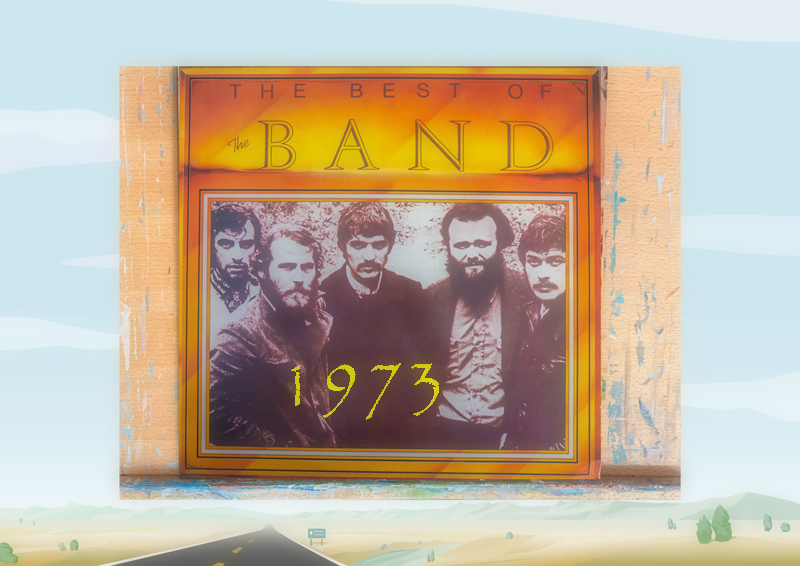

I was listening to The Band well before I started listening seriously to Dylan. There is something about their sound that is quite unique but also familiar. I think it seemed to me at the time that they were the American equivalent of Fairport Convention. They make the history of the States believable and captivating. They are writing the American heritage. Fairport can only be an English band despite taking influences from the States, setting that Englishness down with clarity. The Band do the same in reverse, taking some English influences to make a sound that perfectly connects you to the American story. On the Fairport album ‘History of’ the notes inside make the observation that drummer Dave Mattacks was always having Levon Helm ‘thrown’ at him. No question they took much inspiration from the work The Band were doing.
This particular album is no longer available, so I must base my observations on the individual songs which are all still streamable or available in other Greatest Hits packages. This album is a bit sparse and other ‘Hits’ packages give a more rounded picture of The Band.
I loved The Band. So atmospheric, that word cinematic again. I have touched previously in my ‘reviews’ on my intense disappointment when I saw them live for the first and only time at Wembley Stadium in 1974. I can sympathise with them not being in the best of shape for that appearance, but sad that the years on the road had taken their toll on them, musically and physically. The Last Waltz was on the horizon, needing to take a breather and end the madness. Sadly, for some of them life never did stabilize and was cut short tragically. With the death of Robbie Robertson and now Garth Hudson, it is now a band of memories. I am so glad I saw them live but tinged with a feeling of what it might have been. How much better they must have been when all was right in their world. We do have plenty of recordings to show that and this is a fine collection.

The album opens with the finest song on the record. ‘The Weight’ is one of THE great songs of this era, a Band classic that is a piece of writing in full widescreen Technicolor. It defined The Band and still today is the song most associated with their style of writing and how they all complement each other, especially in the shared vocals and harmony in the chorus. The lines contain clear Biblical Imagery despite Robbie Robertson’s denial that there is no spiritual dimension to the song. There is perhaps just too much of that type of metaphor to totally take him at face value. Pulling into Nazareth is taken from a label on his guitar but followed by clear reference to finding a bed and being refused making a Biblical connection impossible to ignore. The song has an array of unusual, quirky characters that intertwine with similar imagery. Robertson says his inspiration is from the surreal Spanish filmmaker Luis Buñuel. Like him Robertson is trying to show that good people end up doing bad things or in this case resenting being the good guy loaded down with having to do favours for others. The characters are memorable, creating movies in your mind. According to Levon Helm they are based on real people. He particularly recalls Crazy Chester as being a guy who came into town with his cap pistols to keep order on the streets – quite an image. Fanny was a bookshop owner crucial to the song. It builds and builds with each character playing out vividly in the imagination. It ends with the return to Fanny, again for many this has a spiritual dimension. We can take Robertson at his word that all this is purely him trying to mirror the work of Luis Buñuel in cinematic song. However, the film ‘Last Waltz’ ends not on stage but in the studio with the Staples Singers providing weight (sorry) to this song. Surely The Band are here showing that this is indeed a spiritual in the American tradition.
Vocally on this track the band use two lead singers in Helm and Robertson, with all coming together for the chorus in perfect harmony. Sadly, this song in particular was to cause much friction and resentment between them with Robertson portrayed as the bad guy. His fractured relationships, particularly with Levon Helm, are well documented. It does seem unusual that Robertson is solely credited as the writer. For a song as complex as this, performed with such distinct contributions by the members of the band, it feels others surely had an important input as they all claimed. The simmering resentment that Robertson took the songwriting royalties ultimately soured relationships. That is a shame as this is such an outstanding work – an American classic that has never dated. It will live on in the tradition of American songwriting.
‘Up on Cripple Creek’ sounds simple but it is quite complex both lyrically and musically. It has some interesting riffs that were perhaps a bit ahead of their time, particularly apparent in the intro and after the chorus. The Band being funky. It is one of those songs that gets inside your consciousness. After a couple of listens you find yourself repeating lines in your head. Part of the reason is that the lyrics are so intriguing, more great storytelling painting in words. This is Robertson reacquainting himself with the common man amongst his contemporaries. This truck driver has no pretensions, just gets on the road, has Bessie to break the journey, enjoy the distractions of the road as he goes across country. No deep philosophy with this guy but once again we have another screen version of America. Always loved this song and the quirky lyrics sung with panache by Helm for the most part.
‘The Night they Drove Old Dixie Down’ may be the best-known song by the Band chiefly because of the cover by Joan Baez. I find it curious that the version by a female singer was so popular as I always see this as a masculine song. It is a remarkable piece of writing in that it sounds like it could easily be a song in the American tradition composed around the time of Civil War, not by a modern songwriter. Robertson tries as far as he can to be historically accurate even to the extent of Levon Helm helping out in finding the references to study. Helm took him to meet his family in Arkansas to enable Robertson to get the feel of a Southerners point of view. Even so that has not stopped criticism of the song in our revisionist times. Any references to Dixie some feel must be a support of slavery. That surely is not how this song reads at all. It endeavours to be a true and faithful version of the events as they affected the people at a personal level. You can feel the pain of the family as the war affects them, young sons die, and the people suffer. There is no need to try to find subliminal meanings – Robertson writes clearly with feeling. Not bad for a Canadian. The music is superb on this, some of the bands finest. Glorious chord progressions with the band coming together not just instrumentally but with some of their finest harmonies. Helm sings the lyrics with tremendous feeling as only a southerner could. This is the definitive version – accept no substitute. When they played this on the ‘Last Waltz’ it would be the last time they all shared a stage together – quite a thought and a loss to music.
‘The Shape I’m in’ takes on a retrospective poignancy due to the way lead vocalist Richard Manuel met his end. Was this written about the shape he was actually in at the time of writing. It sounds like a plausible assumption, especially as he takes the vocal. It also reflects a tension within the band unit as lifestyle choices and money conflicts started to take a toll. It is a sad song from the point of view of the subject matter, but it is a superb workout musically and rocks along like an improvised jam session. For me it takes on an added tragic dimension. As you know I saw The Band at Wembley in 1974. The mediocre performance that day turned out to be in part because of Richard Manuel struggling to perform, just making up the numbers on stage. It was sadly not always a Band of Brothers for them – things turned sour both professionally and personally, with tragic results for some. This song documents the issues unfolding.
Martin Scorsese, he of ‘Last Waltz’ fame, collaborates again on the film ‘Once were Brothers,’ the story of The Band, albeit from the perspective of Robbie Robertson. It is a moving story even if a one-sided recollection in the main. Robertson comes across as having a deep affection for his former band members, a sense of putting things right even if it is posthumously. There are some deeply touching moments. The revelation that he was estranged from Levon Helm up until his drummer friend was dying is incredibly sad when you go over what they went through together. I cannot quite decide if Robbie is asking for forgiveness or just trying to explain. An emotional watch whichever side you come down on.
There are many more gems on this album of course but best to encourage you to seek out a collection and enjoy America’s finest Canadians bottling the spirit of the States in a way no one else has been able to do. Their association with Dylan is also important and reflected on songs like ‘I Shall be Released’ where they manage to produce a version as good as any of the hundreds of cover versions.
The Band – yes, THE band. Enjoy their legacy as with Garth Hudson’s passing we will not see their like again.
Taken from my book exploring my vinyl collection – enjoy the memories

 French Travel Books - France, Paris, Provence & French Food & Wine
Leave a comment