
Please Enjoy my Travel, Music & Ancestry Books on Amazon – FREE on Kindle Unlimited https://bit.ly/bookneal

The grave of Fergus Suter Blackburn
I was always aware of Fergus Suter and his exploits at Darwen Football Club. The ubiquitous photo of him reclining in front of the team at Orchard House was certainly well known to a football mad Darrener. I knew less about his time at Blackburn Rovers. Presumably, that was because my father would feel rather queasy if he had to mention Rovers. I had heard about Fergus being landlord at the Millstone Hotel, but nothing more about his later life. I was not aware that he was buried locally.
His grave was untended and unloved for many years. This is sad and a little strange due to his importance to the history of football. Blackburn Rovers should have been aware of this as should Darwen F.C. At the time of Rovers Premier League triumph in 1995 Darwen were in a bit of an existential crisis so Suter would not have been high on their priorities. Rovers on a high could have used the exploits of the past to round out their Premier League story. Eventually Rovers would come good and honour their illustrious former player.
The ‘English Game’ certainly was the catalyst for renewed interest in Suter and the events in early football history concerning Darwen and Blackburn Rovers. Jacqueline McAleese lived within the boundary of Blackburn Old Cemetery where she watched the Netflix series. Jacqueline learning that Fergus was buried in the cemetery, took the short stroll to the plot. Finding it she was distressed to see that the headstone had fallen, with the rest of the grave just an unsightly scrub of grassy earth. I have found researching Fergus Suter’s story to be quite an obsessive project and Jaqueline also soon found herself passionately determined to do something about the state of our hero’s grave. This she certainly achieved.
Contacting Blackburn Rovers, she found chief executive Steve Waggott more than willing to pay back some of the respect that was due to Fergus from the Rovers. The result is a fine tribute to Fergus and his family. Now fully restored and looking as it should for such an influential man it is testament to a determined lady who righted a wrong with the help of his former club.
I visited the grave with Jacqueline as tour guide on a balmy early evening in July 2026. The grave is found by following the right fork from the main entrance until you come to a narrow newly created path on the right leading through the graveyard. Following this as it meanders down and then up to the far wall it leads you directly to Fergus’ resting place. It has had a remarkable transformation. Sadly, it was noticeable that the etching on the new plaque containing an image of Fergus flanked by the Blackburn Town and Blackburn Rovers crests had faded considerably in the few years since it had been installed. Jacqueline was already on the case and by about four days later the stonemasons had redone the etching restoring it to the original condition. Jacqueline gets rapid responses and results. Talking to Jacqueline it became clear that Fergus is not the only Rovers player to be buried in the Old cemetery. From an ongoing project a dedicated fan has found that there are over forty players in there. It is hoped to make this information easily accessible and make these players ‘live again’ for the Rovers fans. Also in the cemetery is the man who was there at the founding of the club – John Lewis. There are more stories waiting to be told, and it would be good and beneficial for the club to get involved again in this project.
The Almond / Suter grave itself is interesting in that although the focus is on Fergus it actually tells a family story. The grave is in fact a double one with the plot next to it still unmarked. The unmarked part contains the remains of the two infant children of Martha and Fergus. That plot was purchased in 1867 prior to their deaths. That fits with online information showing Emma Elizabeth Almond being the first in the grave. She was an infant sister of Martha who died when less than one year old in November 1867. Martha’s father John Almond must have purchased the Blackburn Old cemetery site.

In the headstone grave there are five people – Frank Almond (Martha’s brother), John & Jane Almond & Fergus Suter. Frank Almond was the first to be laid to rest in the grave in 1900, but he is for some reason not mentioned on the headstone. Martha Suter despite being on the headstone is officially shown as just being in the cemetery but with no grave reference or even a date which may indicate just her ashes being there. Martha’s sister Mary Alice Smith (on the headstone) is not recorded anywhere in the cemetery. Perhaps they just scattered her ashes without officially informing the cemetery. I suspect the headstone was added in the 1940s, probably by Jessie Suter who married well and would have had the resources. Or it may be Edward Suter’s family who I found came into a substantial amount through marriage.
That still leaves a fifth person in the grave. He is not on the headstone and died shortly after Frank Almond. The mystery man turns out to be Jarvis Suter the brother of Fergus who worked with him as a barman in Blackburn. Jarvis really should be on the headstone or given a separate plaque. He is considered a Partick Thistle early legend as a free scoring player and administrator for the club.
It has to be ‘over to you Partick Thistle.’
=====================
Tommy Marshall Darwen FC
My visit to Darwen and Blackburn to pay my respects and gather photography for this book took me also up to Darwen cemetery. Perhaps it is fitting that the man I had come to see rests here at the top end of Darwen town and Fergus is laid to rest in the main Blackburn cemetery. From the accounts of the day, it is best to have kept them apart. In death these two men could not be separated in how their lives intertwined when their stories were presented in the obituary columns, both locally and nationally. In Darwen cemetery a short stroll sweeping away to the right take you to a secluded section down towards the border wall. In a beautifully restored grave lies Tommy Marshall, Darwen stalwart, English international, and of course the other main protagonist in ‘The English Game.’ As their careers were being summarised by the newspaper obituaries it was noticeable that a large part of the focus was put on the events at Alexandra Meadows when that infamous game was abandoned after the Suter / Marshall altercation. Decades after the event they could not even in death be able to escape the controversy. It really should not overshadow the vital contribution these two men made to these early days of competitive football.
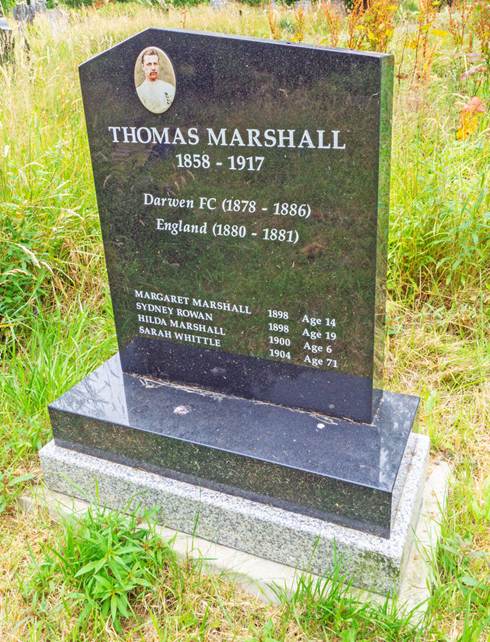
Lovingly restored by the Marshall family the grave has a beautiful headstone where a photo of Tommy proudly wearing his England shirt stares directly out at you from over the decades. Yes, he was a Darrener through and through. Well, at least as much as someone born in Withnell could be. He has a look that declares that he would never let his beloved Darwen F.C. down and he never did play for Blackburn Rovers (a game or two for Olympic though). He also seems to be saying that he certainly did not break young Jimmy Love’s leg.
While in Darwen I had to visit the Alexandra Pub, the alter ego of the Walsh’s home of Orchard Bank. As I came to the top of Bright Street where it reached Durham Road, I was aware that I should try to imagine being close to standing on the touchline of the old Barley Bank ground. Imagination is somewhat difficult as nothing whatsoever remains of the old ground, not even a corner flag. Staring across the ‘pitch’ there are only rows of terraced streets and back alleys. True, they are better quality than the terraced houses on the other side of the Darwen valley, but they are terraced, nonetheless. Heading left over to Alexandra View I pass two young boys playing football. They have to pause as I walk between them, puzzled as to why I have a camera, knowing nothing of the history of the ground they are playing on.
Darwen FC at Orchard Bank or The Alexandra
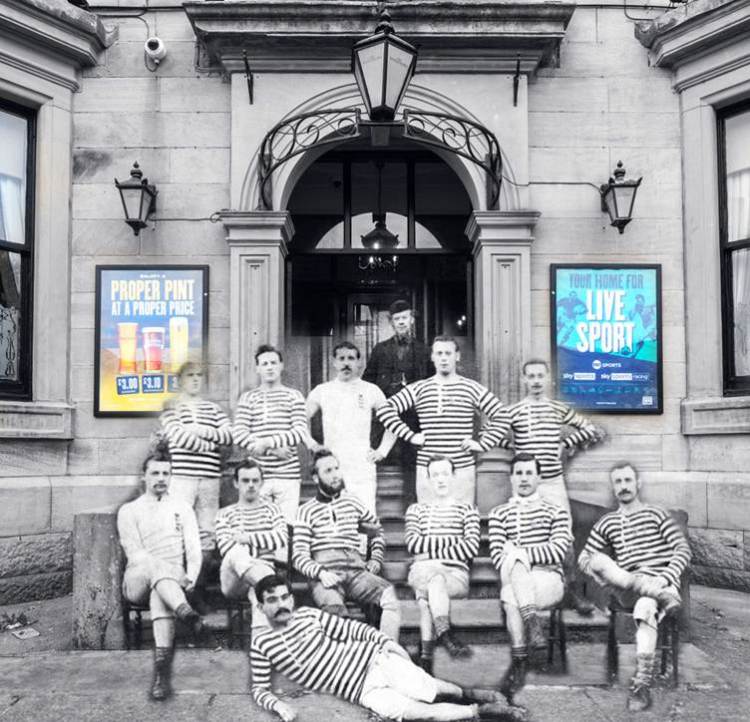
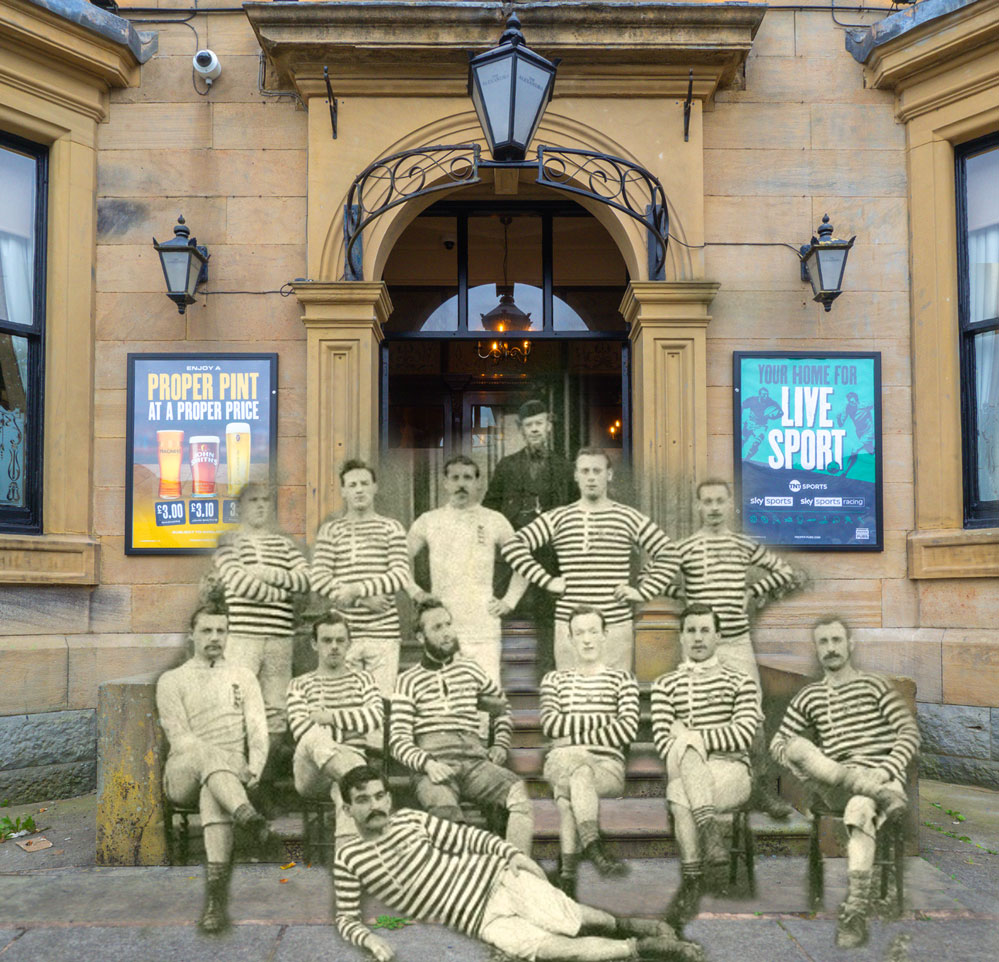
The facing of Orchard Bank where the famous photo of Darwen FC is taken is on the Alexandra View side of the building. Here we saw Fergus looking suitably pleased with himself as he reclines aloof from the others at the front of the assembled group. I find this an endlessly interesting photo, one to enjoy studying the body language and draw some conclusions. Fergus has a prosperous look about him, a man that drew more than the admitted ‘odd tenner’ from his employers. He knows he is the star man, and he wants more. Tommy Marshall is behind and to the left of Fergus sat on a chair at the end of the row. His is perhaps the most interesting body language. He wears his England shirt. His cross-legged pose is of a man comfortable in his own skin and in his position at Darwen Football Club. There is a hint of a glance down at Suter as if to say, ‘I know your game, I know you are off for more money, and we will have our day to settle this.’ The odd man out in the team sits above Fergus, the learned and well to do Dr Gledhill turns his better side to the camera but has a wild look to his expression, hinting at the madness to come which will lead to his early death. There are clues in the body language that betray the fact that this team would self-implode in the not-too-distant future. They had been through a lot together but relationships with each other and the club officials were becoming strained.
The backdrop to the photo is unchanged today. The advertisements on the old wall are perfectly suited to the team that made this frontage famous. Yes, without doubt we are watching the advertised Premier League games because these Victorian footballers grasped the nettle and the North drove a relentless path to the multi-million-pound game we have today. I do wonder if the team had to put on their football kit in the Barley Bank changing rooms just around the corner. Or did the Walsh family let them into Orchard Bank? I suspect the former. Today they would be welcome to go in for a pint but back then, although the Old Etonians were admitted I doubt the social niceties extended to more than the two doctors in the team and possibly Fergus. I would like to think that after the photo session they were invited into Orchard Bank smoking room for a cigar and a glass of port, but it would be another eighty years before footballers broke free from the boardroom control exerted by the men of power.
===========================
Barley Bank Football Ground Darwen
The Barley Bank ground as we mentioned has left not a trace behind. It is possible by superimposing old maps over the modern-day site to walk the outline to a degree and also to locate certain features.
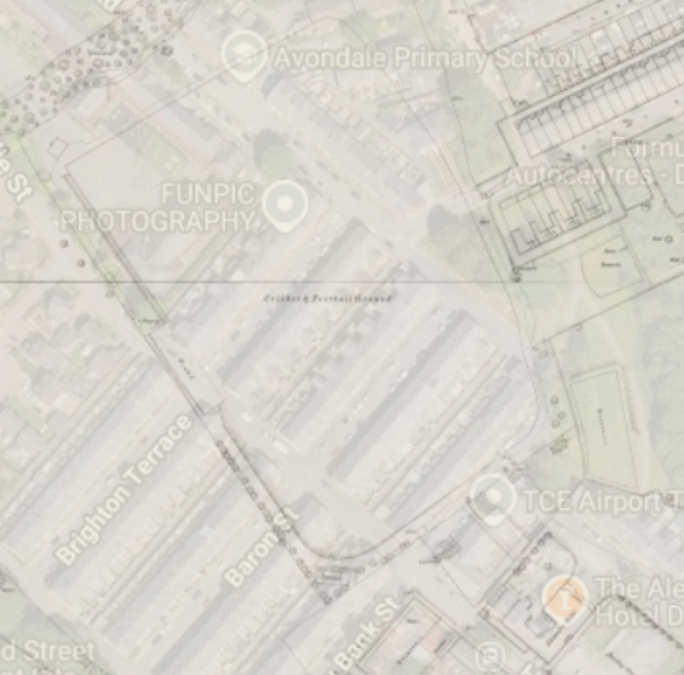
This next photo show where the changing rooms would have been This is the corner of Barley Bank Street and Hindle Street, about fifty yards from Orchard Bank / Alexandra Pub. The players would have changed in a structure roughly where the second and third houses by the white car are situated.
From this and the following photograph you start to get some idea of the slope that the Barley Bank ground had back in the day. The slope would have been across the pitch rather than from one goal to the other.
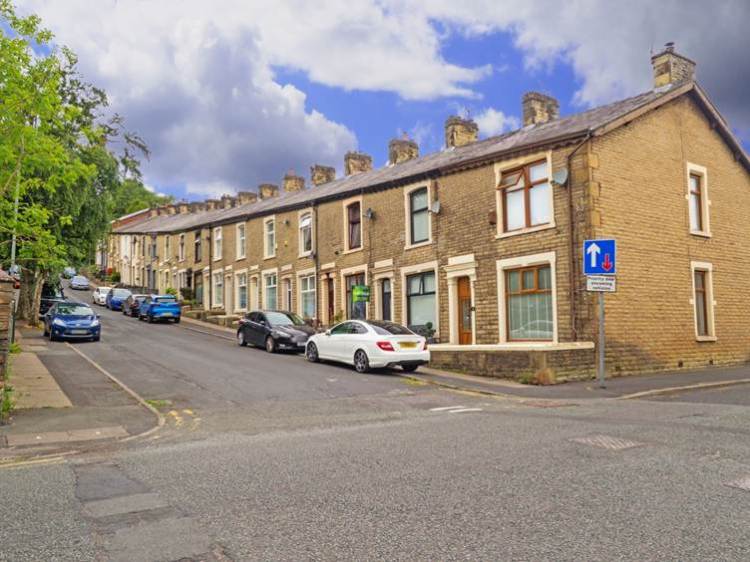
This view is looking down Durham Road away from the Alexandra Pub area. The lower touchline of the pitch would have cut through the houses on the right ending up behind the row. The pitch would have ended just beyond the large tree.

This post/chapter will form part of my book telling the true story of the career and life of Fergus Suter. I will tell of the other protagonists in ‘The English Game’ including Jimmy Love, Tommy Marshall, Lord Kinnaird and others. The life of my Darwen family in Victorian East Lancashire will add the colour and background to the events surrounding the men of Barley Bank. COMING SOON
I am happy to be contacted regarding this project, particularly by any who have an interest through family or have information to share of the events depicted in the Netflix series:


