Featured

Sandy Denny – Sandy

Please Enjoy my Travel, Music & Ancestry Books on Amazon – FREE on Kindle Unlimited https://bit.ly/bookneal

Sandy Denny  –   Sandy

Sandy Denny’s solo albums can frustrate to a degree, as does her work with Fotheringay. There is this sense that others are adding too much of their ideas to a project rather than Sandy being allowed to own the work. Maybe thats why I love her gorgeous demos so much. Sometimes it is the song choice being patchy, it can be over-blown arrangements or just too many musical influences on one album. With Fotheringay the musicians are so good, so used to the rhythm of a ‘Fairport’ type session, they sometimes give the feeling that it is just an easy session in the studio, a day at the office for them. But in all of Sandy’s albums, solo or with Fairport, there are absolute worldclass gems. She is THE English female vocalist of the 20th Century – I do not engage in arguments over that one. If I was encouraging someone coming new to her work, then I would certainly suggest going to a compilation of which there are several worthy ones. I don’t own a vinyl compilation so I must as I write about my vinyl collection go to my favourite solo album.

‘Sandy’ is her most fulfilled album. On this album it comes together, fine songs, cover versions complimenting her own writing. Fabulous musicians that do not overpower her glorious vocals. That is highlighted by some gorgeous contributions from Richard Thompson on guitar & mandolin, so sympathetic to Sandy’s writing and vocals. Her voice is at the peak of its powers – tender with also perfectly directed power. Produced by her partner Trevor Lucas, he applies just the right amount of direction. Despite their often-tumultuous relationship, at this point they are working in complete unison.

This album should have been the one that took her through the crtitical aclaim barrier into superstardom. It had to be, as although she had been producing fine songs and performances, she was just treading water as regards popular acclamation. She was the darling of the critics but that does not pay the wages. She was certainly, in her own mind, running out of time. While not quite the last chance saloon this album had high expectations surrounding it.

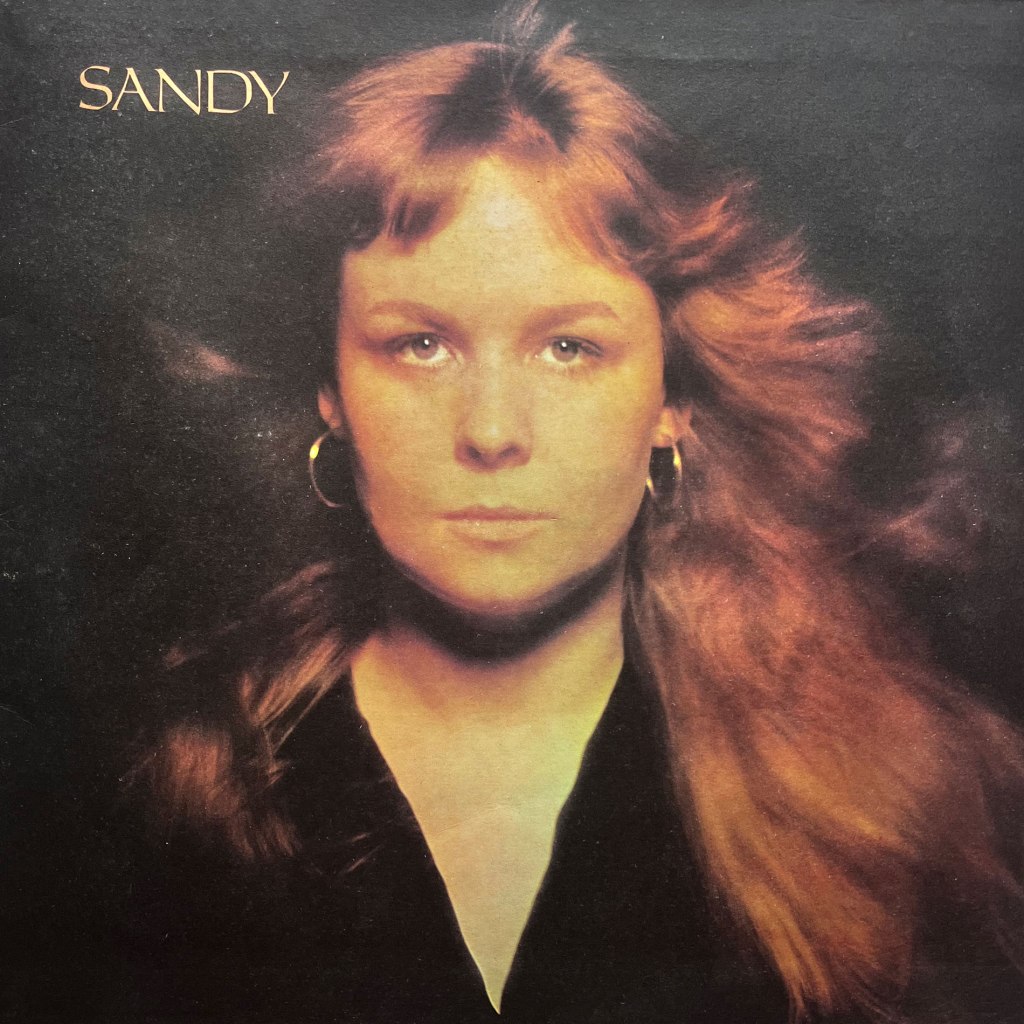
The intent of the album is there from the cover alone. A photo by David Bailey of the beautiful Sandy. From all accounts the session with him was torturous and there seems to be a hint of a look that says ‘just take the picture and be done with it’ about the cover shot. It is still a gorgeous photo. Sandy writes down all the lyrics herself in the centre fold. It is a professional package and designed to impress – it says she has arrived in the mainstream. But had she?
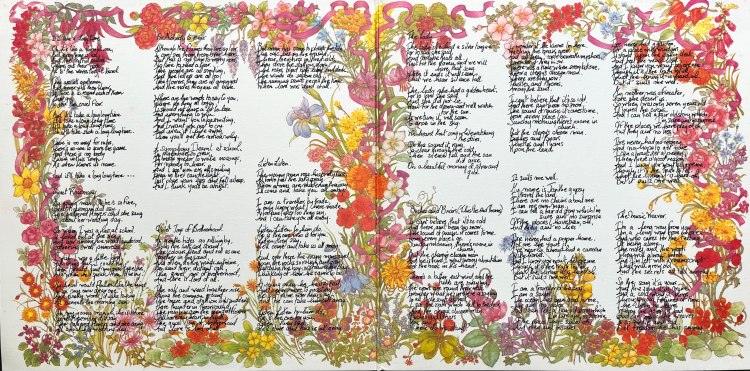
The beautiful artwork inner sleeve of the album by Sandy Denny showing hand written lyrics of the songs on the album Sandy surrounded by a beautiful colourful flower drawing by Sandy Denny
Inner sleeve lyrics written by Sandy Denny

If she had not, then this was certainly a fine attempt at ‘making it’. If you need any proof of her status as a great vocalist, then the stunning acapella ‘Quiet Joys of Brotherhood’ showcases her talent. Dave Swarbrick coming in at the end with his haunting violin solo certainly the icing on the cake. ‘Listen Listen’ and ‘The Lady’ show her remarkable range. On ‘Listen’ she effortlessly soars and swoops around the complex melody. ‘The Lady’ has become her title since her death. Mention ‘The Lady’ to anyone of a certain age who loves this era and music then it will be translated into Sandy Denny. On the track itself she is tender and sings a delightful knowing vocal around some simple but atmospheric piano work and sympathetic arrangement. It sounds autobiographical now from this distance – and sad.

On ‘It Suits me Well’ she goes into a young lady poor wayfaring traveller mode, her voice going into character. It is a remarkable piece of contemporary ‘traditional’ folk song writing and the vocal another example of her diverse vocal range.  

The cover of Dylan’s ‘Tomorrow is a Long Time’ sits perfectly on the album and dare I say that it is better than the original.

‘Bushes and Briars’ conjures up an Englishness that she returns to again and again in her writing. She seems on this and the whole album to be completely at ease with her talent. She sounds confident and that must be down to a large degree to Lucas’s sympathetic production. She does not always exude this confidence and arguably I feel she never really would again.
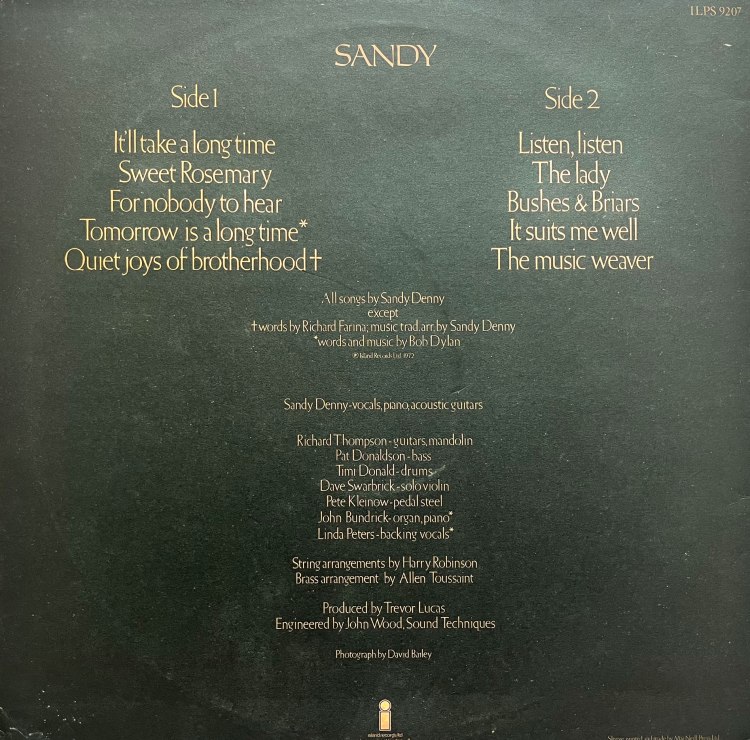
Rear album sleeve of the album Sandy by Sandy Denny
Sandy Denny rear album sleeve of Snady

It is a wonderful album. It should have been the one that made her a national treasure. Sadly, it did not even chart despite some generous radio play support. It is one of life’s great conundrums – Why is Sandy Denny so revered today over forty years after her death but still so little known in most circles? A lot of this is down to her not keeping to a fixed path long enough for people to discover what she was all about. The variety of styles and song choices was often just too much for a single album. She lacked full confidence in her talents and was consistently unsettled in her personal life.

The album was not a success. Her follow up which was not long in coming was not as good, not without merit, but it never stood a chance. Her solo work became too over blown in production and her song choice was not as good as on ‘Sandy’ despite some lasting and much loved gems of her own song writing. She re-joined Fairport Convention for their ‘last chance saloon’ album. It should have been a triumph but again the song writing was not as strong as it needed to be, the dynamics of the previous band had been lost. The reunion was short lived. Sandy Denny spiralled into a dark place, her drinking worsened and only one more album came before her tragic death in 1978. Lucas produced her final album ‘Rendezvous’ but their relationship had deteriorated dreadfully and this almost ‘pop’ production did the songs no favours. Looking back now some of her songs on ‘Rendezvous’ are amongst her finest works and much loved. There were also some inexplicable song choices on the album. Sandy died a few months later. I still vividly recall popping out from work to collect my Melody Maker at the newsagents only to see the headine ‘Sandy Denny Dead.’ Work or conversation were hard to accomplish for the rest of that day, thoughts elsewhere of loss and what should have been. I never saw her live in concert having been thwarted in my attempts, something I truly regret. But, we have a legacy. It is a relatively small body of work compared to most artists.

But it does show that she was indeed ‘The Lady’ – the finest female talent England produced.
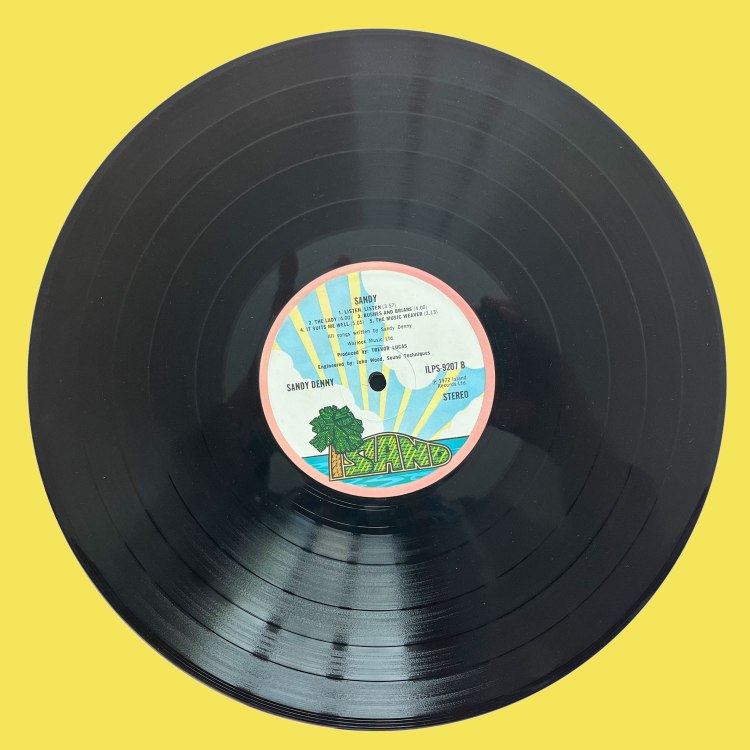
The vinyl copy I have of the album Sandy by Sandy Denny on the Island records label
Vinyl album of Sandy
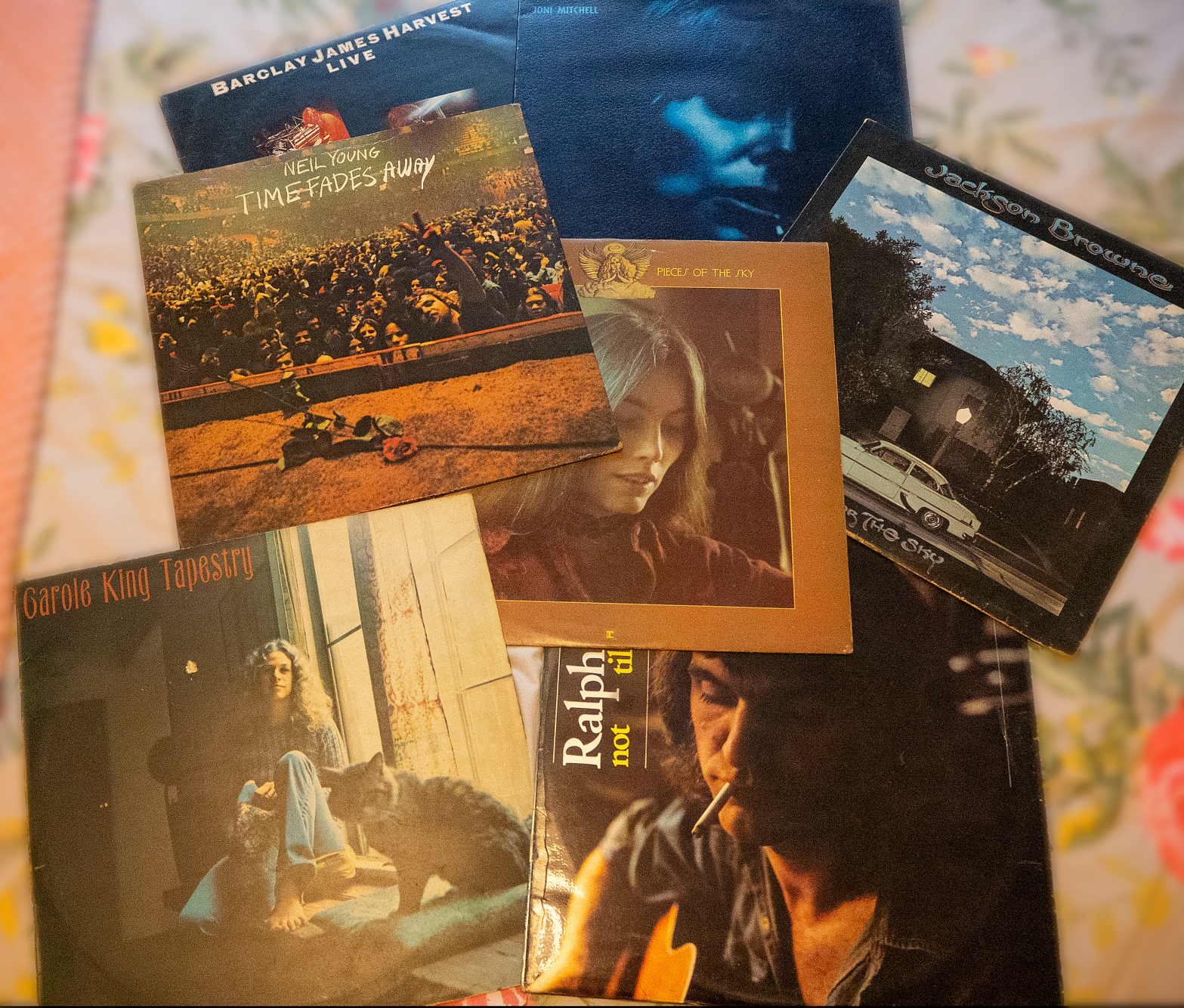
Vinyl record albums stacked together in front of a vinyl disc for a book cover

Leave a comment

Please Enjoy my Travel, Music & Ancestry Books on Amazon – FREE on Kindle Unlimited https://bit.ly/bookneal
Featured

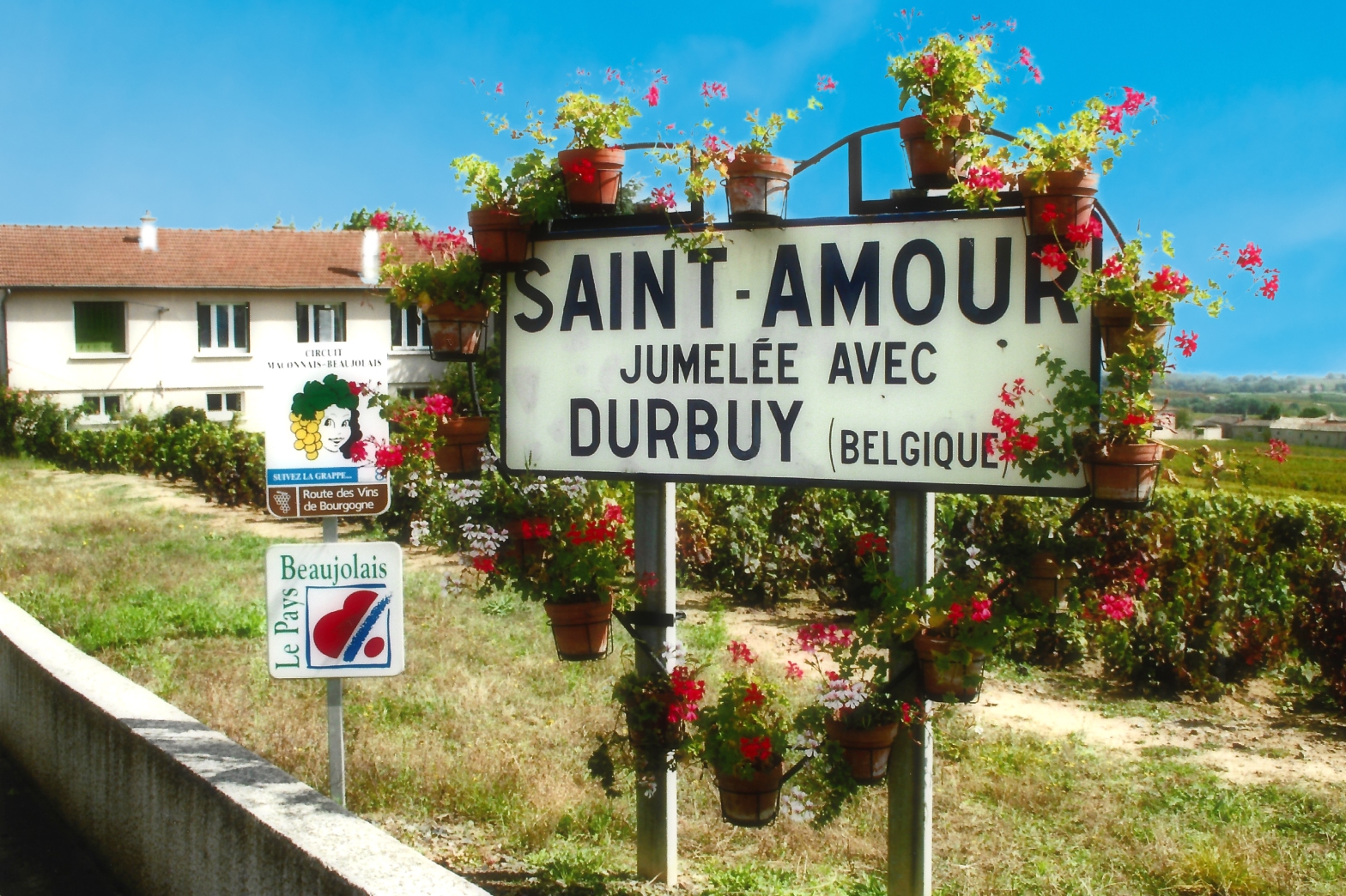
Beautiful Village of St Amour and Paradise Hotel

Please Enjoy my Travel, Music & Ancestry Books on Amazon – FREE on Kindle Unlimited https://bit.ly/bookneal

Alt="Photo of village of St Amour France"
St Amour – a beautiful place in the Beaujolais region of France

South from Beaune in the small but perfectly named Beaujolais village of St Amour is the also perfectly and aptly named Le Auberge du Paradis. Run by Cyril and his wife Valerie this hotel restaurant portrays the atmosphere of being in Paradise effortlessly. The welcome and level of service from these two proud restauranteurs is remarkable. We arrived at reception tired. Although soon refreshed by a shower in one of their beautiful rooms, all named after spices, it still did not feel as if we were ready for a large evening meal. The menu was a tasting one, an expansive presentation of seven courses. We were shown to a sizeable, elegant table with a crisp tablecloth displaying beautiful cutlery and glasses. The feast began but we fell at the fourth hurdle and had to apologize profusely that we were too exhausted to continue.

The next night, feeling substantially revived, Valerie informed us that Cyril would make sure we were able to taste what we had missed the night before. That meant we were going to have around ten courses, but she assured us he would go easy on the portion size. So, ten courses and sufficient St Amour red wine later I was ready to stumble into bed. I asked Valerie the reasonable question of how many chefs they employed to do this every night with a fully booked dining room.

‘Just one – Cyril does all the cooking.’

This was clearly impossible.

So, ‘Can I see?’

‘Certainement, suivez-moi’

Going through the corridor we emerged into a compact kitchen space. There indeed was Cyril, one man. Oh, and his smiling washer-up helper. I bowed in reverence, speechless that such dedication and effort had produced one of the finest dining experiences I have ever had.

What a man is Cyril.

It was a memorable evening, a memorable stay, and after slowly making our way up the softly candle lit staircase we fell contentedly to sleep. Paradise indeed.

St Amour has a compact village centre that has much to offer the visitor. Apart from our auberge there is another enticing hotel. Behind the auberge and just along from it are a couple of outlets for producers of this wonderfully named St Amour wine. Tastings are gladly offered.

Opposite the auberge is the Poterie de Saint Amour Bellevue. France is blessed with having numerous talented artisans of all kinds in most of the villages you pass through. Pottery is always a craft that is pursued enthusiastically by the French, and here in St Amour, Lola et Mathias are skilled artisans. It is a gallery that has you spoilt for choice but finally we decided on a piece for home, for our dining table. It is something that still gives pleasure and has done so on every occasion we have entertained our friends. This cheese platter was so unusual we just had to have it. The colours are beautiful, but it is the perfectly formed little mouse trying to reach the round of cheese that always amuses our friends, no matter how many times we use it.

Alt="Photo of wine cellar in St Amour France"
St Amour Wine producer Pascal Durand

A tour of France is never complete without searching out these gifted artists in the villages and towns. Do not be shy, go in and have a look. They are happy for you to browse and if you buy then that is a bonus, not a requirement.

St Amour is a special place, a romantic one because of the name. I do need to find any excuse to return. Niamh I am sure would enjoy once more the pampering given at Le Auberge du Paradis.

Beaujolais is a beautiful region of rolling hills, some quite small, almost mounds really, with vineyards on the slopes. The land is formed with a base of granite and limestone and as you would expect the ‘terroir’ is distinctive. Beaujolais is an easily recognisable wine with a character much different from its near neighbour Burgundy, again showing how interesting it is to travel and taste your way through so many contrasting regions of France. The wines here flow down to Lyon in the same way as the rivers that pass through that dramatic city and are part of the gastronomic culture that makes Lyon a French capital of food. We gain a clear idea of what we will see in this area just from our hotel room window looking out over these gentle hills and vineyards, a view that is worth every penny of the cost of a stay here – peaceful and bucolic.

We must now pass through Lyon, a city that I dearly wish to spend some time in. Once again, it is merely a fleeting view as we head south. Lyon is spectacular at night, the buildings on the banks of the river are brightly lit and reflected in the water. The old town winds its way up from the river and is beautifully illuminated on the hillside. The autoroute passes right along the quayside and at one point almost puts you amid the diners patronizing the lively restaurants as the road banks down to the river from the long hillside tunnel. Lyon is a city that retains a feel of its immediate past, a centre of resistance during the occupation. Even from our speeding car we sense this is a place of history and one day I will explore. Please try to get there before me.

Of course, our destination is Provence. We are part of a long stream of traffic heading to the sun. Progress will be slow, but we are in no hurry and there is plenty to enjoy on this scenic route to the South of France. It gives me time to compose myself for the force of nature that awaits us at our next base in Lourmarin.

village scene in Provence France with book covers of five french travel books and barcode to amazon kindle
Available in Print or for Kindle on Amazon

Below the Salt – Steeleye Span

First of all – what a great album cover. The frisky play on being peasants well and truly ‘below the salt’ is riotously captured by the band playing up to the camera. I cannot help thinking they are also saying to the traditionalists that actually we do not care what you think but this is our version of traditional folk. This album captures all that is wonderful about these old songs but does so in a way that is more palatable, shall we say, for the non-devotee of traditional folk. This album will never, can never date. The songs are so old anyway at the time of recording that another couple of hundred years will not age them.

The traditionalists have their moments to savour also as there is some gorgeous acapella work on here. What voices they have, not just a one-woman band in Maddy Prior, although she does inevitably steal the show in the solo vocal department. I imagine she was dancing in the studio as well. My interest in Steeleye Span must have come from the fact they were formed out of the fracture in Fairport Convention after recording ‘Liege and Lief.’ Ironically, I came to them after Ashley Hutchings had left Steeleye due to him feeling they were heading in too commercial a direction. Fortunately, the composition of the band at the time of this album was just exactly to my taste. I love this album. Maddy Prior is at the peak of her powers on here and the band gives her the space to wrap her beautiful voice around some extraordinary lyrics. Death, destruction, mad kings, mad women, fearful beasts, ladies in much trouble, naughty men of the countryside, cows, and other assorted animals, should not really be song subjects in this period of introverted singer songwriters. Still, somebody had to do these songs justice and Steeleye Span fitted the bill perfectly. I first saw Steeleye at Blackburn King Georges Hall on the 1st of September 1973 when they were supported by Horslips – another super band but a bit over the top for me. Sounded a bit like Heavy Metal meets Traditional at the time, but that may be a little unfair to the Irish folk rockers. The hall was packed, we were in for an unforgettable evening. The main thing I remember looking back was the extraordinary performance of Gaudete, their unexpected acapella hit. The other was also acapella – the old English song Lyke Wake Dirge. Reverberating around this old civic hall the effect was breathtaking. Lyke Wake Dirge was a regular live song for Steeleye, although they did not record it until many years later.

Ralph McTell wrote his affectionate song ‘Maddy Dances’ about her enchanting, flowing dancing between vocal duties. This was my first sight of her performing and it was gorgeous. They finally brought the house down when they returned to the stage for the encores dressed as Rockers to bring it to a close with a riotous finale. That really did burn the bridges with the traditional stalwarts.

One of the strangest gigs I saw them perform was at Blackpool Football Club’s Bloomfield Road ground in July 1975. Bloomfield Road had to say the least seen better days. Like many stadiums of the day, it had not seen any investment for many years. The major perception of it was that the favoured building material was corrugated sheets, probably iron based although it could easily have been asbestos. One side had a stand of sorts with seats but for reasons best known to the organisers the stage was placed directly in front of the terracing known as ‘the Kop.’ This was devoid of any frills whatsoever for a concert lasting several hours. Those concrete steps were hard I can tell you. It was also a searingly hot day adding to the discomfort. I suppose we should have been glad that it wasn’t a winter show in Blackpool with a gale whipping in from the sea. With the layout leaving three sides of the ground and most of the pitch unused along with the relatively poor attendance it is fair to say the ‘festival’ lacked atmosphere. The line up included Roy Harper who was a cult ‘folkie’ draw at the time, Kevin Coyne, a complex character, an acquired taste musically, plus Chris Spedding, famous for the most part for his distinctive guitar session work hat permeated many a well-known album, although at this time he had a Top 20 hit with Motor Bikin’. Steeleye were top of the bill but despite everyone’s best efforts not even Bruce Springsteen could have put any life into the famous dilapidated old stadium. At least Maddy got to play in her hometown but the least said about this the better.

So, let’s get back to the album. This style of music and lyric is admittedly not to everyone’s taste. If you put your preconceived ideas about it to one side, strap on some headphones and immerse yourself in its beauty, then you will discover a wonderful work of English art. There is not a lot to be gained by looking at this song by song. It is not the type of material that lends itself to a lyrical critique as say a Jackson Browne album would do. Really a lot of the subject matter is just plain bonkers. Take ‘King Henry’ for example, one of the longer tales on the album. I am thinking this King Henry would be Henry VI who was perhaps a jewel short of a crown. Or maybe it was his son Henry VII who tended to have his portrait painted in his mature years to attract a fair princess to share his bed – there were no takers. Certainly, his son Henry VIII would never have fallen for the convoluted story told by the fearful beast. He preferred to marry the finished article not wait on the off chance she would miraculously transform to the woman of his dreams. The chorus shouting ‘More meat, more meat’ has to be one of the strangest committed to vinyl even by Traditional Folk standards. However, what a vocal by Maddy with the band really excelling on this, working hard to drive this weird tale until you almost start to believe it. It is not perhaps an album for vegans as another track ‘Rosebud in June,’ despite extolling the delights of early summer, does require the little lambs to come to a sad, inevitable early demise. The album opens with ‘Spotted Cow.’ An unlikely tale as I think I would never have lost my spotted cow, but there you go. Put that aside and the quite unacceptable actions of the young man who kindly finds said cow, we have here a stunning opener that lends itself to a great live performance for Maddy to grace the stage with her flowing movement. I can see it now as I listen to this studio version, I imagine her in the studio moving between the microphones and wires as she lilts her way through this gorgeous tune. The young man by the way is not as bad a rogue as the chap in ‘Royal Forester’ who does though actually meets his match in the wronged young lady. Musically throughout it is a joy with a clearly defined mix that elevates each instrument beautifully but always leaving room for Maddy’s glorious vocal. Whether you think the stories most unlikely you cannot fail to let it all wrap around you and be as seduced as some of the fair maidens. A shout out here for Rick Kemp’s bass playing  – as good as you will hear, underpinning the overall sound that Steeleye create. You cannot help coming back to the vocals however. Especially when they sing acapella. They had their first commercial success with ‘Gaudete.’ Even fifty years on this is a stunning piece of work. With clever fade in the mix, they create the feeling of choristers (I tend to see hooded monks) moving slowly through the cloisters of an ancient abbey, chanting as they go. A truly atmospheric sound and one to savour if you have seen it performed live. As a band they show great dexterity on the jigs, but it is the overall musical arrangements that are so thrilling. It is fresh, it is not Fairport, it is truly a new look at the English tradition by adding a style of playing that draws on many influences but is unmistakably their own. Even on that ubiquitous English folk classic ‘John Barleycorn’ they are able to put their fresh stamp on it and make it theirs. Steeleye’s version simply makes you want to go out for a pint to celebrate the fruits of the English countryside. The album ends with a piece that is just the most exquisite arrangement on ‘Saucy Sailor.’ Living now in Somerset I suppose I should use local terminology and call it simply lush. A beautiful harmony of strings underpinned again by that sympathetic bass playing of Kemp with Maddy Prior almost lazily drifting through the vocal. The track ends with a long string instrumental with a soft vocal hum in the background. Gorgeous.

Steeleye had not got a producer in place at the time of recording, so they did it themselves. Thank goodness for that. Its ends, you return to the 21st century, you have been seduced by the sheer loveliness of the voices and music.

An English classic.

Go back

Your message has been sent

Warning
Warning
Warning
Warning.

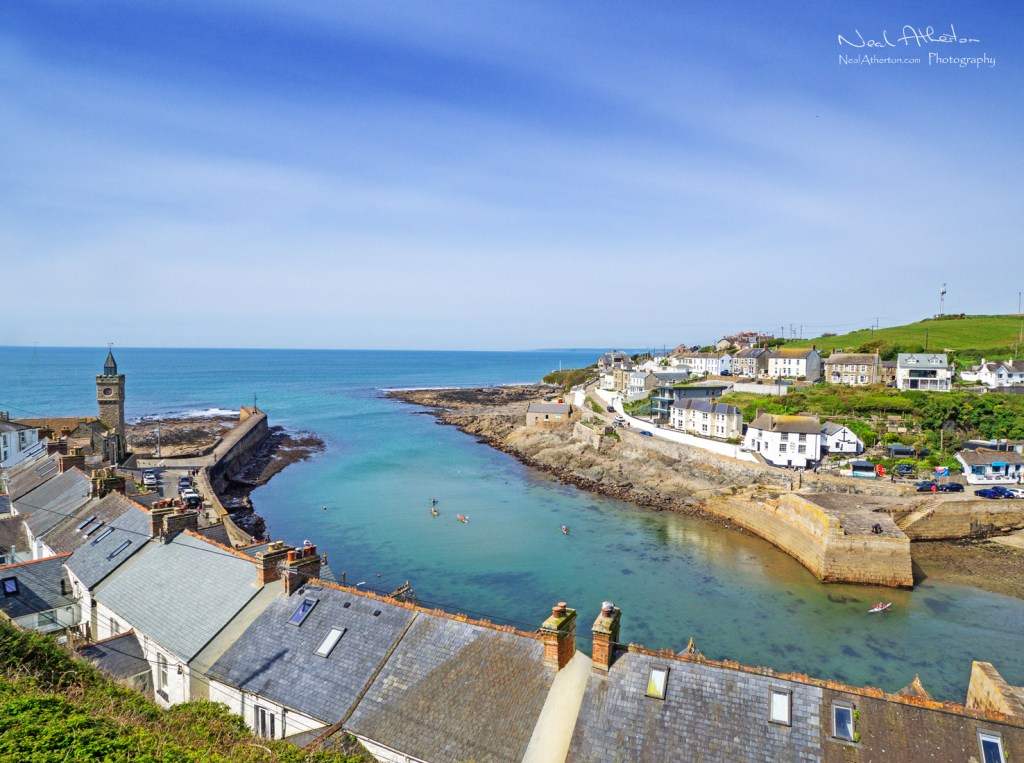
Spring in Cornwall 2025 – Endless Sun

Please Enjoy my Travel, Music & Ancestry Books on Amazon – FREE on Kindle Unlimited https://bit.ly/bookneal

Now available on Amazon for Kindle or in Print

In Search of Cezanne

The harbour at Cassis where many impressionists including Cezanne found inspiration
Cassis Provence

Please Enjoy my Travel, Music & Ancestry Books on Amazon – FREE on Kindle Unlimited https://bit.ly/bookneal

 If you were to question me forcefully and make me confess, then I would probably say that if you exclude food and wine then my most favourite facet of the culture and art of France would have to be the paintings of the Impressionists.

Provence and its landscape are synonymous primarily with Paul Cézanne, if you discount the issue with Van Goghs ear that is. Paul Cézanne was born and later died in Aix en Provence. Although a proportion of his output was composed in Paris it is his work in Provence and particularly in Aix that probably is more well-known and appealling to people as quintessential Cézanne. Since taking an interest in Impressionism I have always admired and enjoyed his work. I have seen many of his and the other Impressionist art works in museums in Paris, especially at the Musee D’Orsay. It is a thrill to see such great art at close quarters. I had not however visited Aix, so it was time to put that right.

Cézanne lived much of his life in Provence and for some of that time he had the challenging task of hiding from his father the fact that he had a son, Paul, by his lover Hortense. His father to a degree supported Cézanne in his chosen career by means of an allowance which would be lost to him if he were discovered to be living contrary to his father’s standards. This delicate situation was ultimately resolved, and he gained a studio at the family home Bastide du Jas de Bouffan in Aix.

His complex relationship with Hortense was by the start of the 20th Century very strained and he was now in the last decade of his life. Cézanne needed peace and somewhere to be left in solitude to paint. This led him to build an isolated studio high up above the town of Aix on the Chemin des Lauves, now known at the Atelier Paul Cézanne. It is open to the public. We should visit, so we set off towards Aix, a place that would be a new experience, but a town I had lofty expectations of in view of its illustrious son.

On arriving in Aix we first of all decided to walk down the Cours Mirabeau and browse the shops and restaurants lining both sides. This is of course the main street in Aix and although not as famous as the Champs-Élysées in Paris it is the thoroughfare that you most strongly associate with Aix. Cours Mirabeau tries to be just as trendy as Paris. It is a beautiful street with fountains along the way and lined with old plane trees giving shade in front of the shops, cafés, and restaurants. No question though, it can be a tourist trap and prices on the terraces of the cafés are high, but what a spot for people watching. This is the place to see and be seen in Aix en Provence. We deviated off the Cours Mirabeau through narrow streets and passageways to reach the Place Richelme where there is a local produce food market held every day of the week. This small, tightly packed square encapsulates every sight, sound and more importantly smell of a market in Provence previously constructed in your imagination. Fresh bread, vast range of cheeses, meats, cold air-dried saucisson of course, mushrooms, fruits of the region and some hot food stalls, especially the tempting chicken rotisserie with the potatoes being sautéed in the cooking juices. Interspersed between are flower stalls and along with the incredible smells from the olive sellers they turn the square into a glorious assault on the senses.

Man selling flowers and olives on a market stall in bright hot sunshine in the south of France
Vibrant market in Aix en Provence

Stopping for a coffee at Bar de l’Horloge at the end of the market we then retraced our steps back up the length of the Cours Mirabeau to the underground car park and made our way up to Atelier Paul Cézanne, not too far from the centre of Aix. The area is unpromising, very 1970’s apartments, and the studio is quite difficult to find. I park the car in amongst the apartment blocks and walk through to find the studio of Cézanne. I have the feeling that the area was a little different back in the time when Cézanne had this studio built. Peace and tranquillity would be a little bit harder for him to find today.

The studio of Cézanne does though give out the impression of an oasis of calm and the views he would have enjoyed around the area and down the hill towards the centre of Aix would in his day have been quite beautiful. The house has the ubiquitous French shutters that you would expect to see in the South, painted in that faded matt red/brown that was beloved of the Impressionists. You can see the same colour on shutters and doors in the village of Giverny, famous as the home of Monet in the last decades of his life. 

Red wooden shutters on an old French building with whitewashed walls surrounded by trees in bright hot sunshine
Cezanne’s studio in Aix en Provence

Immediately inside the house you collect your ticket and to be honest find that the first impression (sorry) is not very promising. There is little to catch your attention that may in some way relate to Cézanne’s time here, but the scene changes dramatically for the better as you ascend the stairs to his studio. As soon as you step inside this magical space you are transported back in time, over a hundred years, to a studio that surely you feel is still being used to create great art. As you stand in the centre you imagine looking over your shoulder towards the door and seeing Cézanne walking briskly through, brushes in hand, ready for a day of creation.  One of the most atmospheric rooms I have been in.

You could argue you are let down to a degree in that there is nothing here that Cézanne actually created, there are no finished works as of course these almost priceless objects are now in museums or private collections. That is though what makes this room special – you must imagine. You need to look at the objects, the high artist steps, the large easel, the tables and drawers left as they were when he last left the room, still ready for use. Other props Cézanne used such as the pottery, baskets, and fruit (replaced regularly). There is the wood and canvas deckchair with footrest. The selection of books neatly resting on the bookcase. A crucifix placed high on the wall, reflecting Cézanne’s conversion to Catholicism quite late in his life. There are the skulls that Cézanne painted in his last works as he contemplated his mortality knowing that he was coming to the end of his life here in Aix.  You feel that Cézanne, if he walked in would not notice the admirers who have visited his studio today and would simply set up his easel and start to paint, calm and happy in his own space.

Like in many other places in France, I appreciate being able to let my imagination wander and fill the space from my mind’s eye.  This is how I like my history, the Atelier Paul Cézanne is a joy. We take our leave and go outside, passing the climbing plants and stone plant troughs, pretty metal table and chairs and back into modernity and our car.  Where to next in our search for Cézanne? Inevitably it must be a view of Montagne Sainte Victoire as we head out of Aix on the A8 AutoRoute. The mountain range of St Victoire is impressive and is a considerable length of formidable rock. If you can spend a little time here, then what you do appreciate about this range is that the thing that most impressed and inspired Cézanne was obviously the play of light on the ridged exterior of the mountain. That is still the same, unaffected by climate change. As with most outdoor artists Cézanne loved the effect of changing light, and you certainly are aware of that spectacle when casting your eyes on this famous mountain. It would have been ideal for us to have gone to the fishing village of L’Estaque, another spot that was synonymous with Paul Cézanne.

We decided on a compromise. Instead, we headed to the coast and the village of Cassis. We also wanted to call at the village of Bandol, Domaine Tempier, and purchase their heady Bandol red wine. I am not sure how familiar Cézanne was with the wines of Bandol but at Cassis port we were very aware of the spectacular light that Cézanne would have treasured when creating his works of art in this region. He surely must have enjoyed the fish and seafood coming out of the clear blue waters of the Mediterranean – we certainly did. He must surely have sat at a seafront table in L’Estaque with a bottle of rosé as we did here in Cassis.

Boats in a small harbour port with restaurants lining the quayside in bright hot sunshine
Cassis Port Provence

We came in search of Cézanne; we were richly rewarded on a very full and tiring day that left us immensely satisfied in theming our day around this great painter.  I encourage you to do the same.

young girl fills water jug from a stone fountain unter shady trees in village in Provence

alt="photo for french travel guide books featuring paris provence and wine for kindle unlimited"
Paris & France – Travel now

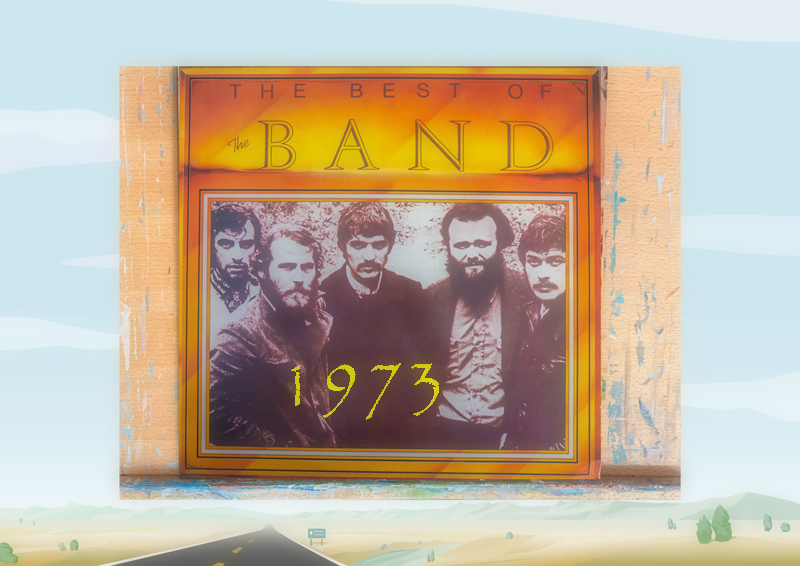
The Band – Best of The Band

I was listening to The Band well before I started listening seriously to Dylan. There is something about their sound that is quite unique but also familiar. I think it seemed to me at the time that they were the American equivalent of Fairport Convention. They make the history of the States believable and captivating. They are writing the American heritage. Fairport can only be an English band despite taking influences from the States, setting that Englishness down with clarity. The Band do the same in reverse, taking some English influences to make a sound that perfectly connects you to the American story. On the Fairport album ‘History of’ the notes inside make the observation that drummer Dave Mattacks was always having Levon Helm ‘thrown’ at him. No question they took much inspiration from the work The Band were doing.

This particular album is no longer available, so I must base my observations on the individual songs which are all still streamable or available in other Greatest Hits packages. This album is a bit sparse and other ‘Hits’ packages give a more rounded picture of The Band.

I loved The Band. So atmospheric, that word cinematic again. I have touched previously in my ‘reviews’ on my intense disappointment when I saw them live for the first and only time at Wembley Stadium in 1974. I can sympathise with them not being in the best of shape for that appearance, but sad that the years on the road had taken their toll on them, musically and physically. The Last Waltz was on the horizon, needing to take a breather and end the madness. Sadly, for some of them life never did stabilize and was cut short tragically. With the death of Robbie Robertson and now Garth Hudson, it is now a band of memories. I am so glad I saw them live but tinged with a feeling of what it might have been. How much better they must have been when all was right in their world. We do have plenty of recordings to show that and this is a fine collection.

Black & White photo of The Band taken in 1974 featuring Robbie Robertson, Garth Hudson, Levon Helm, Rick Danko & Richard Manuel
The Band in a photo taken from the Wembley concert programme

The album opens with the finest song on the record. ‘The Weight’ is one of THE great songs of this era, a Band classic that is a piece of writing in full widescreen Technicolor. It defined The Band and still today is the song most associated with their style of writing and how they all complement each other, especially in the shared vocals and harmony in the chorus. The lines contain clear Biblical Imagery despite Robbie Robertson’s denial that there is no spiritual dimension to the song. There is perhaps just too much of that type of metaphor to totally take him at face value. Pulling into Nazareth is taken from a label on his guitar but followed by clear reference to finding a bed and being refused making a Biblical connection impossible to ignore. The song has an array of unusual, quirky characters that intertwine with similar imagery. Robertson says his inspiration is from the surreal Spanish filmmaker Luis Buñuel. Like him Robertson is trying to show that good people end up doing bad things or in this case resenting being the good guy loaded down with having to do favours for others. The characters are memorable, creating movies in your mind. According to Levon Helm they are based on real people. He particularly recalls Crazy Chester as being a guy who came into town with his cap pistols to keep order on the streets – quite an image. Fanny was a bookshop owner crucial to the song. It builds and builds with each character playing out vividly in the imagination. It ends with the return to Fanny, again for many this has a spiritual dimension. We can take Robertson at his word that all this is purely him trying to mirror the work of Luis Buñuel in cinematic song. However, the film ‘Last Waltz’ ends not on stage but in the studio with the Staples Singers providing weight (sorry) to this song. Surely The Band are here showing that this is indeed a spiritual in the American tradition.

Vocally on this track the band use two lead singers in Helm and Robertson, with all coming together for the chorus in perfect harmony. Sadly, this song in particular was to cause much friction and resentment between them with Robertson portrayed as the bad guy. His fractured relationships, particularly with Levon Helm, are well documented. It does seem unusual that Robertson is solely credited as the writer. For a song as complex as this, performed with such distinct contributions by the members of the band, it feels others surely had an important input as they all claimed. The simmering resentment that Robertson took the songwriting royalties ultimately soured relationships. That is a shame as this is such an outstanding work – an American classic that has never dated. It will live on in the tradition of American songwriting.

‘Up on Cripple Creek’ sounds simple but it is quite complex both lyrically and musically. It has some interesting riffs that were perhaps a bit ahead of their time, particularly apparent in the intro and after the chorus. The Band being funky. It is one of those songs that gets inside your consciousness. After a couple of listens you find yourself repeating lines in your head. Part of the reason is that the lyrics are so intriguing, more great storytelling painting in words. This is Robertson reacquainting himself with the common man amongst his contemporaries. This truck driver has no pretensions, just gets on the road, has Bessie to break the journey, enjoy the distractions of the road as he goes across country. No deep philosophy with this guy but once again we have another screen version of America. Always loved this song and the quirky lyrics sung with panache by Helm for the most part.

‘The Night they Drove Old Dixie Down’ may be the best-known song by the Band chiefly because of the cover by Joan Baez. I find it curious that the version by a female singer was so popular as I always see this as a masculine song. It is a remarkable piece of writing in that it sounds like it could easily be a song in the American tradition composed around the time of Civil War, not by a modern songwriter. Robertson tries as far as he can to be historically accurate even to the extent of Levon Helm helping out in finding the references to study. Helm took him to meet his family in Arkansas to enable Robertson to get the feel of a Southerners point of view. Even so that has not stopped criticism of the song in our revisionist times. Any references to Dixie some feel must be a support of slavery. That surely is not how this song reads at all. It endeavours to be a true and faithful version of the events as they affected the people at a personal level. You can feel the pain of the family as the war affects them, young sons die, and the people suffer. There is no need to try to find subliminal meanings – Robertson writes clearly with feeling. Not bad for a Canadian. The music is superb on this, some of the bands finest. Glorious chord progressions with the band coming together not just instrumentally but with some of their finest harmonies. Helm sings the lyrics with tremendous feeling as only a southerner could. This is the definitive version – accept no substitute. When they played this on the ‘Last Waltz’ it would be the last time they all shared a stage together – quite a thought and a loss to music.

‘The Shape I’m in’ takes on a retrospective poignancy due to the way lead vocalist Richard Manuel met his end. Was this written about the shape he was actually in at the time of writing. It sounds like a plausible assumption, especially as he takes the vocal. It also reflects a tension within the band unit as lifestyle choices and money conflicts started to take a toll. It is a sad song from the point of view of the subject matter, but it is a superb workout musically and rocks along like an improvised jam session. For me it takes on an added tragic dimension. As you know I saw The Band at Wembley in 1974. The mediocre performance that day turned out to be in part because of Richard Manuel struggling to perform, just making up the numbers on stage. It was sadly not always a Band of Brothers for them – things turned sour both professionally and personally, with tragic results for some. This song documents the issues unfolding.

Martin Scorsese, he of ‘Last Waltz’ fame, collaborates again on the film ‘Once were Brothers,’ the story of The Band, albeit from the perspective of Robbie Robertson. It is a moving story even if a one-sided recollection in the main. Robertson comes across as having a deep affection for his former band members, a sense of putting things right even if it is posthumously. There are some deeply touching moments. The revelation that he was estranged from Levon Helm up until his drummer friend was dying is incredibly sad when you go over what they went through together. I cannot quite decide if Robbie is asking for forgiveness or just trying to explain. An emotional watch whichever side you come down on.

There are many more gems on this album of course but best to encourage you to seek out a collection and enjoy America’s finest Canadians bottling the spirit of the States in a way no one else has been able to do. Their association with Dylan is also important and reflected on songs like ‘I Shall be Released’ where they manage to produce a version as good as any of the hundreds of cover versions.

The Band – yes, THE band. Enjoy their legacy as with Garth Hudson’s passing we will not see their like again.

Leave a comment

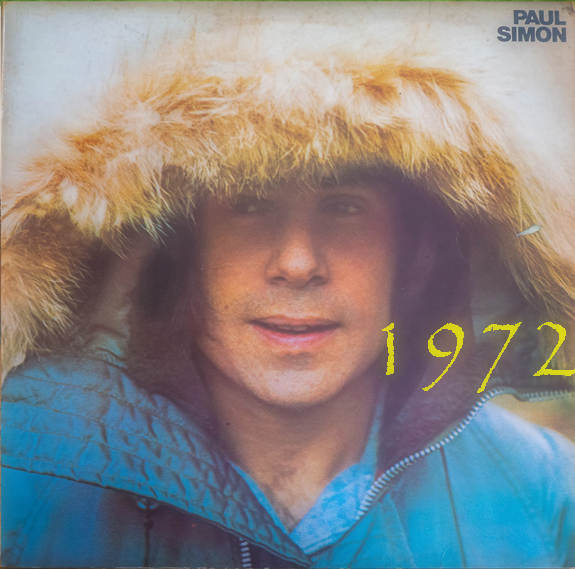
Paul Simon – Paul Simon

Vinyl album cover on a art easel in front of a bcakground of a baseball field
Paul Simon – His first solo album afer splitting from Art Garfunkel

Paul Simon – Paul Simon

Paul Simon released his second solo album in early 1972, having spent two years moving forward from the breakup of his partnership with Art Garfunkel. Looking back some fifty years from the release of this album you can see the template for Simon’s love of using varying styles of music gathered from all over the world. There is a sense of release from the constraints of working as a duo in this work. It is intensely personal, as is most of Simon’s writing. The album represents a crossroads for him but one that he negotiates with a fresh impetus to his writing, but most especially to his musicality. This has a feel of a great starting album from an exciting new artist, one not fully developed, but one of exceptional promise of what is to come. It does not sound possible he could have made this with Garfunkel. This is a fresh start and one of the best albums from the early 1970’s band of singer songwriters. Simon writes a new CV with this album, and he will deliver what he promises on here with some remarkable work to come, culminating of course with Graceland. The seeds of being able to construct the Graceland album are contained here in ‘Paul Simon.’

The album has a strong start by any standards. Few white musicians, if any, had got to grips with using reggae influences in their work. Simon pulls this off on ‘Mother and Child Reunion.’ Great lyric but as so many have already gone over the chicken and egg scenario let us concentrate on the musicality here which you tend to forget was remarkable for the time. The isolated drum beat start takes us right into ‘Graceland’ territory some fifteen years later. An effective device that Simon will exploit effectively on his journey into world music. Simon at this point realizes that if he is to succeed in adding authenticity to his attempts at varied musical styles then he must travel. The music needs to envelop him and of course we see that in its full fruition with ‘Graceland.’

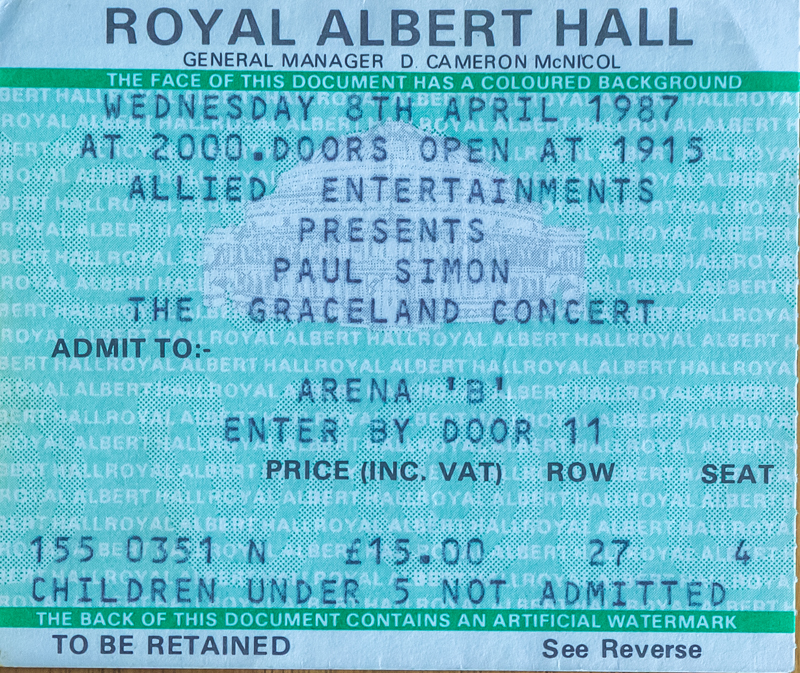
Concert ticket for Royal Albert Hall concert by Paul Simon on the Graceland tour
Paul Simon Graceland Tour London Royal Albert Hall

Occasionally a band of musicians can effectively recreate music that is outside of their culture, but it is rare. Simon here appreciates that, so he travels to Dynamic Sound Studios, Kingston, Jamaica to record just this one track – what the CBS accountants’ thought is anyone’s guess. It was worth the effort and expense as this captures the spirit of the reggae rhythms as fine as any white artist has achieved. Granted, he uses the finest reggae session musicians CBS can afford, but this is still resolutely a Paul Simon track. He will go on to absorb so many influences over the years to come. A track of pure joy and musical energy, with a fabulous percussion track underpinning the whole musical journey. Unusually for him at that time, but not of course for his later work, was that he recorded the soundtrack before the vocal had been written. I remember on first listening I was surprised with Simon’s vocal – it sounds quite affected as opposed to his standard vocal style with Art Garfunkel. It works beautifully on here however, a New York drawl merging into a Jamaican rhythmical lilt. A feature of this album is how Simon is experimenting with his voice, as he will continue to do over the years. It is as if he is trying to prove that although Garfunkel had the sweet high voice, he also could produce a gorgeous vocal if only you could hear him – now he sings alone with nowhere to hide.

An interesting singer in the credits is Cissy Houston who had a daughter that went on to make quite a career for herself before her tragic early death. ‘Mother and Child Reunion’ was a decent worldwide hit for Simon which must have been a relief – number 5 in the UK. Of interest because of his later journey into world music is that this track was number one in South Africa.

Ok then, we must ask what does the song mean? Many discussions on this of course but I like to put it as a divorce/estrangement scenario. Having said that, the chicken and the egg must die to be together again, so as the song says, maybe just ‘let it be.’

So, we are now off to Paris where Simon records ‘Duncan’ with old friends Andean group Los Incas who will later be known as Urubamba when they play live with him over the next few years. Los Incas he knew from early days in Paris, so it is appropriate they record together with Simon here. The band were part of one of Simon’s first forays into world music with ‘El Condor Pasa.’ They are the perfect accompanists to Simon on ‘Duncan.’ They were on stage with him the first time I saw him in concert. That was a night that was marred by two theatre employees chattering endlessly away behind us about Art Garfunkel being in the building ready to come on to restore the duo again. Bit too young and retiring to have said something but definitely my older self would have told them to please shut up.

‘Duncan’ was the first track I heard from the album. Back in the day there used to be such a thing as record stores – yes children, shops that sold music. Even larger general stores such as Woolworths had a record department. It was in one of these – Boots the Chemist actually – that I first heard this much anticipated album. I was a bit obsessed to say the least about when this new solo offering was going to appear. I must have driven the staff mad in the shops continually asking for an update on the release date. On my lunch hour it was my custom to visit the record stores and have a good browse through the racks, even taking advantage of the listening booths in shops such as Reidys in Blackburn to try before I bought – usually just skipping out unseen before I felt obliged to make a purchase.

Anyway, this lunch hour I could hear this captivating South American flavoured tune. Then, surely that is Paul Simon’s voice. I just stood there spellbound. If the rest of the album was this wonderful then what a treat was in store. Problem was it wasn’t payday; I had no money in those pre-credit card days to buy it. I was flustered as I self-consciously went to the young lady at the counter to confirm that this was indeed THE album. She confirmed it was but only a pre-release copy sent to trial in the store – a couple more weeks at least before general sale. Oh, the pain and suffering, but at least I now knew when, so that I would have the money. I must have looked a right gibbering idiot at the counter but then I suppose we all have our moments. About twenty years later that same young lady became my close working colleague and lifelong friend. Fortunately, she recalls nothing.

Back to ‘Duncan.’ Musically it has a foreboding feel to the tune and the lyrics. Although the young man seems happy with his experience, the tone of the song tends to make me feel that all will not turn out for the best. His observation ‘that sweet memory lingers’ suggest his salvation was short lived. His name Lincoln Duncan suggests the assassinated President and the murdered King in MacBeth – not boding well for the poor boy. It is a beautifully observed tale though, one of my favourite Paul Simon songs – such an atmospheric creation by him. The boy repeats the thought ‘I know, I know’ over again as if to say, ‘I should have known better.’ Maybe he was OK but there has been no sequel.

Just as an aside – I find it hard to get past the line about his mother being a ‘Fisherman’s Friend.’ It is on the face of it a clever line but as a Northern Englishman a ‘Fisherman’s Friend’ will always be a famous warming throat sweet produced ‘up North’ in their millions. Simon is familiar with the UK and particularly the Northwest, having written ‘Homeward Bound’ there, so I find it impossible to believe that he was not aware of this. Still, he used the term anyway, but unfortunately, I see the ubiquitous packet of sweets every time I hear the line. Maybe it’s just a Northern sense of humour and I should get over it.

After such a strong start the album has a quality control break. ‘Everything Put Together Falls Apart’ sounds like a bleak reworking of ‘Song for the Asking’ and ‘Run that Body Down’ is an uninteresting insight into the domesticity of the Simon household. Neither should have seen the light of day. ‘Armistice Day’ starts a theme that lasts for the next couple of albums of Simon’s concerns about the state of the Union. These were troubling times in America. Simon was a concerned citizen and not slow at making his point. Not one of his great songs but redeemed by some superb guitar work.

We flip the vinyl, and things take a considerable turn for the better. The third song on here to become a classic Simon song is ‘Me and Julio Down by the Schoolyard.’ This will open most Paul Simon concerts over the next decades and is a joyous celebration of him using other world influences in his music. The lyrics are obscure, deliberately so. In the same manner that his namesake never tells us definitively who is so vain, he will not let us in on what the mama saw. Musically it is Latin, or reggae influenced but the lyric refers to Corona, a part of Queens, New York, so he is drawing on the multi-cultural aspect of his home city. Not one of his most profound lyrics but playful and set to a memorable soundtrack. One of his most beloved songs.

Simon returns to his disenchantment with the powers that be in the States with ‘Peace like a River.’ An interesting song with not the first Biblical reference we get from him. He will return to the theme with much more power and effect with ‘American Tune’ on his next album, but again the seeds are sown.

‘Papa Hobo’ and ‘Paranoia Blues’ are solid songs with intriguing lyrics combined with some complex and gorgeous musicality, particularly with Stefan Grossman’s slide guitar on ‘Paranoia Blues.’ Not quite sure how popular Simon might have been with the New York tourist board with this one, but I suspect it stems from an unpleasant encounter. Simon stretched his vocal range and style on these tracks and the result is some fine work, underrated in his catalogue.

‘Congratulations’ (No, not the Cliff Richards ditty) ends the album. I am sorry but this song may be quite a fine one, but my vinyl copy was badly pressed and plays this at a slow speed and totally ruined it forever for me. I should have taken it back to the store, but I was shy and retiring in those days. So, for me the album always ends with ‘Paranoia Blues’ and maybe better for that.

‘Reunion,’ ‘Duncan’ and ‘Julio’ are the only songs from this album that really ever feature in live performance. That probably tells you that Simon also views this album as a stepping stone. He tries out so many things on here both musically and lyrically with some exceptional high points, others with varying degrees of success. His next album ‘There Goes Rhymin’ Simon’ successfully fuses these ideas together and is a much more complete package as is ‘Still Crazy’ which is a sophisticated masterpiece. Despite its flaws I always enjoy this album, and it can rightly be included in a run of superb music he produces through to the mid-seventies. Simon was interviewed at the time and made the point that although he was in his thirties all great composers did their best work in their forties. The groundwork he was doing here was vital for what was to come.

Yes, the young man did fulfil his promise.

Paul Simon with guitar on stage with four musicians
Paul Simon in concert at Manchester Apollo July 3rd 2011

Please Enjoy my Travel, Music & Ancestry Books on Amazon – FREE on Kindle Unlimited https://bit.ly/bookneal

Explore Beaune: The Heart of Burgundy Wine Culture

Please Enjoy my Travel, Music & Ancestry Books on Amazon – FREE on Kindle Unlimited https://bit.ly/bookneal

Now available on Amazon for Kindle or in Print

Beaune – The Centre of French Wine

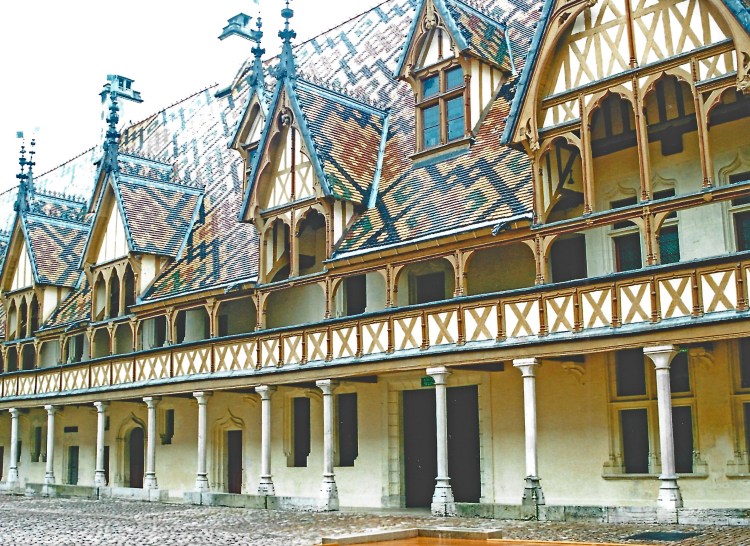
Beaune is quite the centre of Burgundian culture. Having seen the striking tiles on the roofs in Aloxe Corton on our way we were fascinated by the rooftops of the walled town of Beaune, culminating in the magnificent Hôtel-Dieu (Hospices de Beaune). Beaune is a place that revels in its medieval atmosphere and the history contained in the cobbled streets. In many ways it the centre of this wine-producing region and here in Beaune you can indulge in tasting wine from every village and domain of the surrounding countryside.

the hospice de Beaune is the scene of the yearly wine auction of Burgundy wines
Hospices de Beaune or Hôtel-Dieu de Beaune

This you can do in one of the many restaurants who will supply typical Burgundian fare, generally meat based of course, complimenting the meal for you with a fine wine selection. Sadly, although I have had very few poor dining experiences in France it was in Beaune at a quite high-end restaurant that I had the worst Beef Bourguignon imaginable. Beaune though is also a town where I have had some of my best meals, so choose carefully. Beaune is a wonderful place to find yourself in spring or summer when you can eat al fresco on a restaurant terrace, particularly on market day. People watching is a great pastime as this market sprawls through the streets up to the high walls of the Hôtel-Dieu.

The centre of Beaune and the Hospice are alive throughout the year with many festivals and events. These culminate in the wine auction festival at the Hospice when the prices for that year’s vintages are set and the great and the good of the wine world revel in their achievements of the year. The 15th century hospital makes the perfect backdrop to this colourful event. The wine prices for some of the domains of the region are often quite staggering. Before entering one of the many wine boutiques, it is best to study the window carefully. It is a fine game to play to cast your eye around the display constantly finding a bottle that is just that bit more expensive than the last one you spotted. Once into the hundreds of euros you tend to give up. There is however always something for every budget.

The domain of Maison Champy is a wine producer located by the old walls in Beaune Burgundy
Maison Champy by the ancient walls in Beaune

Speaking of wine stores there is one that you really must visit. It is just higher up the road from the Hospice. If you follow the high wall for a short distance, you will find it on the opposite side. Marché aux Vins buys wine every year at Hospices de Nuits wine auction and carries a remarkable selection. We have bought a bottle or two here, but I can also say that I have also bought a second-hand family car for less than some of the extraordinary vintages on offer here. It is a feast for the eyes and the senses to stroll around this store. Some bottles catch the eye because of the colourful and intricate labels but often it is the price tag that stands out. A truly fabulous place and one that offers all available wine accessories, including of course that essential accompaniment to a wine tasting in Burgundy – a tastevin.

A stroll through the streets of Beaune on an early morning is a special treat, especially to a photographer. Get up early and enjoy the deserted streets to take in all the incredible architecture of this ancient town.

Beaune in BUrgundy has old streets that are great for photography - a beautiful Burgundy wine town
Early morning stroll in the old town of Beaune Burgundy

I recall a most enjoyable early morning stroll through rain drenched streets after an overnight downpour. It was a delight to wander through the peaceful town with my camera. I love photography, so to be able to have had this picturesque town to myself was special. The glistening of early sunlight on the wet-coloured roofs of the Hospice was irresistible.

This walk-through Beaune also highlighted a major difference between France and home in England. Beaune boasts a beautiful richly decorated carousel in the Place Carnot. This morning a mother was taking her young daughter to nursery school but had let her play for a moment around the carousel. It was a charming scene. I gestured to the young mother to be allowed to photograph the panorama, and she was delighted to let me do so. I would never, ever, ask to do that in England. France does have many well documented social issues it is true, but it has also retained a certain naïve trust in people, it thinks the best of the visitor and I love that. I recall in England only a few months earlier when I had taken a sea front photo in Lytham St Annes. Looking towards the pier there was an ice cream cabin about thirty metres away from me. From there a lengthy line of children queued away into the distance along the sea wall for their treat with the promenade busy with visitors, an almost Victorian promenade scene. I had taken the shot on a clearly wide-angle lens, not a zoom lens in sight, when a deranged woman teacher tried to grab my camera off me demanding to see my photo. What she thought I could possibly have taken I could only imagine but it was a sad reflection of today’s climate.

Beaune is always a beautiful town, but early morning is special. If, like me, you can be there after a rain shower, then the Hôtel-Dieu sparkles even more with the wet roof tiles glistening in the sun. The colours of this medieval roof are vibrant and contrast beautifully with the blue sky behind. Beaune is a town that repays looking up at the architecture. This is true throughout France. The town has endless photo opportunities and as I stroll, I spot more and more. The café owners are starting to set out the tables for the locals to arrive for a coffee and petit dejeuner. They nod a silent bonjour as I pass by. Another young mother takes her daughters to school and as the town wakes up, I go back to the hotel for my own petit dejeuner.

Place Carnot in Beaune Burgundy France on an early morning
Early morning in Beaune but Lunch awaits

Beaune is a perfect place to stop for lunch. It has many narrow, ancient, winding side streets. These reward you with some lovely little restaurants that are ideal for a quiet, lingering meal. This day we got more than we were bargaining for. One item on French lunch menus that you will often come across are the ubiquitous brochettes. The French love a good kebab. Perhaps the wine had dulled my senses, but I only partially read the menu as I have often had brochettes for lunch. They are always the same, peppers, lamb, chicken. Always a fine choice for an inexpensive lunch stop. This first-rate pair of well packed skewers were indeed excellent. The pieces of chicken were somewhat unusual, a bit small and I assumed they may have been guinea fowl or quail. Well, if I had read the menu, I would have spotted that they were cuisses de grenouilles – frog’s legs. Delicious, but all the same not really my meat of choice. I still have snails to try yet to pretty much complete my collection of French delicacies.

young girl fills water jug from a stone fountain unter shady trees in village in Provence

Linda Ronstadt’s Emotional Performance with J D Souther on Prisoner in Disguise

Please Enjoy my Travel, Music & Ancestry Books on Amazon – FREE on Kindle Unlimited https://bit.ly/bookneal

Linda Ronstadt say in a red dress on the front cover of her 1975 album Prisoner in Disguise
Front cover of my well worn copy of Prisoner in Disguise

Linda Ronstadt – Prisoner in Disguise

Linda Ronstadt divided opinion back in those days when your musical tastes seemed to be fair game for everyone’s scrutiny. Not that I paid much attention to what my peers thought of my musical tastes. I was well away from the mainstream for the most part. Mentioning Fairport Convention as being my favourite band would nearly always result in ‘Who?’ – or if they really wanted to turn the knife ; ‘Why?’. Even now all these years later it can be difficult to explain your tastes in music unless you can produce a Lionel Richie, Elton John or Diana Ross from your back catalogue. Just a few weeks ago I was chatting music with a youngish friend, one old enough to have known better though. He mentioned he had seen Take That at Wembley Stadium, so I told him I had seen concerts there, the first being Crosby, Stills, Nash & Young in 1974.

He looked totally bemused.

‘Yes. CSNY’

Total blank expression.

I just said that they had been massive in the day, back in Victorian times.

I digress. Linda Ronstadt met with some resistance among the clever ones who thought they drove the musical thinking of their peers.

‘Just a Rock Chick, too pretty to take seriously’.

‘Doesn’t write her songs’.

‘Good background music’.

Amongst other objections.

Now the first one was taken seriously by some. My brother for one. In those days of sharing bedrooms, I kept the ‘Prisoner in Disguise’ vinyl, but the cover was pinned next to his bed. He never played the record. OK, she was undoubtably a contender for the most beautiful woman on the planet but please what about the music?

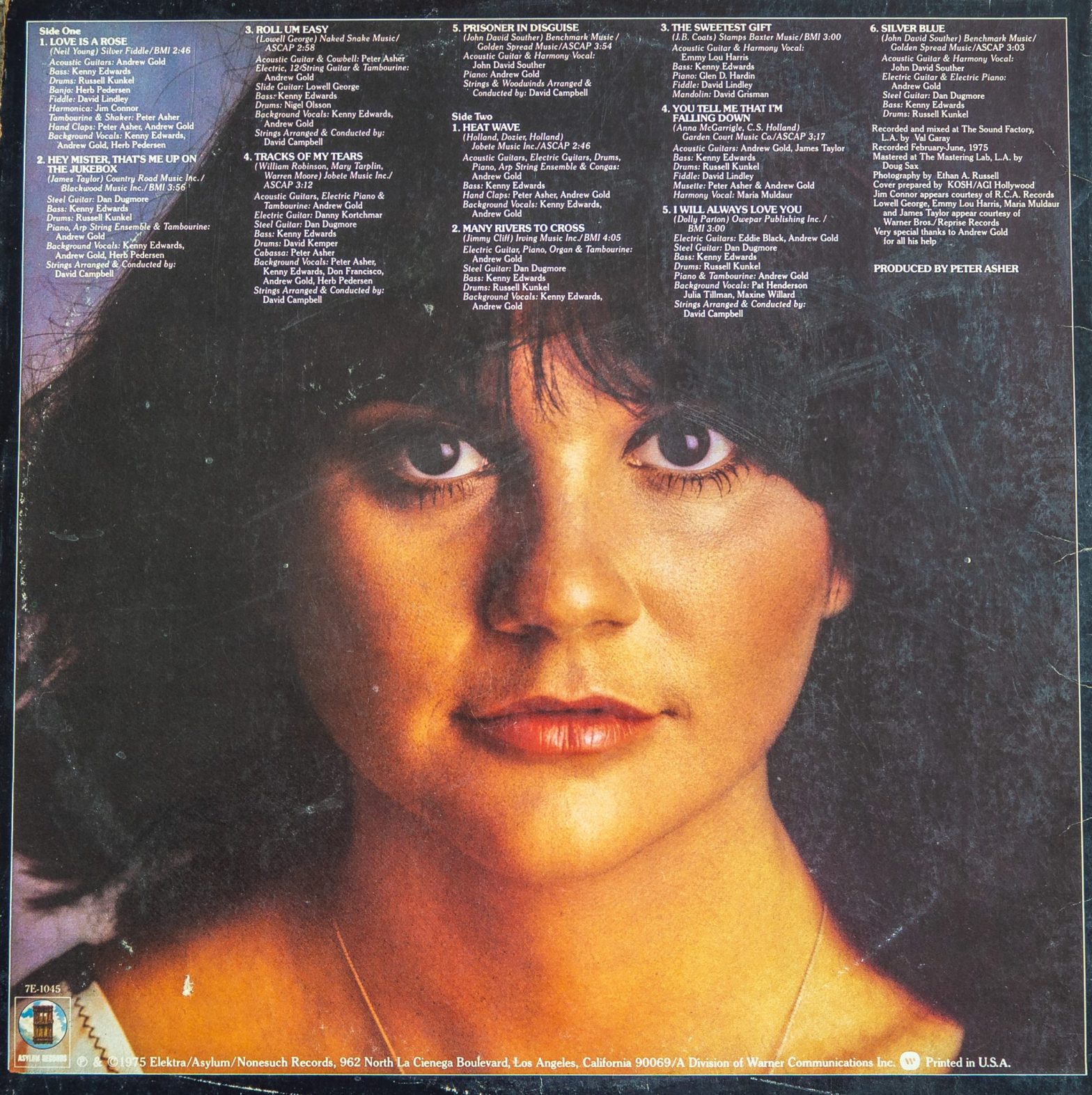
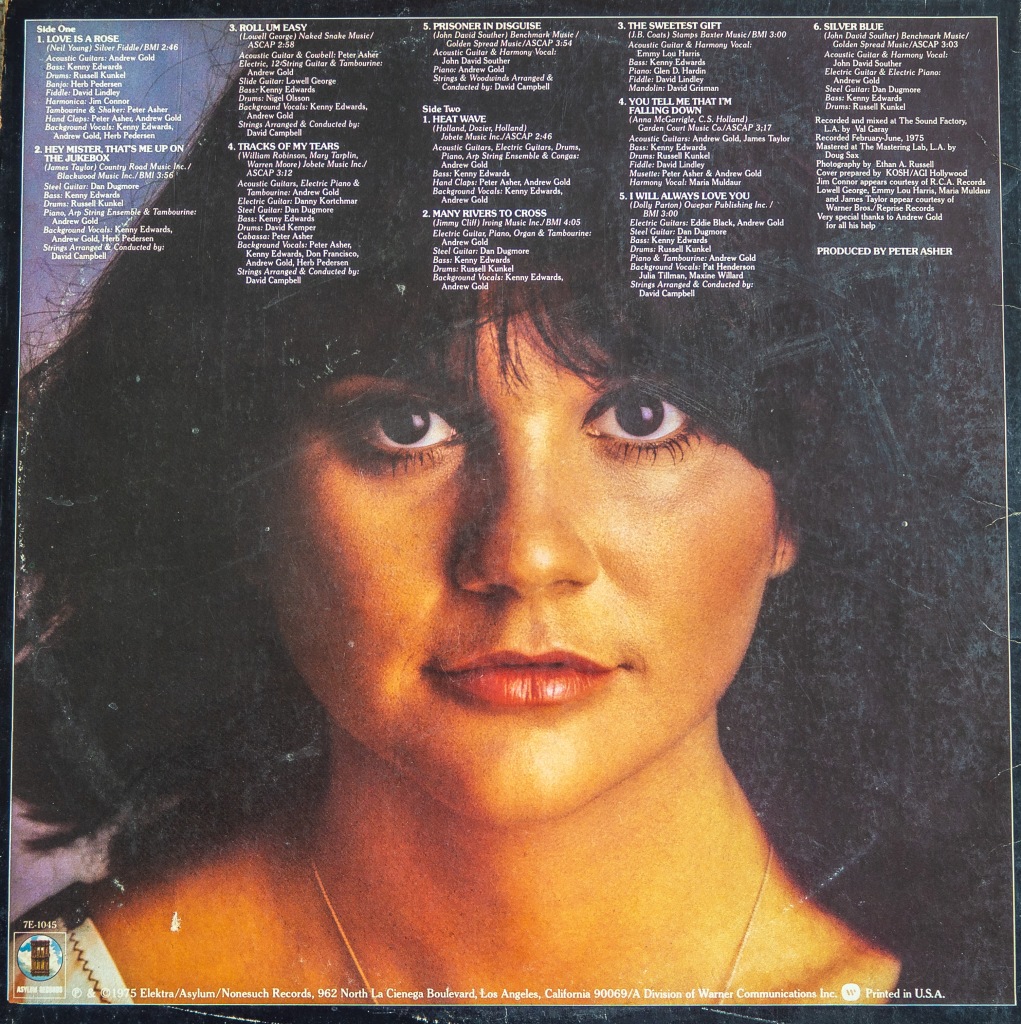
Portrait of Linda Ronstadt on the rear cover of her album Prisoner in Disguise
The beautiful rear cover of the Prisoner in Disguise album that adorned my brothers bedroom wall

‘Prisoner in Disguise’ is my favourite Linda Ronstadt album. Every one of the ‘covers’ on here can lay claim to being better than the original. Her voice is so multi layered on this, betraying emotion so deep you feel she owns these songs, you can be persuaded that she did in fact write them. The song selection is perfection. It is of the time. That L.A., Eagles, Southern California vibe particularly contributed to by J D Souther is stamped right through this with a tight, multi-talented band of Who’s Who of L.A. musicians. Because she was so admired by these contemporaries, and loved, the whole album is one of harmony and joy, it feels like they got great pleasure from the collaboration. Check out the gorgeous tender backing vocals of J D Souther on the ‘Prisoner in Disguise’ track. She chooses some beautiful songs on here.

Neil Young’s ‘Love is a Rose’ was a track unrecorded by him at the time. She joyously romps through this short track to set up the album perfectly. Although a song that Young probably composed before breakfast one morning it still hits that opening spot so well.

She continues this theme of setting you up for the meat of the record by elevating James Taylor’s ‘Hey Mister, That’s me up on the Jukebox’ to a much higher level than the original.

Tempting us on with another up-tempo number with Lowell George’s ‘Roll um Easy’ she had us on a cliff edge of expectation. George must have been happy with this superb performance of his song as he plays on it himself.

Hand written lyrics by the various artist who wrote the songs covered by Linda Ronstadt on her 1975 album Prisoner in Disguise
Inside cover of Linda Ronstadt 1975 album Prisoner in Disguise

Now we are really cooking with gas as they used to say back then. Smokey Robinson’s ‘Tracks of my Tears’ comes next, as the mood changes. What a cover version this is. Those tears are real – Linda is spilling them on to the vinyl. I love the original of this song, but this version is something else entirely. It is so moving in the hands of a female voice but what a voice. Sweeping in and out of the various emotions of the lyric, Ronstadt gives one of her finest performances. So convincing is it that you are struggling to see how she recorded this, having to control the emotions. Totally credible and compelling. She wrote this surely from experience – but no, it is a cover.

The album is called ‘Prisoner in Disguise’ and the title track coming next is arguably the standout one on the album. Gorgeous, beautiful, stunning – where is my thesaurus when I need it. Ronstadt has romantic history with J.D. Souther and that is so believable on their exquisite harmonies. They complement to perfection but also are so crisp that you can concentrate on one or the other to feel the emotion of the individual. One of my favourite tracks of all time and a go-to performance if you need to convince anyone that she has few peers in song interpretation. J D Souther had such sensitivity as to how he should harmonize with her and lyrically he clearly writes with a love of not just her voice but her person.

The Holland – Dozier – Holland track ‘Heatwave’ gives her chance to regroup before laying more emotion on the vinyl. Not a filler as such but gives us chance to dry the eyes.

Off we go again. ‘Many Rivers to Cross’ by Jimmy Cliff is a superb song by him. However, although he might have written it, he did not get into the real emotion and meaning of his song as Ronstadt does on her version. Listen out for the melodic organ and piano work of Andrew Gold that underpins the vocal superbly. She sweeps and soars on this track, keeping pace with the interplay of the musicians with consummate skill. Many years later I was in Eastern Provence and an open-air concert by Jimmy Cliff was advertised around the small town of Apt. Sadly, we could not be around for the show, but I would have loved to have seen him do this song. I am sure he was delighted with this interpretation.

The next track – ‘The Sweetest Gift’ is significant. Emmylou Harris had become a dear lifelong friend after the tragedy of Gram Parson’s death and the help Linda gave to her. This collaboration was one of their earliest and would lead to some of the finest harmonies to come out of this genre. Later on the album Linda covers Dolly Parton’s ‘I Will Always Love You’ and the three of them would go on to be a trio with some stunning results. The joy of friendship developed here for them, they would weave in and out of each other’s careers until Linda became unable to continue.  Both these tracks are just dazzling in the vocal range and close harmony that is achieved. Emmylou harmonizes with skill and beauty and on Parton’s song Ronstadt blends her vocals perfectly with an impressive backing trio.

I concede one filler in ‘Tell me that I’m Falling Down’. That is somehow not quite right on here, personally I sense it is not a song that she seems convinced about. Just my opinion but she doesn’t shine on what is not the strongest of songs.

The finish is just right – ‘Silver Blue’. This is the end, both of the record, but also where she says goodbye to all the admirers until next time. Another exquisite J.D. Souther song and surely written with her in mind. Wonder if she was ever lonely?

So, to address the charge that she only covers others. Guilty as charged of course but I take the view that if she can elevate a song to where I assume the writer wanted it to be then what a gift and what a joy to listen to. Generally speaking, I don’t tend to find cover versions usually surpass the original – check out Patty Griffin ‘Stolen Car’ though, – I digress, so that is what is so impressive about this album. Wonderful proof of how special an artist she was, tinged with sadness that it had to come to an end. So, the ‘who do I listen to question’ – well, I say proudly – the peerless Linda Ronstadt. And I reply – who do YOU listen to that can compare to this voice, this soulful interpretive singer?

No, I didn’t think so.

Vinyl record of the Asylum album Prisoner in disguise by Linda Ronstadt
MY original vinyl copy of Prisoner in Disguise 1975

More of my Vinyl Collection including Jackson Browne is here

village scene in Provence France with book covers of five french travel books and barcode to amazon kindle
Available in Print or for Kindle on Amazon

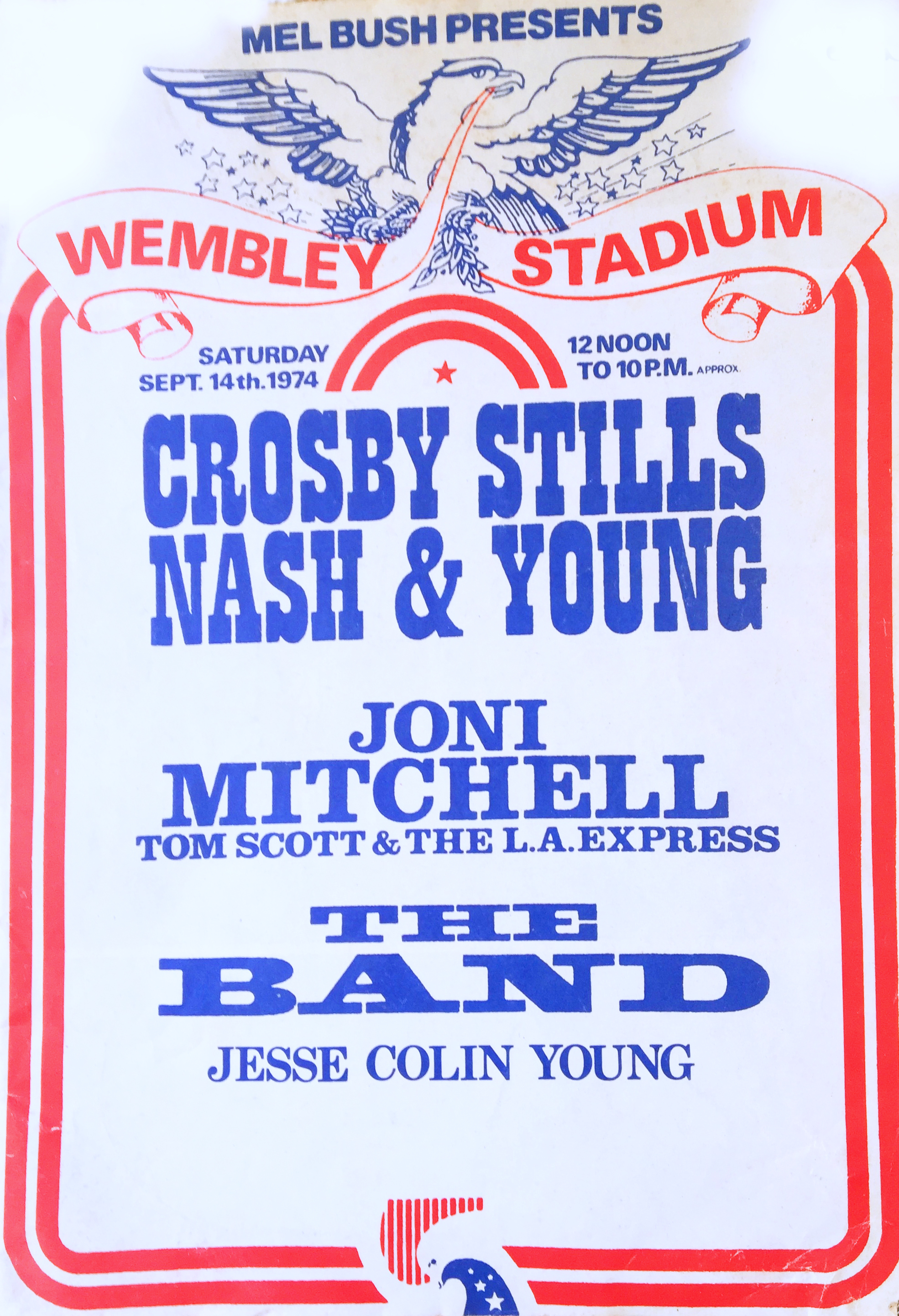
CSNY, Joni Mitchell, The Band: Legendary Wembley Concert – Sept 14th 1974

Programme for CSNY London Wembley concert in 1974 featuring Joni Mitchell and the Band
Programme for Wembley, London Concert 14th September 1974

England in 1974 was a country in crisis, politically and socially. Strikes, civil unrest, three-day weeks, power cuts, a decaying infrastructure, were troubling many. Saturday September 14th did not seem to be a day where any of that was noticed – at least not by me. Historians look back on this time as something of a dark age (excuse the pun) but to a nineteen year old at the time everything seemed fine, even what must have been a shabby Inter City train from the North seemed ok to me. Even the crumbling Empire relic that Wembley Stadium was becoming seemed impressive that day.

This day was the day of the largest stadium concert up until then, headed by Crosby, Stills, Nash & Young but by no means dwarfed by them were Joni Mitchell and Dylan’s trusted collaborators The Band.

Arriving at the twin towers we could hear Jessie Colin Young on stage but as he had been put on earlier than scheduled and it took some time to get into the stadium, we missed seeing him. As we walked into the cavernous space of Wembley to find a seat the bright summery tones of the Eagles ‘Take It Easy’ were being belted out over the sound system. All seemed right with the world and the song captured the mood of what was a glorious late summers day.

The sad passing of Robbie Robertson and Garth Hudson means the lineup of The Band have all left the stage. A generation, my generation, is passing on. Robbie and The Band were musicians I admired as much as anyone. Like many people my introduction to them was via their collaborations with Dylan and how they shaped his sound and influenced so many of the musicians to follow. I so looked forward to their set at Wembley. My recollections here of The Band, Joni and CSNY are nearly fifty years in reflection, but I don’t feel my views have changed over the years, so this is how I saw the day and the astonishing array of talent served up to us on that remarkable day.

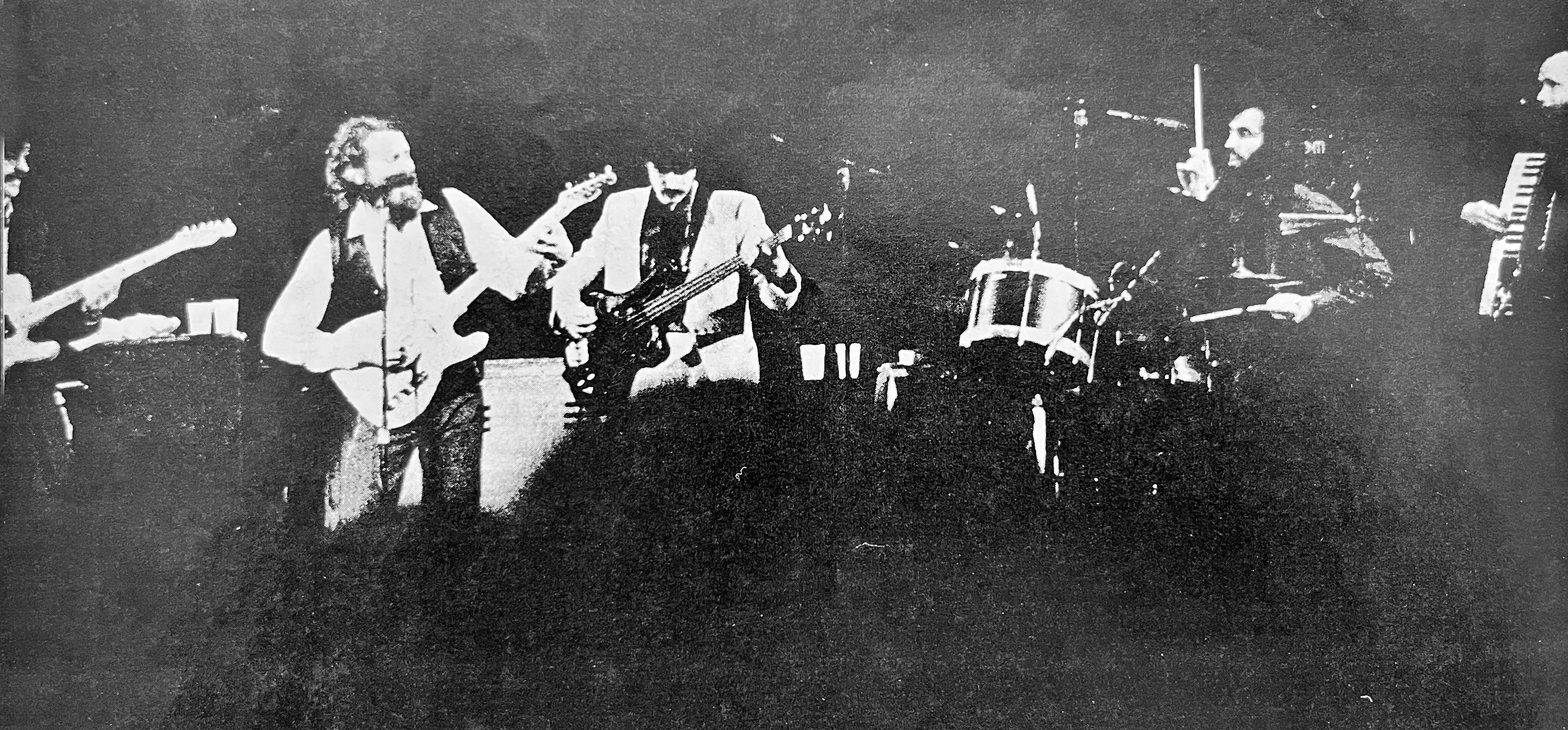
Black & White photo of The Band taken in 1974 featuring Robbie Robertson, Garth Hudson, Levon Helm, Rick Danko & Richard Manuel
The Band in a photo taken from the Wembley concert programme

The Band were a major disappointment. I appreciated they were performing off the back of what must have been a heavy, stressful tour of the US with Dylan who took them on his reappearance before his adoring public. There was though to my young untrained eye something wrong with them this day. Robbie Robertson was leading from the front as usual but seemed preoccupied and in constant dialogue with others on stage. They were hesitant between numbers, their sound not as seamlessly together as they were on record. Even the adaptable Dylan might have struggled if they had backed him up in this manner. It was only years later when various accounts of this weekend were written that the story of this performance came to light.

Leaving aside that members of the band had seemingly had a late night to say the least prior to the concert, it was related later that one band member was barely functioning, and the hesitation and consultations were because they were winging it on stage, desperately trying to cover for him as they performed as a virtual four piece. Richard Manuel was seemingly not in any condition to perform adding to the usually harmonious performance expected of The Band. The concern was that they could only carry this for so long and indeed the set was cut short. At the time I did not appreciate anything so dramatic was going on, simply puzzled that they were so disappointing – it was sad. At least I saw them, Robbie Robertson led the line as best he could, I enjoyed seeing him in the flesh with his guitar sounding as gorgeous as ever. They were close to the end, ‘The Last Waltz’ was being readied, on this performance it was clear the road had indeed taken its toll.

The Band setlist:

Hard Times the Slop

Just Another Whistle Stop

Stage Fright

The Weight

The Shape I’m In

Loving You Is Sweeter Than Ever

The Night They Drove Old Dixie Down

Across the Great Divide

Endless Highway

Smoke Signal

I Shall Be Released

The W.S. Walcott Medicine Show

Mystery Train

The Genetic Method

Chest Fever

Up on Cripple Creek

Black & White photo of Joni Mitchell singing at the piano
Joni Mitchell as photographed in the Wembley programme

Joni came next and such a contrast. She was magnificent. Looking all Parisian casual chic heading the band with dynamic confidence. This was a perfect setting for her. Tom Scott and the LA Express were tight, professional musicians who may have intimidated a lesser talent trying to perform in front of them. They backed her to perfection, but Joni was the director, the female band leader dominating the front of the stage. Her latest album ‘Court & Spark’ formed the backbone of her set and was just the right selection of songs for such a day as this.

Opening with ‘Free Man in Paris’ soaring around the famous old stadium, she went from strength to strength, confidence oozing from every note she sang. She even carried off ‘For Free’, as incongruous as it was in this setting – no one was playing for free here to this 80,000 crowd. Tom Scott and the LA Express added that summer jazz vibe that her set needed, with such complimentary arrangements you would have though they had been all as a band together for years. Looking back at the set list after all these years you could easily put this together on Spotify (other streaming services are available thankfully) and call it your greatest hits list for Joni – ‘A Case of You’ was the glaring omission but I cannot quibble. The encore was the Annie Ross song ‘Twisted’. With a nice touch she brought Annie Ross on stage. An electrifying set came to a conclusion, and she was gone. I never saw her in concert again but what joy to have seen her give such a magnificent performance – unforgettable.

Joni Mitchell setlist:

Free Man in Paris

You Turn Me On, I’m a Radio

Woodstock

Big Yellow Taxi

Rainy Night House

The Last Time I Saw Richard

This Flight Tonight

Raised on Robbery

Same Situation

People’s Parties

Blue

All I Want

Help Me

For Free

Carey

The Last Time I Saw Richard

Twisted

So, to arguably the main reason for being here – Crosby, Stills, Nash AND Young. This was the first time I had seen Neil Young and I have to confess he along with Joni was the main reason I had made the trip from Lancashire. A lot went on this day, however two things stand out, still in full Technicolor after all these years. We were sat in line with the wide walkway that led to the side of the stage and come showtime what can only be described as a tribe of musicians, wives, girlfriends, children, agents, corporate hangers on, slowly moved along to the stage with CSNY in amongst them. I remember the scene well, but my abiding memory is of this one person standing out in this throng as they made their way to the stage – Neil Young. Of all the scores of people he was the only one that your eye focused on. On stage it was even more apparent that only one person was dominating this show and he stalked the stage as if he was playing a solo gig.

Photo in black & white of David Crosby, Stephen Stills, Neil Young and Graham Nash taken in 1974 on tour
Photo of CSNY taken earlier in their 1974 tour

That I suppose is the problem with this band, much as I loved them at the time. Young was dominant, you couldn’t take your eyes off him and when he was truly centre stage it was obvious his songs and delivery were on another level. I appreciate some reviews say that the four of them as a unit were glorious, irresistible on this Wembley stage, but I didn’t see it like that. A personal reflection for sure but I have always seen it that way. There were moment of genuine stunning collaboration – ‘Suite Judy Blue Eyes’ for sure, the angry, forceful delivery of ‘Ohio’ was the peak of their togetherness. A song that was probably one of the fastest Young had ever written still packed an emotional punch that saw the four of them all in line and unison belting out a message they all clearly still believed in. The light-show came to the fore on this to add a stunning dimension to a super charged performance. Young’s ‘Helpless’ was another occasion where the individual elements all gelled beautifully and with Joni Mitchell coming on to add ethereal harmony this was a magic moment.

CSNY were all superb musicians in their own right but it was always going to be a night of some musicians are equal, but some are more equal than others. There was always a tension in the group dynamic, each one or in the case of Crosby & Nash the two of them, needing their moment in the spotlight. In reality, before such a large crowd only Neil Young could genuinely pull this off. Crosby and Nash were lost in such a large space and Stephen Stills, well he was just trying too hard. The moments he shared with Neil Young in dualling guitars were exhilarating but the need to win the dual meant neither knew when to stop. Their competitiveness and egos would cause a major split two years later on their Long May You Run tour. Tonight, it was tension driven but at least they stayed on the same stage to the end. I saw Crosby & Nash a couple of years later at Manchester Free Trade Hall and they gave a wonderful performance together, two friends bouncing amicable off each other in a warm, good natured evening of harmonious music and gentle songs. That was the perfect environment for them – Wembley was just too large and impersonal.

The highlights before the successful finale came when Neil Young went centre stage. ‘Traces’ was an unrecorded song that gripped the audience. ‘Pushed it over the End’ came before the closing harmonious finale. Remarkably a song that is legendary for him never releasing it, although a version from this tour and a later collaboration are now on stream. Classic Young with a band, driving them on but always out in front and the focus of attention. Like ‘Cortez the Killer’ it build up with a long intro until Young inserts the narrative building to a simple, effective chorus. A device he uses often, but why not when it is so captivating.

Unquestionably the highlight of the evening was when he played ‘Don’t be Denied’. It was so breathtaking that you almost felt it was time to go home, that was the peak. A number one song for many Young afficionados, it really packed a punch. Young fires out the repeated line ‘Don’t be Denied’ with venom and feeling, with the gorgeous powerful sound of his Gretsch White Falcon highlighting the peaks of this song. It rocked you back in your seat and for the audience on the hallowed turf it must have been like being caught in a wind tunnel. Young was not to be denied this night.

The four of them ended on an extraordinary high – together. You felt that this was in some ways the end, every last ounce of energy and goodwill was pouring out of them. ‘Carry on’ maybe carried on too long but a powerful statement nonetheless. ‘Ohio’ perfectly wrapping up the day and it would have been clear to them on stage that it was in fact the end of their best days of collaboration. It was certainly clear to Neil Young, who headed straight off on a European road trip, that his road was solo and with Crazy Horse. He added a lot to CSNY but he would have too many diverse ideas to stay with the confines of the needs of others. It was a great journey while it lasted though.

So, a mad dash across London to reach a dark and run down Euston station and our train to the North. It was a grubby, tired train but who cared. It was all we knew back then, nothing could dampen the excitement of this day.

CSNY Setlist

Love the One You’re With

Wooden Ships

Immigration Man

Helpless

Military Madness

Johnny’s Garden

Traces

Almost Cut My Hair

Teach Your Children

Only Love Can Break Your Heart

The Lee Shore

Time After Time

It’s All Right

Another Sleep Song

Our House

Hawaiian Sunrise

Star of Bethlehem

Love Art Blues

Old Man

Change Partners

Blackbird

Myth of Sisyphus

Word Game

Suite: Judy Blue Eyes

Déjà Vu

First Things First

Don’t Be Denied

Black Queen

Pushed It Over The End

Pre-Road Downs

Carry On

Ohio

Please Enjoy my Travel, Music & Ancestry Books on Amazon – FREE on Kindle Unlimited https://bit.ly/bookneal

village scene in Provence France with book covers of five french travel books and barcode to amazon kindle
Available in Print or for Kindle on Amazon

Go back

Your message has been sent

Warning
Warning
Warning
Warning.

John Thomas Atherton – Surviving the Tragedy of War

My grandfather was a quiet, thoughtful man. A man of very few words, a man seemingly haunted, preoccupied to a degree by something in his past. The tragic death of his very young brother Roger would have been a major contributor to that. There would also be a heartbreaking death of another one of his siblings, a brother so much younger than himself, that would hit him hard during his service in WW2.

I recall as a child a photo of a man in uniform, enclosed in a plastic art deco frame on the sideboard at my grandparents’ house. It never occurred to me that it was my grandfather, despite seeing it on every visit. Later I assumed it was his brother Alan who we will meet shortly. It was only decades later, after my father died, that I found this photo in my father’s possessions. Studying it with more interest than the young child I was back then, I would discover from the uniform the role my grandfather played in WW2. Let us see.

His young 18-year-old brother Alan initially enlists for service in the RAF, but his stay there is a short one. He transferred to the Royal Navy which would lead to his death on the beaches of Salerno, Italy during the allied landings of September 1943. My grandfather John Thomas Atherton also joined the RAF; he would have been around 34 years old at the time. His RAF service is shrouded in mystery, but I was led to believe he was based in the North of Scotland on ground support rather than training as a pilot. More research was needed to eventually uncover some of the facts. I discovered that my grandfather was actually based on Walney Island, just off the coast from Barrow in Furness, Cumbria. He was indeed employed as ground crew, keeping the aircraft flying and the pilots happy. However, I now know that the events on Walney Island were another major contributor to his air of sadness and lack of zest for life.

Walney Island was used for an RAF aircraft training base. Throughout my research into our family history, I gained precious little knowledge from family members that were alive during some of the times I was researching. The events of WW2 were interesting to me, but not it would appear to my family members who could have provided some background. Eventually, not long before my father died, he opened up a little on his uncle Alan and also passed on a snippet of information regarded his father. I learned from my father that my grandfather came back traumatised by having to attend to bodies of airmen on Walney Island, placing them in body bags for burial. This would have been a harrowing job considering the state of the remains of these pilots and crew. However, I found this seemed unlikely due to Walney Island being a training facility rather than a base that would have received dead or injured air crew.

One particular incident came to light that would seem to confirm what my father knew about his father’s service would have been correct. This was a disastrous end to a training flight over the island. The crew of an Avro Anson LT778 (10 Air Gunnery School at RAF Walney Island, near Barrow-in-Furness) had completed a target practice firing on a drogue target towed by Martinet HP303. This would have been a dangerous exercise in itself but that was completed successfully. They were preparing to land when the pilot of a Martinet overtook the Anson without sufficient clearance to starboard. The Martinet struck the Anson damaging both aircraft. The Belgian pilot of the Martinet, Pilot Officer J.E.J. Wegria, managed to land safely and later commented that he believed the Anson had already commenced its landing when the accident happened. Tragically, Anson LT778 crashed on the beach just short of the runway killing all on board. It appears the pilot, Sergeant Anderton, was trying to land the damaged Anson. Blame was subsequently distributed between the actions of the pilots of the two aircraft. This incident would I assume be what my grandfather was referring to when he told my father about his experiences on Walney Island. It explains a lot about my grandfather and his reluctance to talk about his war experience. Further research shows that other aircraft assigned to Walney Island also met with disaster. It appears that some of these crew members would have been brought back to Walney Island. It is possible my grandfather had also to be in attendance on these occasions.

There was an air of sadness as I mentioned about my grandfather John Thomas. Suffering the death of his young brother, a boy he had been so protective of as a much older brother, hit him very hard. This 8-year-old brother died when running across the road on his excited journey home from school. He was hit by a truck and died instantly. His father was away in the army, still serving as a driver in 1919 attached to the Army Service Corps Mechanical Transport Depot at Grove Park in Lewisham.

My grandfather’s brother Alan was born in 1924, meaning John Thomas was just about old enough to be his father rather than his brother. Losing yet another brother in tragic circumstances must have been hard to bear. The body of Alan Atherton was never recovered so he is recognized and commemorated on Panel 101, Column 3 of the Plymouth Naval Memorial maintained by the Commonwealth War Graves Commission. It is very moving to visit the memorial despite Alan being only a reference on a plaque, not having an actual grave. When you walk around the memorial in Plymouth there are always people around it searching for a reference on the walls that is relating to an ancestor. A slightly surreal experience as often your thoughts are interrupted by someone who cannot work out the method of locating a plaque and you break away to help before returning to contemplate your own ancestor’s life and death. Alan is someone I never knew but he is an Atherton, a good man, loved by all according to his obituary, someone who went through horrors that fortunately have been spared to any of his family since that time.

For my grandfather life became a serious matter. He would never openly be seen to be ‘having a good time,’ all the joy had gone, he raised his family without any sense of happiness. But he raised them well, taking them a little farther out of the poverty that dogged the family from Victorian times. This air of melancholy would remain with him, but this was in stark contrast to my grandmother Florrie, who along with her sister Ethel in tow, was the life and soul of any room or street they occupied. Their crazy laughter seemingly never to be stifled for very long. How I always thought this must have grated on my grandfather who had lost so much and retreated into himself. I for one could never quite understand where or how they met – two peas in a pod – I don’t think so.

Grandfather just before the war – Florrie his wife and my father Ramon

My family has had its share of wartime tragedy. The personality of my grandfather is a little clearer to understand now. Although he never had to display the bravery of the pilots he worked alongside, he played an important role. One that would have had the responsibility of doing his job conscientiously, lives depending on the quality of work men like my grandfather had to perform.

These photos of the reminders to the ground crew about the importance of being diligent are sobering:

ŽQ@CTv«Ýïú÷õùë
4;8584J I¼ÕÕÔ

Although this story enlightens me about my grandfather and adds to my memories of him, I find that ultimately his story leaves me thinking about those brave men that my grandfather helped to their last resting place. My grandfather went on to live a relatively untroubled life until his death in the 1980s in his hometown of Darwen, Lancashire.

The men who flew and died from Walney Island never had that opportunity.

Grandfather with the next three generations shortly before he died

I am indebted for the detail regarding the Avro Lancaster at Walney Island to Ian D B who runs the aircrashsites.co.uk website.

Also, to Mark Haywood for kind permission to use his Walney Island photographs. Mark’s grandfather died in the crash I have referred to.

During the allied landings at Salerno in Italy we see on the beach soldiers coming from a landing craft
US troops coming onto the beach at Salerno Italy in September 1943

Leave a comment

Please Enjoy my Travel, Music & Ancestry Books on Amazon – FREE on Kindle Unlimited https://bit.ly/bookneal

village scene in Provence France with book covers of five french travel books and barcode to amazon kindle
Available in Print or for Kindle on Amazon
Vinyl record albums stacked together in front of a vinyl disc for a book cover

Musical Reflections: Uncovering the Stories Behind My Vinyl Collection

Alt='My LP vinyl collection, Carole King, Jackson Browne. Neil Young' Joni Mitchell, Emmylou Harris, Paul Simon"
My musical loves – a Vinyl collection

A life through Vinyl

Today, as I listen to the Bruce Springsteen ‘River’ album, I am wondering what it is that shapes our love of music and particularly a genre that we seem to stay with for life. To be fair I did come to Springsteen a little later in life although the seeds were already there for him to step into my collection. My reason for starting this journey through my past, to paraphrase Neil Young, was my father’s vinyl collection. My father died recently, and he left a vast collection of vinyl including 78’s which I suppose are technically shellac. His CD collection was even more extensive, but it was the vinyl that fascinated me.

As I looked through the records there was a familiarity about them. Growing up, I had of course heard nearly all this music many times. My father’s tastes did not greatly change from his first loves. These were mainly vocalists of the style of Sinatra, Billy Daniels, Al Martino, Nat King Cole, Frankie Laine, Alma Cogan, Kay Starr and many others of that 50’s and early 60’s generation. The CD collections showed little change in his tastes other than a large collection of Willie Nelson and a decent Classical music range.

These artists were special to my father. He saw the majority in concert, mainly in Manchester at the Palace Theatre or Blackpool in its heyday of attracting the big stars of the day. He loved to tell of seeing Sinatra in Manchester when the theatre was not even full. Yes, all special musical memories for my father.

I then realised that none of these great mid-20th century artists, massive stars in their day and all familiar to me, had not touched my musical consciousness one iota. A great collection of vinyl was just memories to me but musically I had no desire to hear them again. Why? At the time I heard them I certainly was not also listening to or even aware of the artists I would form a love of – a lifelong love. So why did I not share my father’s love of his artists before other influences kicked in? For me I would say that music did not take priority at that time. Sport did, especially cricket. However, when I look back, I can see that the seeds had been planted in my musically education. It did not come from my father’s collection.

The album, or should I say 10” vinyl album, a quirk of the day, was in fact among the records I found in my father’s collection. It was a great, pleasant surprise to find it as I thought it was long lost. It was the very first selection of music that started to form my musical DNA. It did not belong to my father but was a treasured possession of my grandmother. I spent a lot of time with my father’s mother and although her record collection was tiny compared to what was in our home it was more interesting to this young child. My grandmother delighted in playing this small group of records over and over again.

‘Satisfaction’ by the Rolling Stones was one of them. I didn’t mind it and it was certainly for an eight-year-old a great departure from the music on the stereogram back home. The other favourite of hers was ‘Green Green Grass of Home’ by Tom Jones. She loved that but I never pursued a Tom Jones collection of my own. There was a rare recording of the Beatles at the Royal Command Performance but again the Beatles did not stir any musical feelings. Wish I still had that single though. Did it really exist? Perhaps just in my memory. Maybe I just watched it with her.

It was this visually interesting 10” vinyl LP she had that I kept going back to. The green cover of the artist in the studio was intriguing. The PYE label on the vinyl was fascinating, it was the same logo as my father’s stereogram. This was her pride and joy, one I had to listen to – ‘it were great’ she said in her Lancastrian tones. This was Lonnie Donegan, and the album was called Showcase. Released the year after I was born it was already well used by the time my grandma introduced me to it. I loved it and insisted on hearing every time I visited. Only now, looking back and studying this well-worn copy re-discovered in my father’s collection do I understand that it formed the basis of my love of music and a musical genre. Musically Donegan was interesting, fresh and different for the time. It was lively and somewhat loose in style, sort of folky jazz. It stirred my musically feelings. I am ashamed to say that I never bought any of his recordings and music went on the back burner for about 10 years. I had other things to do. Lonnie Donegan though had introduced me to what I really love about music. As I look at that album now, I can see its influence very clearly. It is words. Words set to music are my great love. I want to be moved, I want to be sad, I want to be uplifted, I want a story and preferably a sad one. That 10” vinyl had those things. As a seven-year-old he formed my future love of a style of music and performing.

That album was full of stories and not all with happy endings. ‘Wreck of the Old 97’, ‘Frankie and Johnny’, ‘Wabash Cannonball’ and others were all stories, music with words. That would always be my love. I love sad music. My daughter says, ‘the sadder the better’. Artists such as Sandy Denny and Richard Thompson would certainly fill that need later, amongst others. On that Lonnie Donegan album is a song ‘Nobody’s Child. I defy you to find a sadder one.

Looking back, I find it fascinating that I could have had such a love of music formed so deeply at such a young age. So deeply that I never realised it until recently. Lyrically at the time they meant little, an eight-year-old could not relate to Frankie and Johnny that is for sure. But, they entered my make-up and the outcome would flourish later.

Lonnie Donegan was an extremely influential artist, and many artists of the calibre of Paul McCartney, Mark Knopfler and others testify to his influence on their music.

I can testify that he influenced my love of music and so having enjoyed looking at this old vinyl I will continue and explore my vinyl collection. I will try to express what these songs mean to me and add some context to the time and place they appeared to me. Maybe, that will resonate with you – I hope it will.

The reviews from 50 years or so on will be in no particular order, in fact I will probably just put my hand in there at times and see what comes out. I do have to begin somewhere so this choice selects itself as the beginning.

I will start in my new book with the first LP I ever bought – Carole King Tapestry.

Please Enjoy my Travel, Music & Ancestry Books on Amazon – FREE on Kindle Unlimited https://bit.ly/bookneal

Vinyl record albums stacked together in front of a vinyl disc for a book cover