In search of Hemingway and Midnight in Paris – The Full Story

Please Enjoy my Travel, Music & Ancestry Books on Amazon – FREE on Kindle Unlimited https://bit.ly/bookneal

This is the FULL chapter from my book ‘A DREAM OF PARIS’

I know many of you have enjoyed the excerpt so here is the chapter in full
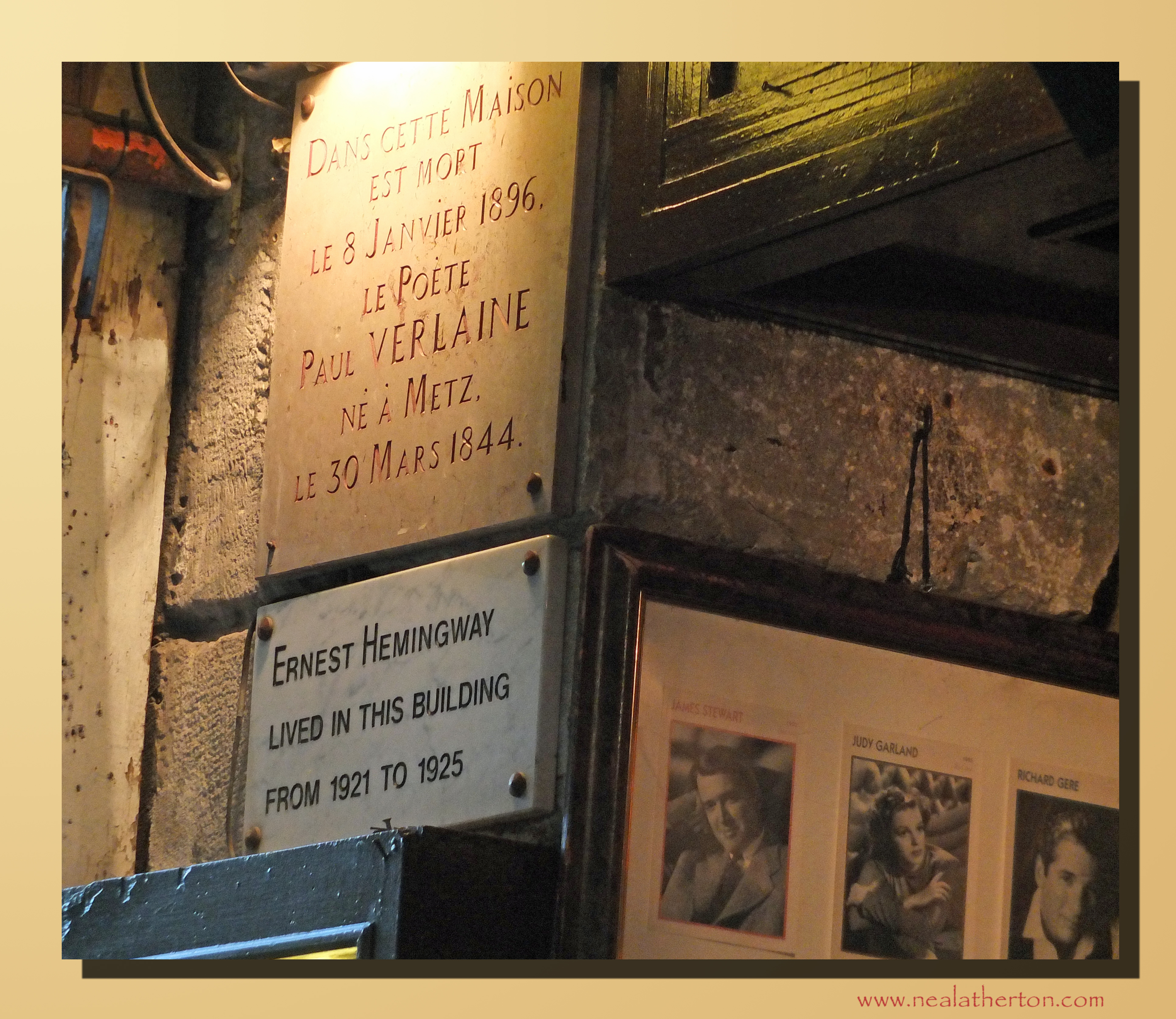
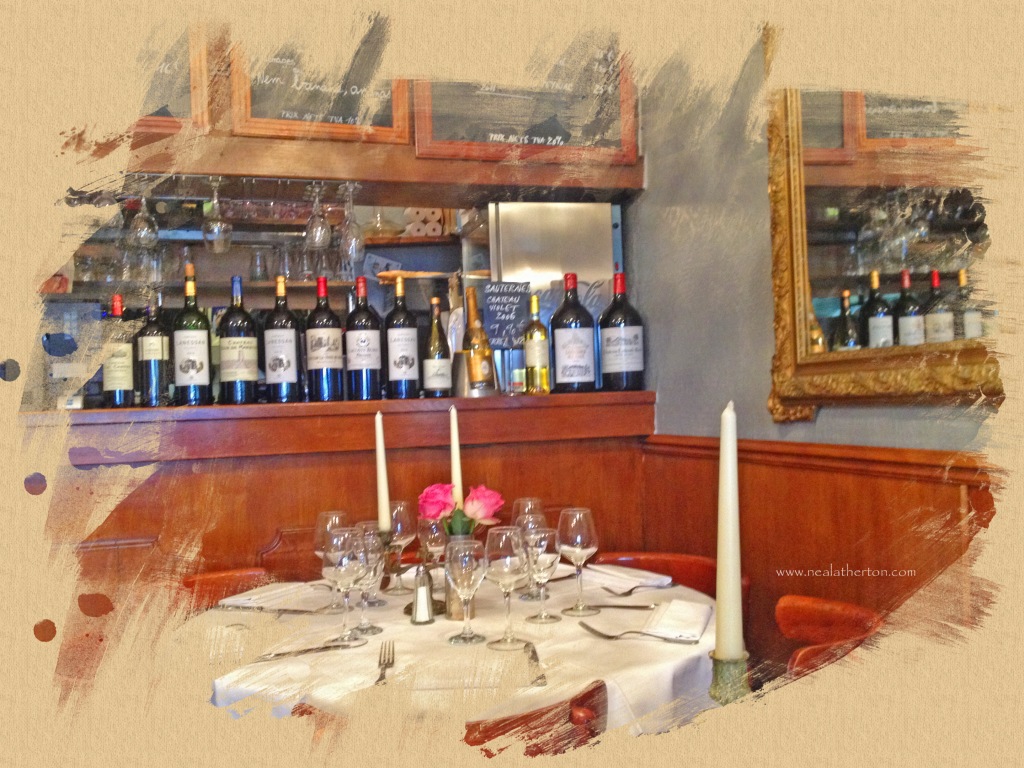
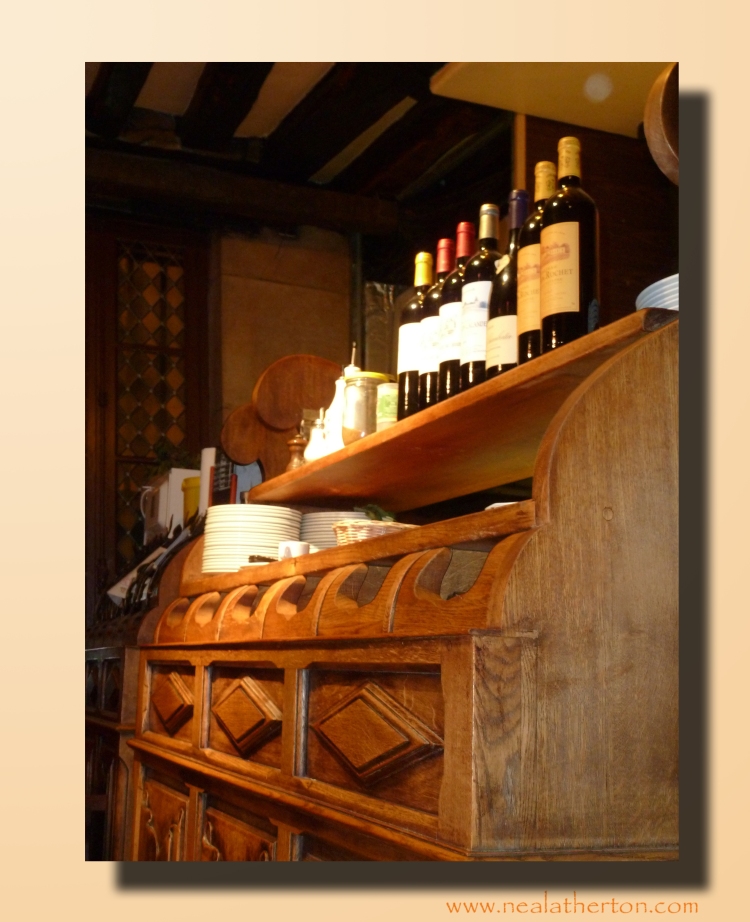
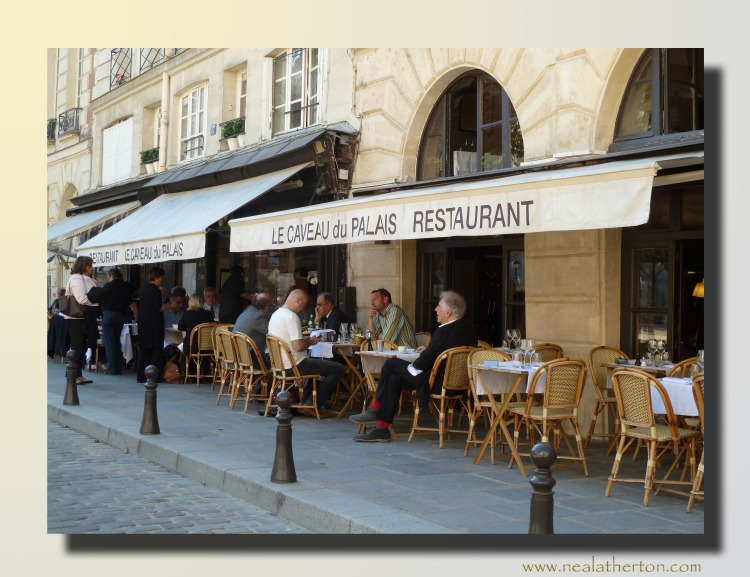
Alt="Interior photograph of Restaurant Verlaine with Ernest Hemingway in Paris France from my French travel guide books"
Restaurant Verlaine – Ernest Hemingway’s workplace Paris France

One of the most evocative books about Paris could be considered to be Ernest Hemingway’s ‘A Moveable Feast’. If ever I need inspiration to write about Paris or to make plans for another visit then that is the book that clinches my mood and motivation. It works every time for me even though you do have to take some of his Paris memoir writing with a reasonable sized pinch of salt. He paints such insightful but sometimes harshly unsympathetic portraits of the characters from the era, the writers and artists that dominated ‘20s Paris. Describing the life and ambiance of the city at that time period so well – he constructs a painting in words. His portrait of F Scott Fitzgerald made me laugh, cry and wince at the astonishingly eccentric tales he recalled. Yet it is a book that has such a depth of sadness too. Like my taste in music it appeals to my melancholic side – as my daughter says; ‘the sadder the better’. Certainly there is a sadness surrounding the future aftermath of Fitzgerald and Zelda’s tragically short lives spiralling downhill shortly after these events. It is though the final chapter of a book that was written just before Hemingway’s lonely death nearly forty years detached in time from the events in the book that conveys his deep regret. He threw away the happiness of his life in Paris with his first wife Hadley and their young son. There is not always something better around the corner, often what we already have is all we need for our contentment. It is a book that can be a Parisian guide but today we have something more visual based on his work.
The Woody Allen film ‘Midnight in Paris’ is themed on Hemingway’s book as any cursory read of it will establish. Really though it is a film that does more for the Paris tourist board than any amount of advertising. It is a love letter to a great city. The film recreates the times of the 20’s that Hemingway so eloquently describes, an era that the film’s main character Gil adores as he is bewilderingly entranced to be transported back to that time. Adriana, his new muse, prefers La Belle Époque but he cannot understand wanting anything more than to be experiencing the lively writing and arts scene of Paris in the 20’s. I am with him on that, but really all the book and the movie do is to convince you that Paris is the finest city in the world. When I arrive at the Gard Du Nord on the Eurostar from London then my current era waiting outside the station is just fine by me. The filming locations for ‘Midnight in Paris’ are well documented and in fact Hemingway makes a fine job of that. So if you want to follow them all it is easy to do in our smartphone era. I will take you through on a mixed journey, some of the places in the film that I love. Also bring in some parts of Paris that historically are so very interesting and should be part of your visit. If your time in Paris is all fine dining then you are missing out on a broader experience.
If you are going to start on a history and writing tour of Paris then I suggest it begins on the steps of the church of St Etienne du Mont, Place Sainte-Geneviève, 75005. The actual steps used in the film where Gil waits for the time travelling car and his famous hosts are just around to the side of the church. From here they look down Rue de la Montagne Sainte Geneviève, the road up which the car approaches. It is a supremely evocative location and it is worth taking the time to search out on the internet a photo taken on 22nd August 1944 of armed resistants just coming down from the area of the steps at the height of the struggle to liberate Paris from the German occupiers. Historical fact and fiction can be found being enacted side by side on the streets of Paris and in your imagination. If you go back around to the front of the church onto Rue Clovis and head towards the Latin Quarter by turning right onto Rue Descartes you will come to a small but perfectly formed restaurant – La Maison de Verlaine. The clue is in the title but it was not a happy place when Verlaine died there in a miserable state as a result of his alcoholism. It is also a building where Hemingway rented a small attic room and took himself off to write in peace and seclusion. There is a delightful story in his book about the goatherd taking his flock every day past Hemingway’s building and milking the goats to order as the locals emerged with their containers. It is certainly an evocative street. We have eaten on the terrace at this restaurant of an evening and the food is excellent. The location is pure Paris left bank so don’t let me stop you going. Just a little farther up is Place Contrescarpe which again features in Hemingway’s life and times in Paris. This is a place where he describes almost with affection the bar humming with the pungent smell of bodies and drunkenness. It is a vivid portrait you can almost sense the reality of from the page.
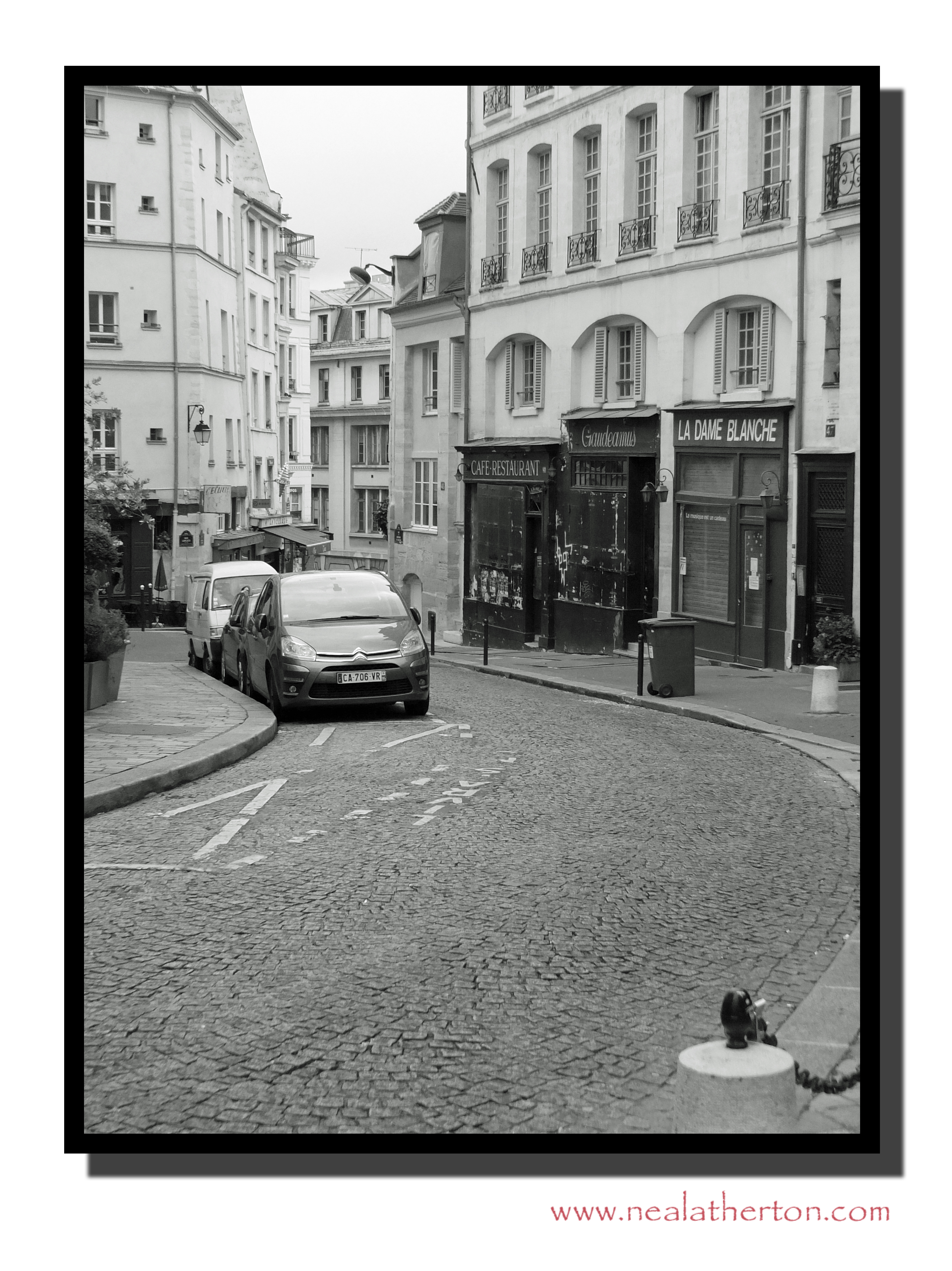
Alt="Rue de la Montagne Sainte Genevieve Paris Midnight in Paris film location from my French travel guide books"
Rue de la Montagne Sainte Geneviève

Today it is a lively square and to sit and eat at a table (we ate overly large portions of Greek food one night at L’Ile de Crete) gives you quite a show as life quite literally revolves around you. It is a place that is perfect for riding a motorbike around and around or posing in an open topped car. A ready supply of onlookers at the cafes and bars will either admire you or stare in total disdain.

Around the corner at 74 Rue Cardinal Lemoine is the building that houses the small apartment that the Hemingways lived in from 1922. He describes their lives here so affectionately despite the way Hemingway cultivates a lifestyle of relative poverty as a writer that seemingly is always relying on the odd cheque arriving for an article he had submitted.  The area still retains a character today but back in the 20’s it was a place far removed from the modernity and chic of Paris today. They were clearly a very happy family unit in this lively area.
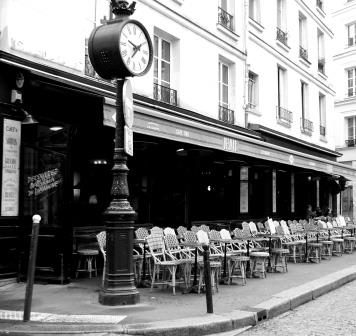
Alt="Photo of Place Contrescarpe Paris French travel books"
Place Contrescarpe Paris

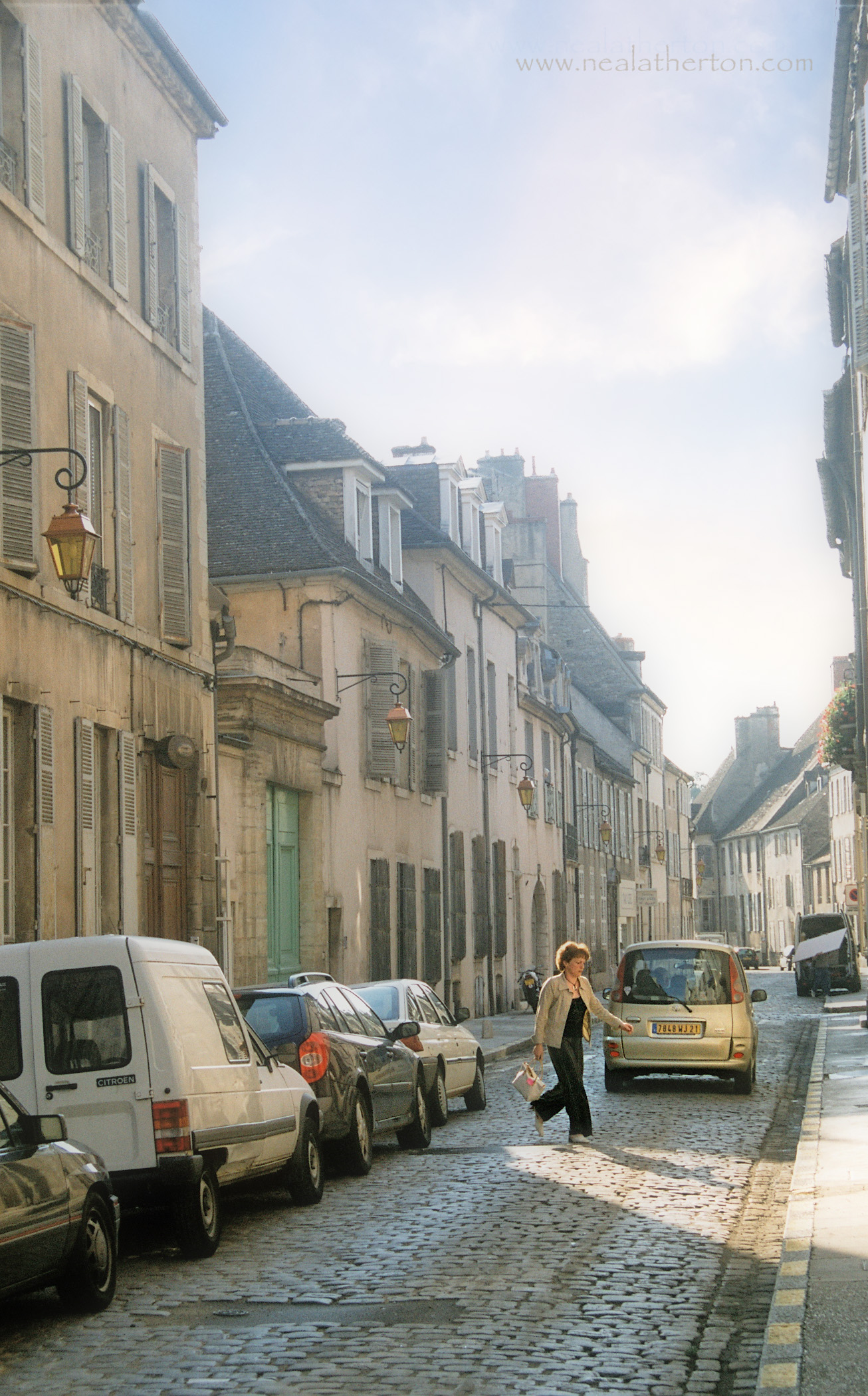
Retrace your steps back towards Place Contrescarpe and look out for Rue Rollin on your left, a street that leads through to Rue Monge. This route is worth the detour for a couple of reasons. Rue Rollin makes you feel as if you are in a provincial town rather than a city like Paris. To me it almost felt like a street in Burgundy, a town like Beaune. The real surprise of Rue Rollin comes at the end as you emerge onto Rue Monge. There is an extraordinary exit. It is a cul-de-sac for cars but there are two flights of steps either side of the street and these go down a beautiful frontispiece facing the street. This is bedecked with plants and flowers and if you are here at the right time of year with everything in full bloom it is a gorgeous photo opportunity.

Alt="Rue Monge Metro Paris French Travel Guide Books"
Rue Monge Paris Metro Station at Night

Once you are onto Rue Monge and if you have an interest in architecture, particularly art deco then it is worth a short walk across the road. Start heading to the right, finding the Metro station Monge. Admire the front of the Metro with the beautiful ironwork on the entrance. A great photo shot in black and white. Go back the way you came and stay on that side of Rue Monge for a genuine unexpected surprise. It may be that you are completely unaware that Paris has its own Roman amphitheatre, a genuine one from the first century AD. Neither did I until some years ago when we stayed at a hotel on Rue Monge – Hotel des Nations St-Germain and very pleasant it was too. Across the street there was a sign above a passageway at No. 47 Rue Monge over which was a stone carving of a Roman soldier’s helmet. The sign said ‘Arenes de Lutece’ but there was certainly no great fanfare accompanying it. As you watched from the window of our hotel the daytime scene of people busying themselves with the business of getting to work and school, watching the tourists making their way down to the Seine and the Islands, you hardly ever saw anyone going through the gateway. If you go to the front of the entrance way there is a little more information (in French) as to what lies beyond. Looking down the short passageway it has to be admitted the prospects are a little unpromising. However it is definitely worth stepping inside. As you emerge into the light the area gives off the appearance of a small park, perhaps a children’s play area and here you may well encounter some youngsters playing soccer.  Unmistakably though you are now in a very well preserved, compact Roman Arena. It is a pleasant space, away from the traffic noise of Rue Monge. It is a place where people may sit and read or just stroll through on their way to work. It will have very few tourists so please make a visit. When you return home you can amaze your friends with this discovery and your knowledge of hidden Paris.

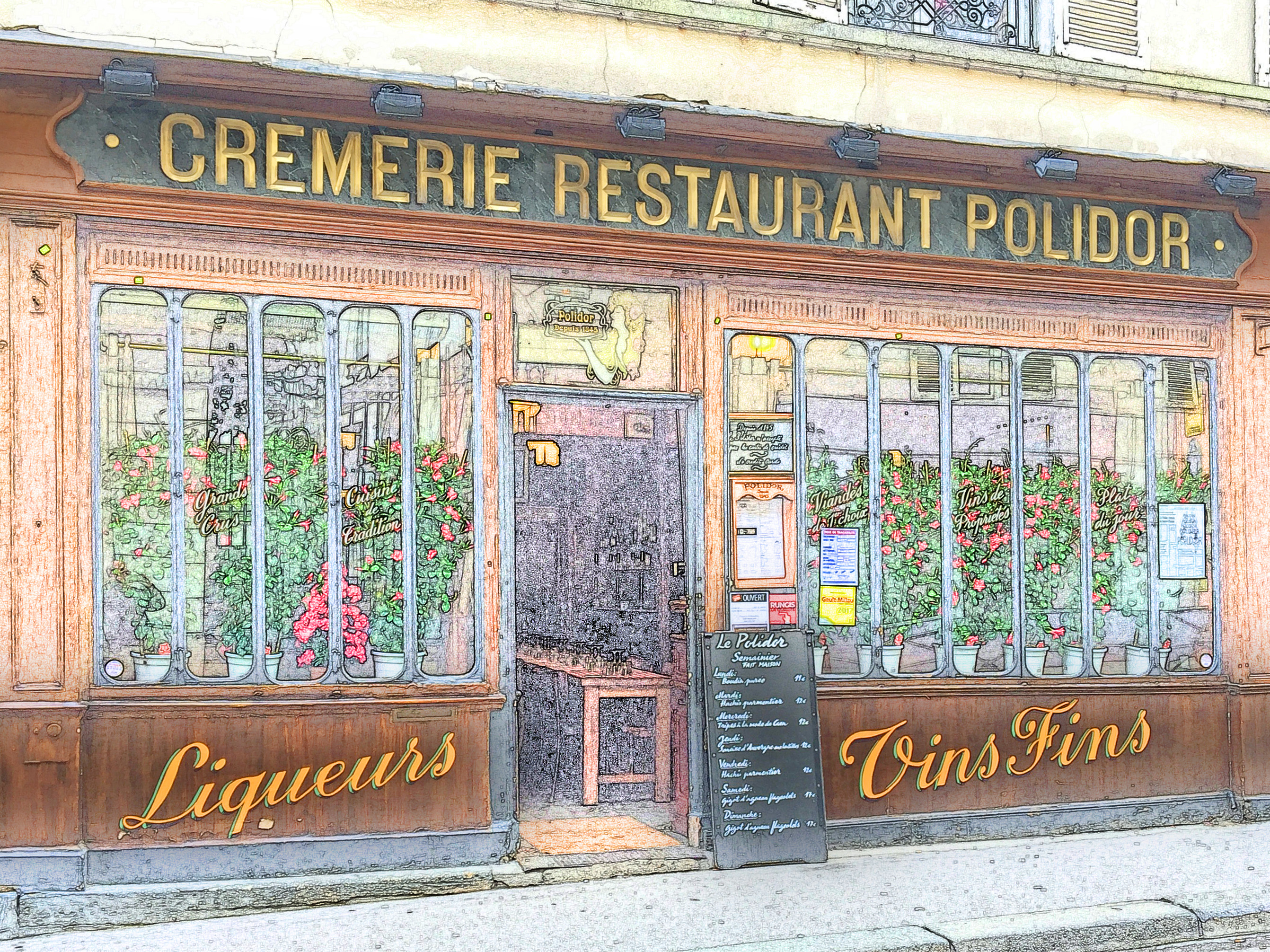
Time to move on with a pleasant stroll down Rue Monge and then left onto Rue des Ecoles until you come to Rue Racine on your left. The goal of this walk is to reach Polidor restaurant, certainly a Hemingway destination and this historic building was heavily featured in ‘Midnight in Paris’. Even if you are not going to dine here (cash only – no cards) it is well worth a look and again bring your camera (or these days your phone).

Before we get to Polidor it repays a few moments pause outside the Restaurant Bouillon Racine previously known as a Chartier Restaurant. This is a building of Art Nouveau splendour both outside and in and is in fact listed as a historical monument of Paris. Apart from boasting a fine reputation for its food it has another much darker claim to fame. One of the most extraordinary verdicts in a French murder trial came after an event that took place in the street outside this restaurant. On May 25th 1926 the President in exile of the Ukrainian National Republic, Symon Petliura was assassinated by a man named Sholom Schwartzbard. He claimed to have lost all 15 members of his family in Jewish pogroms in the East. This was a horror that he held Petliura personally responsible for. Schwartzbard made no attempt to flee from the scene nor did he in any way claim that he was not responsible for the murder. Despite the cold hard facts of the evidence he was acquitted by the French jury basically on the grounds that his actions were justified. In effect such a man as Petliura had no right of protection because of his alleged crimes. It is not a verdict we would expect today but it is one that had been argued previously and it has a place in French history. It is still a verdict that resonates today with the animosity between Ukraine and Russia. The prosecution at the trial put forward that Schwartzband was in fact a Russian agent and that view holds good to many Ukrainians even now. There is plenty of interest on the streets of Paris and it always repays the effort of seeking it out. On the left hand side as you continue along Rue Racine you come to Rue Monsieur le Prince and there is the venerable Crémerie-Restaurant Polidor.
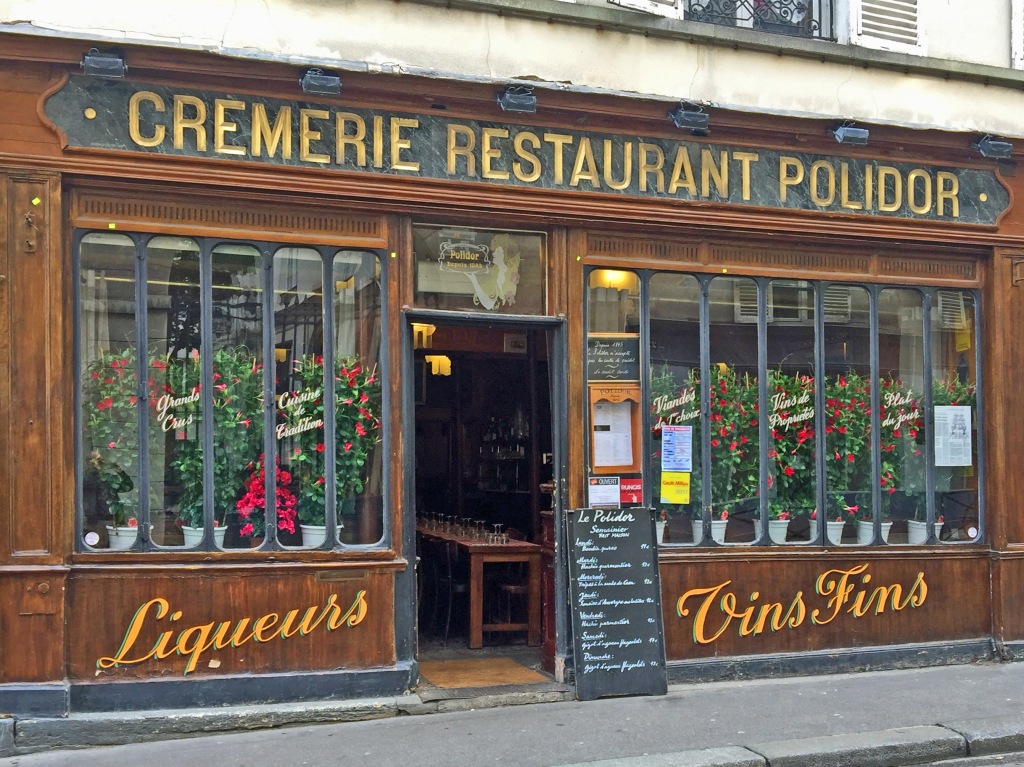
Alt="Photo of Restaurant Polidor Paris France French travel books"
The period exterior of Restaurant Polidor Paris


This eating place is a throwback to the times of Victor Hugo and of course Hemingway and the contemporary artists and writers. The interior is little changed from the days Hemingway would have patronised this restaurant. It plays a central role in ‘Midnight in Paris’ although it has to be said there is not a sign of the laundromat that Polidor transforms into. This is a restaurant to savour with a menu that is right out of the Belle Époque and they have no intention of changing any time soon thankfully. The exterior is a remarkable throwback to another age and one of the finest photo opportunities in Paris. You may have to be more sociable than usual and share a table.

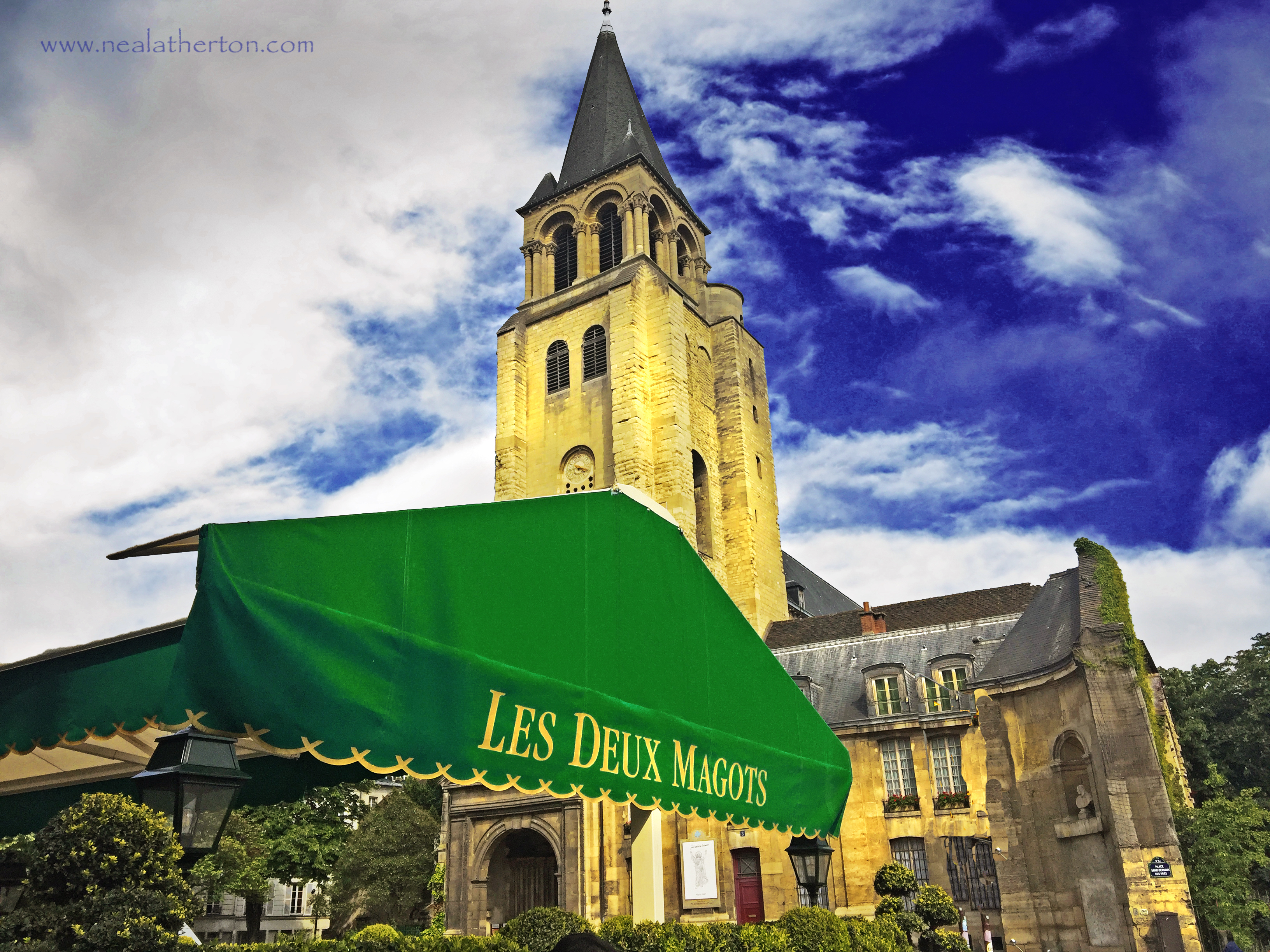
From here it is a relatively short walk to the Boulevard St Germain and on to three café/restaurants that are synonymous with the writers of Paris. Brasserie Lipp is often referred to by Hemingway in ‘A Moveable Feast’ and it takes little imagination today to place this establishment in its historical context. It always feels very 20’s/30’s to me and certainly sets the mind racing as you contemplate the stories the tables could tell. Hemingway famously goaded the ‘friends’ he had cruelly portrayed in his novel to come at an arranged time and shoot him at a Brasserie Lipp table. Across the road are the two famous cafés that always seem to be in competition for clientele and of course they are.  They have historically competed for the favour of writers and artists down the decades. Some preferred to sip a coffee for hours and write at a table at Café de Flore and some at Le Deux Magots. Some fell in and out of favour with their regular haunt and interchanged the two. Today it is a must see destination for many and plenty of visitors are happy to pay a coffee price that would have horrified Hemingway and others who were allowed to sit and write for a few centimes back in their day. It is undeniably an experience and just once maybe it is worth the cost to watch the world go by. You can have that world just wondering if you may be a ‘someone’ which of course you are to your family and friends. It is a little game to play for a pleasant moment in time.

I have only scratched the surface of artistic Paris and the historical gems that are to be found. I do encourage you to do more research and have a clear plan before you go. There is so much to see and experience beyond the obvious. You will take so much more away with you in memories and knowledge if you dig deeper than the ‘tourist’ sites. It also depends on how far you wish to walk and for that reason it seems the right time to bring this chapter to a close. Be assured however that there is far more than I have portrayed waiting to be discovered.
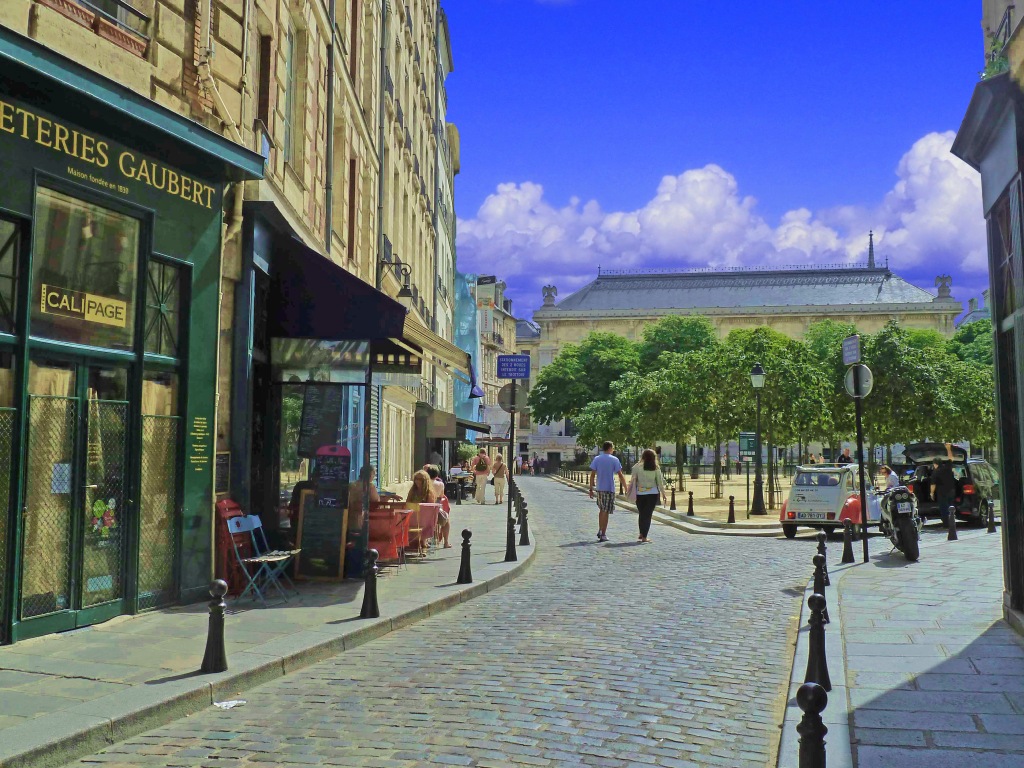
Alt="Photo of Place Dauphine Paris French travel books"
Entrance to the beautiful Place Dauphine Paris

To finalise I will take you back to the river and the Pont Neuf at the very tip of the Île de la Cité. As you go over the bridge coming to around the midway point of the island you find a narrow street on the right. Going through this entrance way the narrow road opens up into a most beautiful space – Place Dauphine. For me this is a very favourite spot in Paris, a quiet place with many relaxing cafes and restaurants intertwined between the gorgeous apartments. It is leafy and tranquil yet but a stone’s throw from the noisy hordes congregating around Notre Dame. It is clear that few tourists even know this is here and selfishly long may that continue. It is a delightful space and to eat here or just enjoy a coffee is a joy. The pretty cobbled streets of Place Dauphine inevitably appeared in ‘Midnight in Paris’. If you go and sip a coffee at Restaurant Paul at number 15 Place Dauphine you can if you close your eyes just hear the gentle sound of the horses hooves drawing the approaching Belle Époque carriage along to the terrace. You can certainly imagine that scene. The ambiance of this square has retained its charm effortlessly down the decades – a place to savour and to relax.


Hemingway burned his bridges with his ‘friends’ in Paris, cruelly portraying many of them as characters in his novels, making no attempt to hide as to who he was basing his writing on. Most of all he discarded the woman he loved and lost the stability of the family he had around him. He has left a romantic portrait of Paris that is portrayed in ‘Midnight in Paris’ and like much of the best art and music this is a legacy based on the suffering of the tortured artist. His footsteps make for an interesting walk through this quarter of Paris. I could walk farther but I am as my friends have complained perhaps a little over active in that department. So I will consider a wider audience and end my tour sitting at the terrace of Restaurant Paul – but tomorrow is another day.

I hope to convey just what these people meant to us and how Paris bound all the best of memories together but it is a slower process. As I said Paris is throwing up too many ideas and I think it will produce two books rather than one. Just adding my love of its history to the book gave me a challenge to fit it all in. I have a passion for the time of the occupation, perhaps because I know that I would have been personally caught up in all its horror had I been living in Paris back then. I find it fascinating and hope to convey that a consideration of those events should not be overlooked by the visitor. No, Paris unlike Provence cannot be based around wonderful long lunches, it needs more effort for a visitor to get full value from a visit. I loved the writing and research for this book but despite Hemingway dwarfing me as a writer I do possess something he relinquished – I can write of Paris without any regrets.
This full chapter and other meanderings through Paris are in my book : A DREAM OF PARIS available free on Kindle Unlimited

Alt="Les Deux Magots Cafe Paris France home of Artists and writers including Ernest Hemingway"
Les Deux Magots Cafe at the heart of St Germain Paris

Come to Paris with my Dream of Paris Memoir
alt="photo for review of French travel guide book A Dream of Paris non-fictio on Kindle Unlimited"
Paris & France – Travel now
alt="New French Travel Guide Book Off the Autoroute"
OUT NOW on Amazon for Kindle, Kindle Unlimited, paperback & hardback
Vinyl music records stacked togerther on a music book cover
Enjoy a travel back into time with my Vinyl record Collection

Aix en Provence – In Search of Cézanne

Please Enjoy my Travel, Music & Ancestry Books on Amazon – FREE on Kindle Unlimited https://bit.ly/bookneal

The harbour at Cassis where many impressionists including Cezanne found inspiration
Cassis Provence
young girl fills water jug from a stone fountain unter shady trees in village in Provence
My French travel book ‘Off tge Autoroute’ is now also available on Kobo

If you were to question me forcefully and make me confess, then I would probably say that if you exclude food and wine then my most favourite facet of the culture and art of France would have to be the paintings of the Impressionists. Provence and its landscape are synonymous primarily with Paul Cézanne, if you discount the issue with Van Goghs ear that is. Paul Cézanne was born and later died in Aix en Provence. Although a proportion of his output was composed in Paris it is his work in Provence and particularly in Aix that probably is more well-known and appealling to people as quintessential Cézanne. Since taking an interest in Impressionism I have always admired and enjoyed his work. I have seen many of his and the other Impressionist art works in museums in Paris, especially at the Musee D’Orsay. It is a thrill to see such great art at close quarters.

I had not however visited Aix, so it was time to put that right. Cézanne lived much of his life in Provence and for some of that time he had the challenging task of hiding from his father the fact that he had a son, Paul, by his lover Hortense. His father to a degree supported Cézanne in his chosen career by means of an allowance which would be lost to him if he were discovered to be living contrary to his father’s standards. This delicate situation was ultimately resolved, and he gained a studio at the family home Bastide du Jas de Bouffan in Aix. His complex relationship with Hortense was by the start of the 20th Century very strained and he was now in the last decade of his life. Cézanne needed peace and somewhere to be left in solitude to paint. This led him to build an isolated studio high up above the town of Aix on the Chemin des Lauves, now known at the Atelier Paul Cézanne. It is open to the public. We should visit, so we set off towards Aix, a place that would be a new experience, but a town I had lofty expectations of in view of its illustrious son.

On arriving in Aix we first of all decided to walk down the Cours Mirabeau and browse the shops and restaurants lining both sides. This is of course the main street in Aix and although not as famous as the Champs-Élysées in Paris it is the thoroughfare that you most strongly associate with Aix. Cours Mirabeau tries to be just as trendy as Paris. It is a beautiful street with fountains along the way and lined with old plane trees giving shade in front of the shops, cafés, and restaurants. No question though, it can be a tourist trap and prices on the terraces of the cafés are high, but what a spot for people watching. This is the place to see and be seen in Aix en Provence. We deviated off the Cours Mirabeau through narrow streets and passageways to reach the Place Richelme where there is a local produce food market held every day of the week. This small, tightly packed square encapsulates every sight, sound and more importantly smell of a market in Provence previously constructed in your imagination. Fresh bread, vast range of cheeses, meats, cold air-dried saucisson of course, mushrooms, fruits of the region and some hot food stalls, especially the tempting chicken rotisserie with the potatoes being sautéed in the cooking juices. Interspersed between are flower stalls and along with the incredible smells from the olive sellers they turn the square into a glorious assault on the senses. Stopping for a coffee at Bar de l’Horloge at the end of the market we then retraced our steps back up the length of the Cours Mirabeau to the underground car park and made our way up to Atelier Paul Cézanne, not too far from the centre of Aix.

The area is unpromising, very 1970’s apartments, and the studio is quite difficult to find. I park the car in amongst the apartment blocks and walk through to find the studio of Cézanne. I have the feeling that the area was a little different back in the time when Cézanne had this studio built. Peace and tranquillity would be a little bit harder for him to find today. The studio of Cézanne does though give out the impression of an oasis of calm and the views he would have enjoyed around the area and down the hill towards the centre of Aix would in his day have been quite beautiful. The house has the ubiquitous French shutters that you would expect to see in the South, painted in that faded matt red/brown that was beloved of the Impressionists. You can see the same colour on shutters and doors in the village of Giverny, famous as the home of Monet in the last decades of his life. 

Immediately inside the house you collect your ticket and to be honest find that the first impression (sorry) is not very promising. There is little to catch your attention that may in some way relate to Cézanne’s time here, but the scene changes dramatically for the better as you ascend the stairs to his studio. As soon as you step inside this magical space you are transported back in time, over a hundred years, to a studio that surely you feel is still being used to create great art. As you stand in the centre you imagine looking over your shoulder towards the door and seeing Cézanne walking briskly through, brushes in hand, ready for a day of creation.  One of the most atmospheric rooms I have been in.

You could argue you are let down to a degree in that there is nothing here that Cézanne actually created, there are no finished works as of course these almost priceless objects are now in museums or private collections. That is though what makes this room special – you must imagine. You need to look at the objects, the high artist steps, the large easel, the tables and drawers left as they were when he last left the room, still ready for use. Other props Cézanne used such as the pottery, baskets, and fruit (replaced regularly). There is the wood and canvas deckchair with footrest. The selection of books neatly resting on the bookcase. A crucifix placed high on the wall, reflecting Cézanne’s conversion to Catholicism quite late in his life. There are the skulls that Cézanne painted in his last works as he contemplated his mortality knowing that he was coming to the end of his life here in Aix.  You feel that Cézanne, if he walked in would not notice the admirers who have visited his studio today and would simply set up his easel and start to paint, calm and happy in his own space. Like many other places in France, I appreciate being able to let my imagination wander and fill the space from my mind’s eye.  This is how I like my history and the Atelier Paul Cézanne is a joy.

We take our leave and go outside, passing the climbing plants and stone plant troughs, pretty metal table and chairs and back into modernity and our car.  Where to next in our search for Cézanne? Inevitably it must be a view of Montagne Sainte Victoire as we head out of Aix on the A8 AutoRoute. The mountain range of St Victoire is impressive and is a considerable length of formidable rock. If you can spend a little time here, then what you do appreciate about this range is that the thing that most impressed and inspired Cézanne was obviously the play of light on the ridged exterior of the mountain. That is still the same, unaffected by climate change. As with most outdoor artists Cézanne loved the effect of changing light, and you certainly are aware of that spectacle when casting your eyes on this famous mountain. It would have been ideal for us to have gone to the fishing village of L’Estaque, another spot that was synonymous with Paul Cézanne. We decided on a compromise. Instead, we headed to the coast and the village of Cassis. We also wanted to call at the village of Bandol, Domaine Tempier, and purchase their heady Bandol red wine.

I am not sure how familiar Cézanne was with the wines of Bandol but at Cassis port we were very aware of the spectacular light that Cézanne would have treasured when creating his works of art in this region. He surely must have enjoyed the fish and seafood coming out of the clear blue waters of the Mediterranean – we certainly did. He must surely have sat at a seafront table in L’Estaque with a bottle of rosé as we did here in Cassis. We came in search of Cézanne; we were richly rewarded on a very full and tiring day that left us immensely satisfied in theming our day around this great painter.

I encourage you to do the same.

Please Enjoy my Travel, Music & Ancestry Books on Amazon – FREE on Kindle Unlimited https://bit.ly/bookneal

Now available on Amazon for Kindle or in Print

D-Day Omaha Beach and the American Cemetery in Normandy

On the anniversary of D-Day these are my thoughts from a poignant visit to the American Cemetery overlooking Omaha Beach.

This is taken from my book – OFF THE AUTOROUTE

The cemetery is poignant especially because of being situated where these young men fell.

I hope you enjoy this recollection

We look forward to the end of war and a peaceful world.

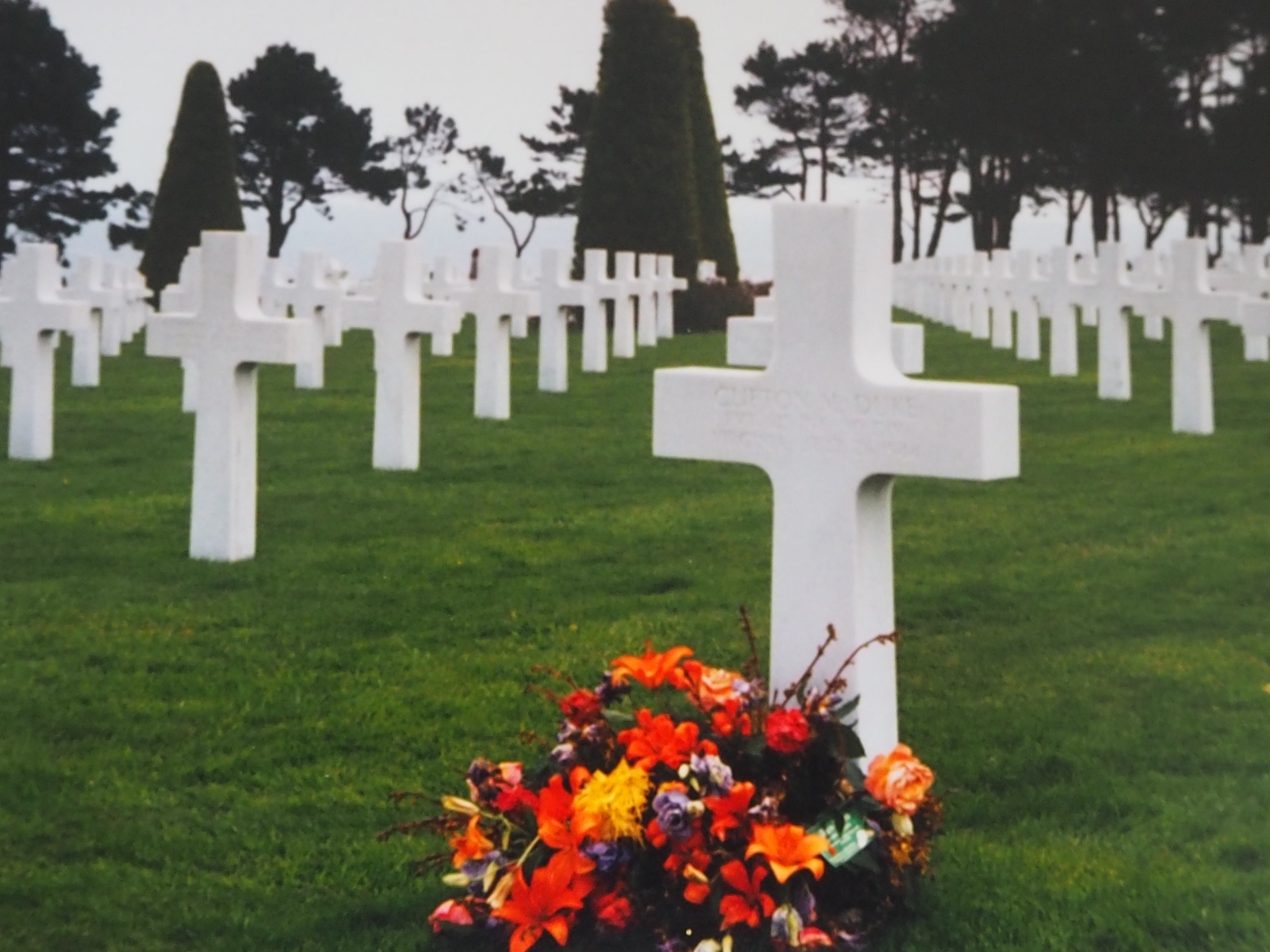
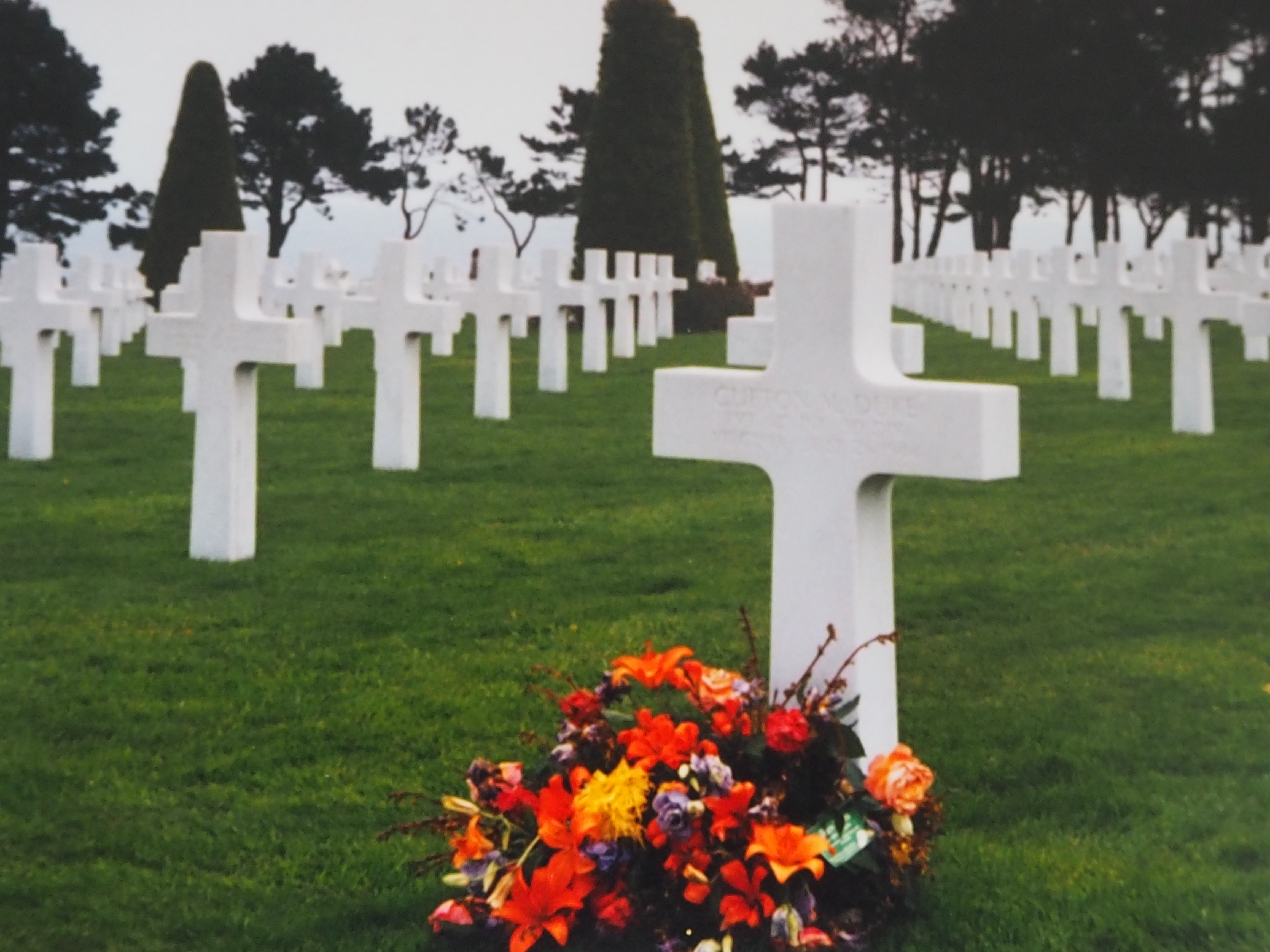
Rows of crosses give a moving and stark reminder of the events of D-Day at the American Cemetery Omaha Beach

Please Enjoy my Travel, Music & Ancestry Books on Amazon – FREE on Kindle Unlimited https://bit.ly/bookneal

Despite my love of history and the interest I have in the time period in France that covers the occupation and the D-Day landings it is not my intention to go over all the story. That has been well told many times by far better historians and relatively recently with the fascination with the 75th anniversary of the landings. All my writings are done with a desire to inspire you to visit the places we have loved over the years. What I hope to achieve is give you a sense of the atmosphere and the way these sites have an impact on us as visitors. With the war sites in Normandy the feeling that these are places we have loved is perhaps not the correct expression. You can love Provence. You can love Paris. You cannot love a cemetery at a place where so many lost their lives. You can however be moved.

The Normandy American Cemetery and Memorial in France, Cemetiere Americain,  is located in Colleville-sur-Mer, on the site of the temporary American Saint Laurent Cemetery. This was  established by the U.S. First Army just three days after D-Day on the 8th of  June, 1944. By definition of its location it was the first American cemetery on European soil laid out in World War II.

The approach to the cemetery and memorial is quite unusual and unexpected. As you get close to Colleville-sur-mer on the D514 you come upon a roundabout that is well tended and rather than being on a well-used coastal  road you feel in another place altogether. You could be at the approach to a upmarket Golf and Country Club, reminiscent of where the Masters is played in Atlanta, USA. What this sudden change in the landscape impels you to do is to turn left and not to carry on. You cannot just drive past this place, a site that is the most visited memorial site for Americans in the world. Turn left you must do through the wooded area where you can park your car and take what is one of the most extraordinary walks you will ever make.

There is a new visitor centre here now, opened in 2007, but that was some three years after our visit. The new centre tells the story of D-Day and Omaha Beach and gives the visitor a place to reflect and hear the recollections of many participants bringing those dreadful days to life once again. On our visit we just had the cemetery and memorial to contemplate but be assured that was more than sufficient to bring those days back into vivid perspective.

As you walk across into the cemetery you are confronted by row upon row of stark, brilliant white crosses. Every one perfectly laid out in unison so that whichever way you look down the rows they are in line, stood to attention. Initially this is just too much to take in and you sort of want to turn away and try not to look. We found ourselves drawn over to the memorial at the head of the cemetery and facing down a long straight manicured lawn that leads the eye between the two sides of the grave site. In front of the memorial is a reflective pool. There is not a sound, even the birds seem to have caught the mood and are silent.

The memorial is made up of a semi-circular colonnade that has a large inscription running around the upper curved part. Attached at either side of the memorial there is a loggia, and these contain large maps and narratives of the D-Day military operations and the subsequent breakout into the Normandy countryside. At the centre of the semi-circular structure is a bronze statue, “Spirit of American Youth Rising from the Waves.” You cannot help but reflect that sadly the place is dedicated to and contains the generation of American youth whose rise ended so abruptly and tragically just yards from this statue.

On the Walls of the Missing, constructed in a semi-circular garden to the east side of this memorial you will find inscribed 1,557 names of those who never had a last resting place. Some have been found and identified in the years following the construction of this memorial and those are marked by a Rosette against their names.

The cemetery site in front of you covers over 170 acres and contains the graves of 9,385 of American military dead, most of whom lost their lives in the D-Day landings and the operations that followed as the Allies broke out from the beachhead. The whole cemetery spread out before you is so impeccably laid out that it is somewhat dreamlike. Can this be real? In many ways it should not work as a memorial, it is too pristine and so far from the bloody horrors of those landings. Yet, it is that starkness, that total contrast with the events themselves that cause you to be so moved by the experience. It stuns you into silence. I have never been a place with so many other people and not been aware of any sound. No one speaks; they just silently walk through the paths, occasionally looking at the graves but not too often.

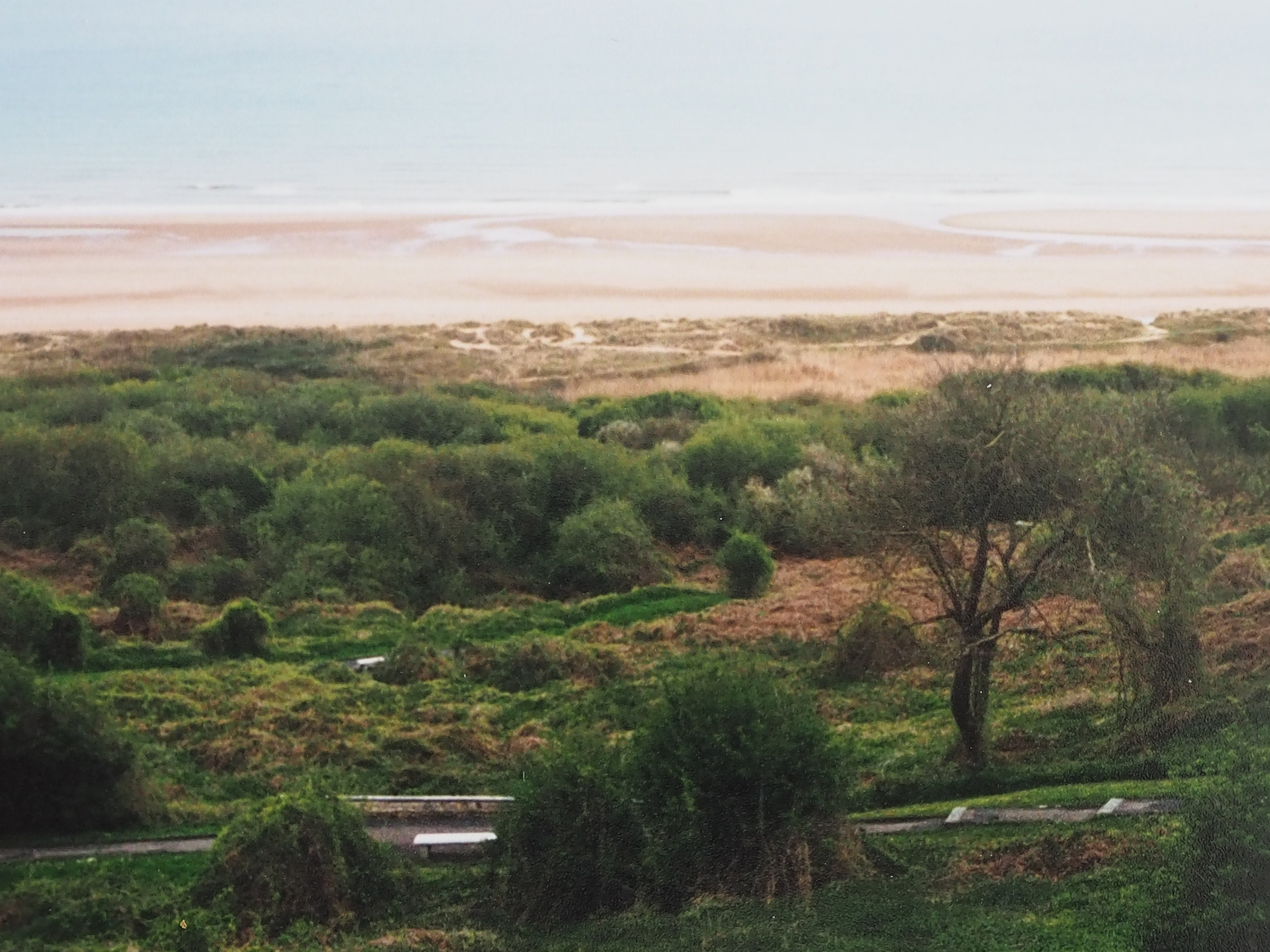
There is one more place that you have to visit and to do so you have to leave the flawless cemetery behind you and step through to an observation point overlooking Omaha beach. At its centre there is an orientation table that gives a battle view on a map of the scene as it was on the 6th of June 1944. The cemetery was very affecting, but it is here overlooking the beach that you feel the emotion of this poignant site. As you look out down to the beach over the grassy knolls you get a sense of the actually deadly dangers those young men faced. The beach is not wide but it is wide enough to know that it would seem a very long way to a soldier running towards a machine gun at the site of this observation point. It is then that it finally hits you that the men in those graves behind you are buried within yards of where they fell. This is as far as they got. It is that realisation which moves you to tears.

alt="Photo of American Landing zone at Omaha Beach Normandy"
The American landing zone on Omaha Beach Normandy

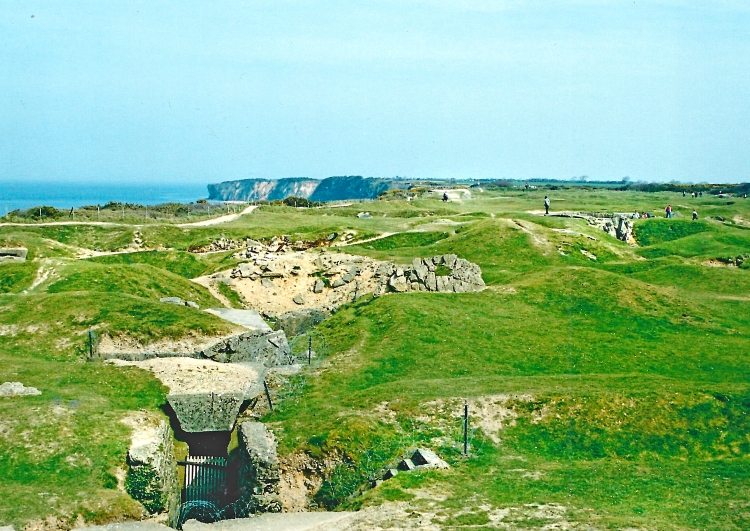
If you get chance after your visit then make your was along the coast to the dramatic spot of Pointe du Hoc. This extraordinary cliff was the scene of the famous action by American Rangers in scaling the cliff under heavy fire from above. The vital position was taken with heavy casualties. Visiting the sight it can only be concluded that such a thing was impossible but it was accomplished and was in allied hands. This was after some navigational errors made the task even more difficult by giving the Germans more time to prepare and the element of surprise was gone.

Alt="Photo of Pointe du Hoc D-Day battle scene by US Rangers"
Pointe du Hoc – scene of the daring assault by US Rangers on D-Day

This American Cemetery at Colleville-sur-Mer, is a place that I would say affected me almost as much as anywhere else I have visited. The only other memorial site that I find more intensely moving is The Mémorial des Martyrs de la Déportation at the eastern tip of the Île de la Cité in Paris behind Notre Dame. That one in Paris has a personal resonance for me so it should and does have a deep effect on me whenever I visit Paris. Unlike Paris the Normandy Cemetery does not have a personal connection to me but it is a place that stirs the emotions, and I will never forget it.

the deportation memorial in paris france is a poignant reminder of the horrors of the Nazi regime and the lights in the memorial show a memory of each person including Jehovah's Witnesses
Mémorial des Martyrs de la Déportation in Paris, France – A memorial to the more than 200,000 people who were deported from Vichy France to the horrors of Nazi Germany

This Paris Memorial commemorates Jews, Political prisoners, Jehovah’s Witnesses, Gypsies, Stateless persons, and other groups who the Nazi state desired to permanently remove from society. Many were still deported after D-Day and right up to the day of liberation. I would have been one of them. Few returned.

We look forward to the end of war and a peaceful world.

https://bit.ly/peacetocome

This chapter is taken from my book – OFF the AUTOROUTE

young girl fills water jug from a stone fountain unter shady trees in village in Provence

Canal du Midi Pezanas & a D-Day Veteran

Please Enjoy my Travel, Music & Ancestry Books on Amazon – FREE on Kindle Unlimited https://bit.ly/bookneal

tables and chairs on tiled terrace with stone wall and tiled roof
Our stay in Pezanas offered this beautiful terrace for breakfast

If you approach the Languedoc from Burgundy rather than from the Catalan or Carcassonne area there is a very definite change to the climate and to the countryside. It becomes warmer, drier, and more fragrant. If you can stop the car for a while away from the autoroute the ubiquitous sound of the cicadas will fill your head. It is a love it or hate it sound, loud and persistent enough to irritate but can also be strangely soothing. It will most certainly announce your arrival in the glorious south.

This is a first time in Pezanas for us, in fact, we had previously only passed by or through the Languedoc region on our way down to Perpignan and French Catalonia. It was an opportunity to become more familiar with this area. Pezanas is an old town that draws on a glorious past with some stunning architecture. One thing you notice is that the town has many fine private mansions sitting happily alongside the characterful buildings of the old town. It is to one of these that we had booked a three-night stay as a detour on our way to the Lot region.

The Hotel de Vigniamont is a luxury bed and breakfast 17th -century Hotel particulier located in the heart of town. It is a fine and quite extraordinary building and Pezanas is blessed with many such examples of period French charm. One thing that you cannot avoid being impressed with is in front of you soon after entering through the heavy carved original door. In the centre of this multi-storied building is a beautiful open courtyard, something you are more likely to encounter in Morocco. It takes your breath away and can make you quite dizzy trying to crane your neck to look up towards the sky. Later in the stay it displayed itself in pure dramatic theatre when a sudden thunderstorm sent water cascading down inside the property. Exceptionally clever drainage took the water away from the living quarters.

In sympathy with the grandeur of the building the rooms are furnished in period style. Our room was exquisite, with the focus of the room centred on a beautiful carved Parisian oak bed. We would sleep well. I am sure you can do your own research on Trip Advisor to check my happiness at being in such a place, especially after a long journey.

Our intention was to explore Pezanas in the evening to discover a local restaurant. Before heading out into the night we had been invited by our lovely hosts to join them in the grand salon for an aperitif with a couple of other guests. It is certainly a grand salon and would have seen some fine dinners stretching into the night over the decades. It was not difficult to imagine the scene in this room a couple of centuries ago with the ladies’ beautiful hair and makeup complimenting silk finery, hopefully outdoing the gentlemen’s fine hair and makeup. Tonight, we are all feeling just a little casually dressed, but our hosts, although having made a little more of a sartorial effort, put us at ease.

The main reason for them entertaining us was to acquaint us with the dish that Pezanas is famous for – the small bobbin shaped petit pâté de Pézenas. Legend has it that this tasty little treat was first brought to the region by the Englishman, Lord Clive of India. It is made of a thin raised pastry case containing minced lamb or mutton, delicately spiced and slightly fruity. They are delicious and morish but also an appetite suppressant, so we did not eat too many before dining out. Accompanied by the local Picpoul de Pinet white wine it was an excellent start to the evening. You may not be at all surprised to learn that there is a festival to this tiny pie here in Pezanas. It seems that all regional food has its own local celebration and often its own appellation to prevent any devious foreigner stealing it. However, it does appear that this one is English anyway, so I have no qualms about baking this back home. Why the National Trust at the home associated with Clive, Powis Castle, do not make a feature of serving this in the tearoom I am at a loss to understand. I would prefer it to a cream tea.

Alt="Photo in the evening of a bar in Pezanas France"
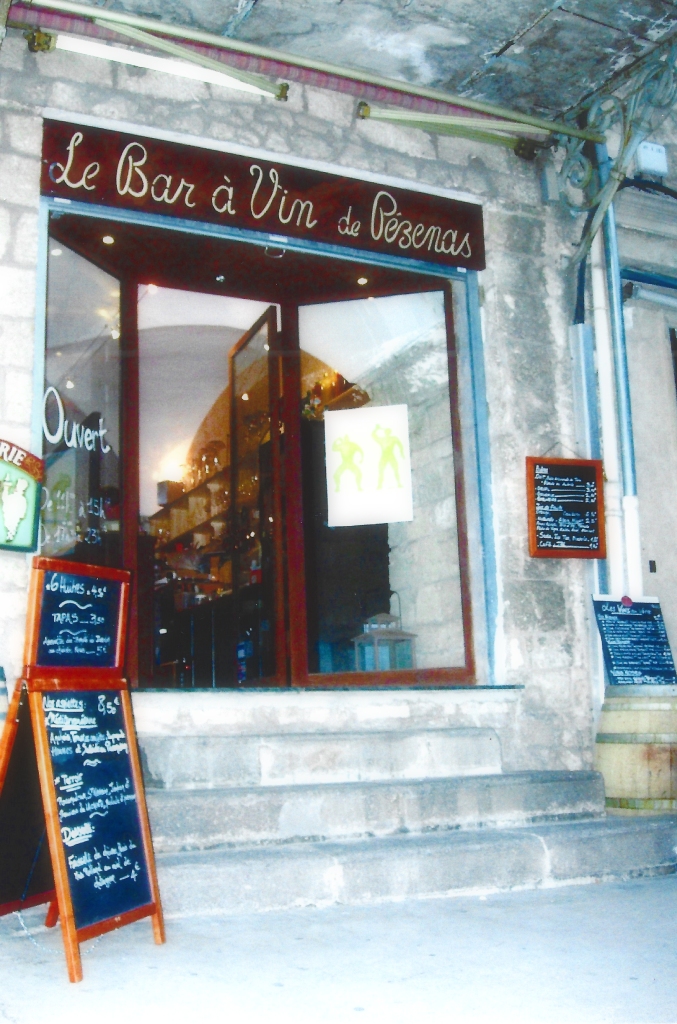
Evening bar in Pezanas France

Pezanas town has a different persona when you view it from street level on foot. It is quite multi-layered. Grand buildings as we have seen but also a faded charm in other areas all culminating on a lovely central square with cafés spilling their tables out onto the cobbles. The architecture heads skywards with many streets being narrow with a medieval ambiance. It does not take much of a leap of imagination to visualize the locals emptying their refuse and worse from high windows into the streets. Fortunately, that practice has long died out and the old streets are filled with artist studios and cafés.
Of course, you will also always pass by a bakery making the famous pies.

We chanced upon an interesting restaurant that specialised in serving fish and seafood cooked a la plancha. It suited our mood and so it proved. The interest though was not just food related but in the layout of the interior. The walls appeared to me more of exterior style than the usual charmingly decorated interior you might expect. If you managed to turn your gaze upwards it soon became noticeably clear as to why this was. Above us was only sky to quote a famous Liverpudlian. Exterior was the new interior in Pezanas. Fortunately, the sky was clear tonight, the atmosphere was warm but being pleasantly cooled by all this exposure to the elements.
We enjoyed a tasty well-cooked meal that was served by a charming girl of the south. A memorable travel experience, nothing fancy it is true, but quite preferable to a fancy Michelin star restaurant tonight.

Of course, we slept well. Morning brought another interesting encounter.

Sometimes you are just in the right place at the right time, and as so often in France, this early morning was one of them. Breakfast is taken at the hotel on the sun terrace at the very top of this building. As is common in France we are offered a seat at a large, shared table. I am a little taken aback as I make my first impression of our breakfast companion.

The only way I can help you to visualize this scene, and in absolutely no way do I mean any disrespect, is to say that this tall elderly man looked for all the world like Jed Clampett from the Beverly Hillbillies. Large red braces contributed to this first impression. He was a man from the mid-west of America and had been a farmer. One had to admire this man and his wife to be travelling so far from home at an age where most have given up on such adventure. They were a charming couple, but it was his past that intrigued. Yes, they had come south to enjoy the climate and see some history, but it was to Normandy that they were heading and that was the main feature of their visit. He was a D-Day veteran and I do have a fascination with that time period, often visiting the region ourselves. I cannot say what we had for breakfast or how good it was because this man had me spellbound. What a privilege to meet someone who had shared and survived such history, a pivotal moment of the 20th Century. They had to press on unfortunately as they were headed to Montpellier for a flight to Paris. I could have talked to him all day long. The joy of travelling and making the effort to engage with people can throw up some special moments.
This was one of them.

That was a wonderful start to a morning that would throw up an awe-inspiring sight later in the day. The countryside of the region is soft and mellow, gentle mist over the canal and fields taking time to evaporate as the sun becomes warmer. It is a driving landscape at its best. Our destination is a legendary one, a place we had heard so much about but never seen. Fonserannes Locks or the Fonserannes Staircase is a formidable and surely on first impression an architecturally impossible structure. The engineer fashioned a system in which barges can travel up and down the seven chambers of the staircase raising boats around 22 metres in height over a distance of 300m. This engineer, Pierre-Paul Riquet, achieved this staggering accomplishment in the 17th-Century, well in advance of the modern day heavy industrial construction equipment we use nowadays. His right-hand men who took on the challenge were two brothers – Michel and Pierre Medailhes. Standing at the base of the structure the feat is simply incomprehensible. One of the finest pick and shovel enterprises known to man. The chambers are large and can hold more than one vessel – and yes there are seven of them. I cannot imagine how they all felt when the finished the first of them and looked beyond to the summit knowing there were six more to dig and fashion. It is one of the wonders of France. Please pull off the autoroute and be amazed.

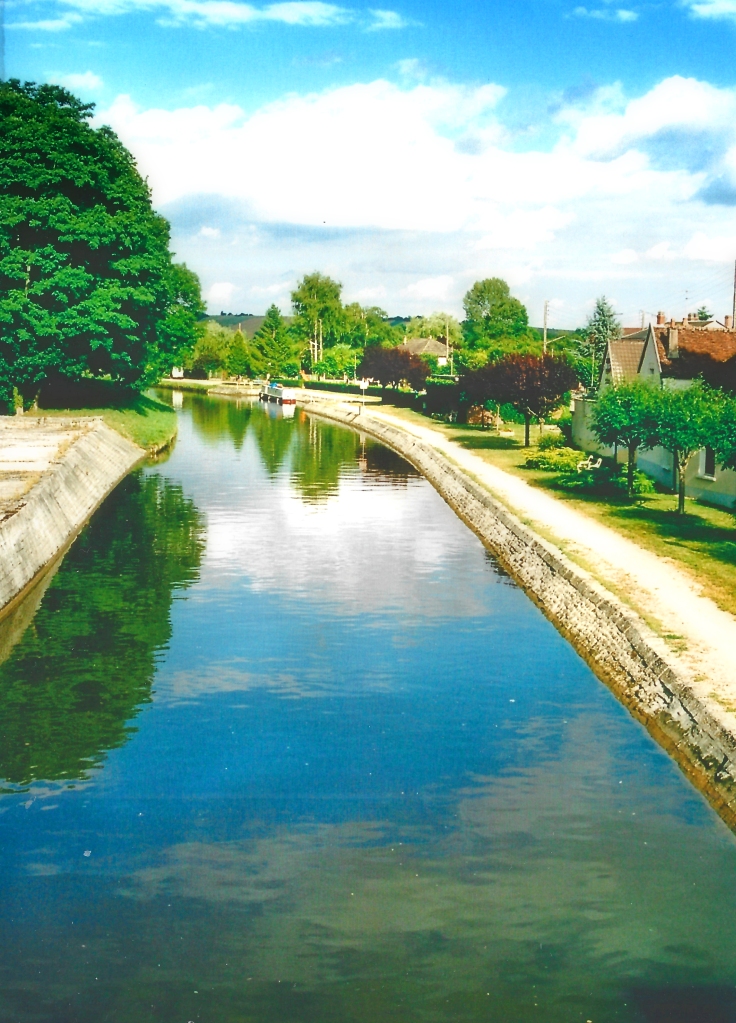
Alt="Photo of the canal by Accolay Northern Burgundy"

I have always had a feeling that I would one day like to drift by boat along this famous canal. Inspired by some attractive and bucolic journeys in sugar coated documentaries it always seemed the idyllic way to spend a holiday. Our visit, although totally memorable, dispelled any dream I held of ever doing this journey. The canal gently curves around the tree lined banks to meet the first lock. This morning a substantial barge, carrying as it turned out a group of German tourists, glides through the lock gates. The canal is silky calm, but these lock chambers are not. The power of the water of seven substantial chambers being emptied and refilled causes turbulence reverberating down the staircase. This barge is tossed around in this whirlpool bath. We are part of quite a crowd of people observing the scene. I feel like one of those people that curiously stop at an accident on the motorway. On the side of the barge just alongside the wheel a lady is endeavouring to attach a rope to a bollard on the bank to secure the vessel. At one point her leg is over the rail of the deck as she leans over as the barge is forced downwards and then upwards towards the lock wall – I cannot look. She survived, as did her leg, but it was a terrifying sight. I suspect the occupants had not listened as closely as they might have done at the training briefing before setting off.

However, the Canal du Midi is not for me – not on it anyway.

village scene in Provence France with book covers of five french travel books and barcode to amazon kindle
Available in Print or for Kindle on Amazon
Vinyl music records stacked togerther on a music book cover
Enjoy a travel back into time with my Vinyl record Collection

Perpignan, French Catalonia and our Café

Please Enjoy my Travel, Music & Ancestry Books on Amazon – FREE on Kindle Unlimited https://bit.ly/bookneal

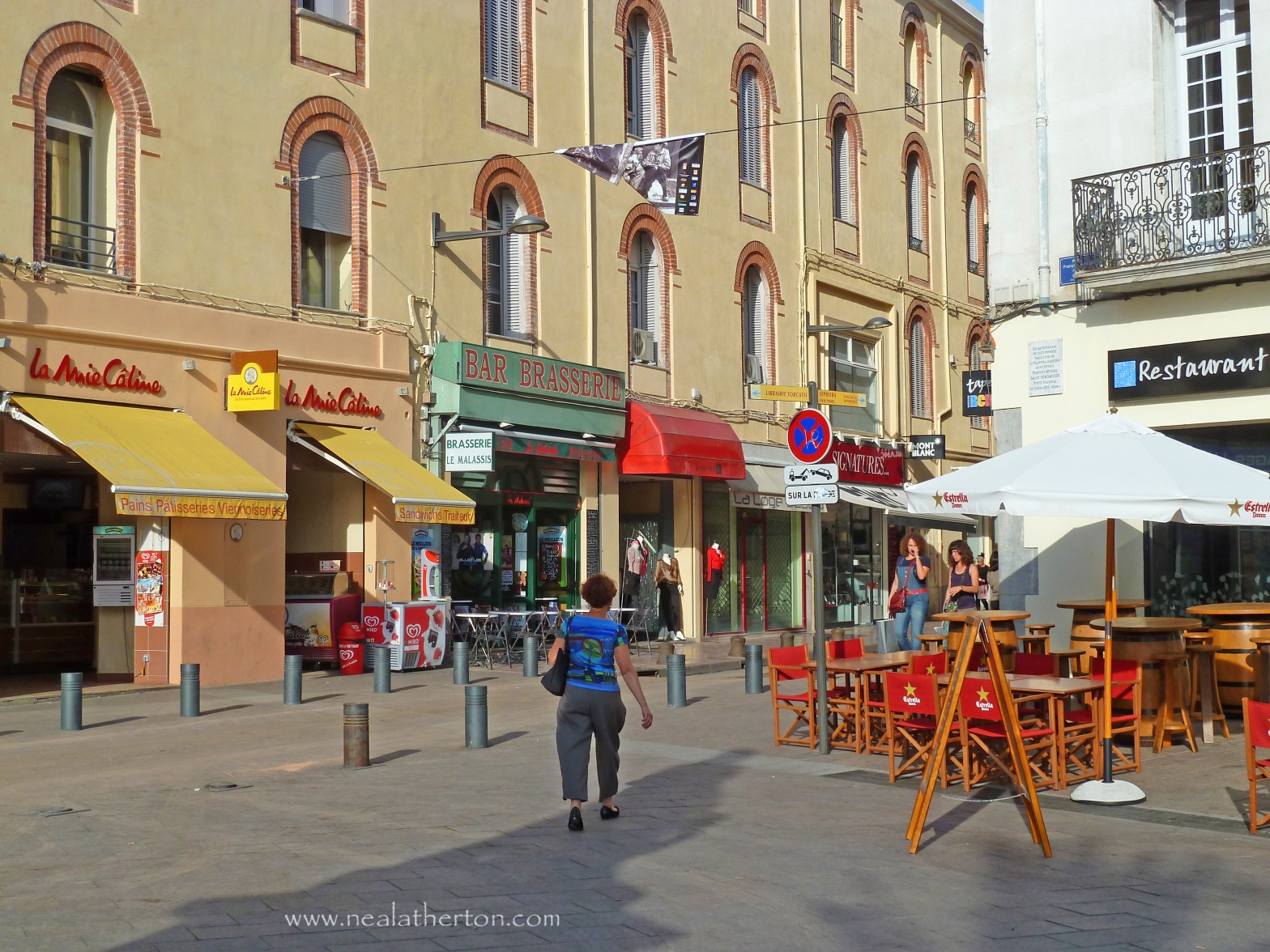
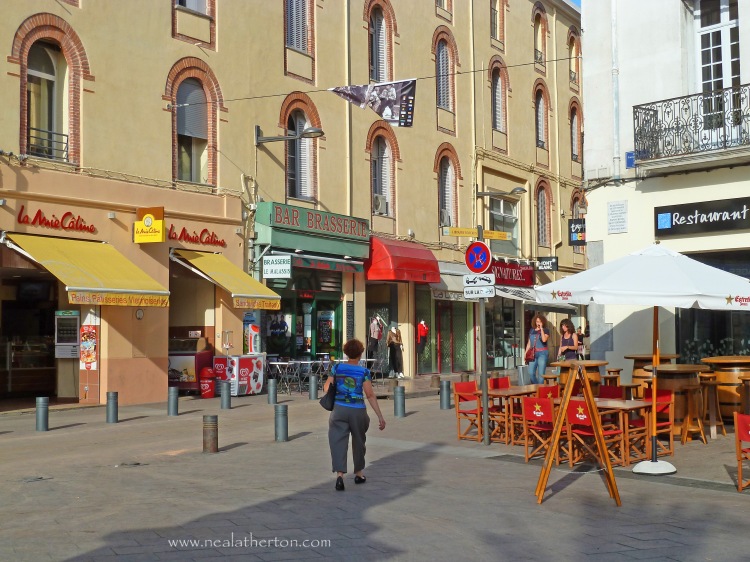
Alt="bar restaurant le Malassis in the southern French town of Perpignan"
Where our French adventure began – Le Malassis Bar Restaurant Perpignan

The area around Perpignan in French Catalonia is where our travels all started around twenty-five years ago. It is a short hop from Provence so let us see what we found there starting in Perpignan or Perpinyà as the Catalans call it – I advise you to do the same.

Walking down a bakingly hot Rue Alsace Lorraine in Perpignan I was feeling deeply sorry for myself. Quite rightly I was extremely guilty about all that my family had endured as this, their first French holiday, had started so dreadfully badly. That part of the story I covered in detail in my first book.

On the right-hand side of this narrow street, we came across Le Malassis, a small typically French, Café bar. It shone out to our bedraggled party like the oasis of calm and welcome that we so desperately needed. For us, this fine little café and its owner would become the turning point towards a lifelong love of France, its food, wine, culture, and people.

A small red metal table and four chairs were available on the narrow pavement terrace. Seated at the next table were two young Japanese tourists engrossed in their camera. We were more than delighted to sit at the available table. The chef patron was leaning nonchalantly on the doorframe of the café. He was taking a mid-morning cigarette break but keeping his chef’s hat, his toque blanche, firmly on his head. My exposed and I suppose I must admit it, a head that was now rather lacking in top cover, was swiftly heading towards the colour of a London Bus or a glorious Languedoc rosé wine. Monsieur Le Chef headed languidly over from his station at the door and looked pityingly at my once pale Lancashire complexion. He slowly took off his toque and placed it firmly on my head to protect me from the blazing sun.

​Two words were all he said, ‘Tete Rouge.’

Now France made sense, my mood transformed.

Yes, I was going to like this place, the café most certainly, but I would soon grow to love France as a travel destination and especially its people. From that moment on I always have, but these first moments in Perpignan will always remain special. We will often return in years to come to Le Malassis and the delightful M. Argenson. We will spend many happy times in his delightful café with his generous warm hospitality, until one day when we found Le Malassis shuttered up and closed. When we visit up until that final time we are remembered and greeted as friends rather than merely customers.

Le Castillet Perpignan South West France

Let me explain why.

From the open doorway we tentatively peer inside the restaurant and see the busy M. Argenson cooking inside an extremely hot steamy kitchen with his African sous chef working alongside him. M.Argenson’s rather formidable wife is waiting behind the typical well stocked old wooden zinc-topped bar just to the right of the entrance. A friendly, and can I say on behalf of my son, a stunningly attractive young waitress, immediately comes up to greet us. This is a fine start and Le Malassis is just the sort of place I had hoped to find on our first exploration into the art of French dining.

We are seated at the allocated table and yes, it does have the expected check tablecloths and yes, the waitress does immediately bring a carafe of water. It is all so stereotypically French – it is delightful.

I take off my cap, oh, sorry no I still haven’t got one.

I begin to mop my brow to the amusement of M. Argenson who is looking over his shoulder at our party from the kitchen. He comes out after having handed his hot pan over to his assistant he warmly shakes my hand and reserves his kisses for the ladies. Although the waitress is attentive and capable, he is happy to explain the menu himself and then hand us over to the young lady, not before insisting we have a carafe of rosé wine for the table.

We have already decided on what we wish to order for lunch and the charming mademoiselle brushes a slender hand across her hair as she first asks our son what his heart’s desire is. Unfortunately, and entirely due to her extreme attractiveness, he is unable to speak. This condition applies to English as well as French, so I quickly step in and decide to order for him. He has already resolved that he would happily stay here and follow her life’s journey but sadly this must be a brief encounter. How many times does that happen in France?

For myself, I order conservatively and safely for my very first French meal – omelettes fines herbes with a bowl of frites. Excellent choice.

Niamh orders a goat’s cheese salad. I am not really a fan of goat’s cheese. For me it is too goaty. Oh, come on you know what I mean.

Niamh loves this pungent cheese and especially the intense French versions of this variety which varies in flavour and strength from region to region. You will find that goat’s cheese in France is just as popular as Cheddar cheese in England.

Our daughter Charlotte plays safe also, and orders a croque monsieur, which is basically a ham and cheese toastie although the French tend to try to elevate it to a higher gastronomic level.

I see my omelette being rolled for plating and when it arrives it is simply perfect. One of the benchmarks that many famous chefs use when deciding to hire a new chef in their kitchens is to test how well they can cook an omelette. Get it right and they get the job. Cooking the perfect omelette is not as easy as we amateur cooks tend to think and no doubt like myself you have had or made some firm rubbery ones in your time.

There are no mistakes here, this omelette is superbly cooked, just on the point of being set and a little gentle in colour on the outside, still soft and oozing at the centre, flavoured with an excellent balance of herbs. The fresh green herbs are as is usual in this French omelette – parsley, chives, tarragon, and chervil. Delicious.

The omelette is accompanied with a bowl of the absolute best French fries I have ever tasted. No, I must insist that they must be the best anyone will ever have tasted. Charlotte certainly thinks so as she keeps taking a handful from my bowl as her meal has not come with any such accompaniment.

All the while M. Argenson has been observing the scene and watching her stealing my fries. Then he busies himself once again in his kitchen. Within a few moments he comes out from the open kitchen to our table carrying a large bowl of fresh fries and places them down in front of Charlotte. Her eyes light up in delight and so does his at seeing her obvious pleasure and her thanks for getting such a treat.

Le Malassis is a generous place that is full of warmth and pleasure. As I have described this meal you can appreciate that it is in fact only a simple lunch, but this restaurant firmly sets a standard for us to use on our future travels. Thankfully in the intervening years we have found many such places throughout France. These café/bar/restaurants will be quite humble and generally run by one chef who will deliver the most pleasingly simple food reflecting that particular region and punch well above their weight in giving pleasure to the diner.

In between all this frites activity Niamh’s goat’s cheese salad had been brought out by M. Argenson. I have to say it was hard to ignore the huge smile on his face as he presented this dish in front of her. As he set the plate down I recoiled in my chair as if someone had just sprayed some ammonia or incredibly strong bleach on the table. The strength and goaty power of this cheese was breath-taking in a very literal sense.

His smile said it all, ‘You like goats’ cheese, well let’s see how you get on with this one – Ha.’ (The smile was in French)

He turned and headed back to his open kitchen, his broad shoulders rising and falling with laughter. He and his able assistant were giggling like two young schoolchildren who had just placed a whoopee cushion on the teacher’s chair.

I said at a moment when I could breathe:

‘There is no way in this world that you can eat that. I don’t think I can even stay sat next to you with that on the table. It needs to go outside.’

Niamh said, ‘I can, and I will, just watch.’

Do you know what? She ate every single morsel of it.

How she did that I will never know as I can say categorically, I could not even have tried a small bite of it.

The kitchen audience looked on as Niamh unhesitatingly ate the dish, a smile of pleasure and satisfaction on her face, a smug face that was turned in the direction of the kitchen. Absolutely no sign of the immense pain I was sure she must be in. She genuinely was not at all discomforted. She enjoyed her meal and looking back she has eaten more similar strength goat cheeses over the years, and I have had to sit there observing and taking in the aroma.

This incredible culinary feat of Niamh showed M. Argenson and his staff that it was our intention when here in France to engage with their food and culture. Along with our attempts at speaking French it sealed a lasting friendship as we continued to return over the years to this café bar, always welcomed and recognised even though it could be a couple of years in between visits. By contrast, you can visit a supermarket café in England every single day of the year and order the same thing and be asked by the same person on every subsequent time as to what you want without being offered a flicker of recognition. That makes the level of service at a humble place such as this so lovely and rewarding, something you will happily travel a long way to keep experiencing.

After finishing our carafe or two of local rosé wine and our ice cream desserts we bid a warm farewell but assured them all that we will return later in the week and of course we do, repeating almost exactly the very same meal we have enjoyed on this our very first meal in a French restaurant.

Quiet courtyard in Perpignan South West FRance

The time this Saturday is getting close to two o’clock by now, but the shops are still closed except for a rebellious cheap clothing store just along the street and also the pharmacy next door to the café. Presumably, people need indigestion tablets at lunch so some exceptions can be made.

As we turn back into Rue Louis Blanc we hear the unmistakeable sound of a jeweller’s clock high above his window and then the shop front shutters crashing back upwards signalling that all shopping can now restart. Everyone has been fed and watered, people are a little sleepy perhaps, but they will try to serve you with your intended purchases now. To us it is very odd how all this routine works. For a full two hours the whole activity in the centre of Perpignan comes to a stop except for the pavement cafés. Then precisely on two o’clock it is as if time restarts and the whole place is once again alive and vibrant with shoppers and the pleasant hum of people finishing their long lunch.

This is not the English way but then again this is the beauty of travel and even at this early stage in our travels it is clear that you will always get the best out of your trip by embracing the local culture wholeheartedly. A carafe of chilled wine at noon is certainly a fine incentive for me to stop shopping, not that I need much incentive. Another carafe at two o’clock would encourage me not to restart.

We begin to explore down the side streets that lead away from the centre of the town and come upon the Serge Blanco clothing store. This was launched by the famous French Rugby Union full back, a sport I love to watch, and I have admired his style of play over the years. The great man is actually stood outside the store, but I still do not trust my French language skills sufficiently to approach him. On this visit to Perpignan his brand is in its infancy, but it goes on to be an expensive global brand. Should have got the shirt.

While I am distracted, and star struck, Niamh and Charlotte manage to find yet another jewellers shop. That is not too difficult here in Perpignan, famous for its fine garnets. If there is one speciality store that Perpignan is not short of then you would have to say that it was jewellers and there are lots of excellent ones here. This one that the girls have now found specializes in Lalique, that very high-quality French glassware started by Rene Lalique in Paris in the late 19th century. This jeweller sells a range of necklaces and earrings created by Lalique and it is understating it to say that the girls find these baubles incredibly attractive. Once more the service in the store is very attentive but without making you feel overly pressurised, and it is not long before a purchase is made. The opaque azure glass necklace and earrings are unarguably beautiful and by the standards of today’s Lalique prices these turn out to be a sensible purchase. These gems are still as beautiful today over twenty years later.

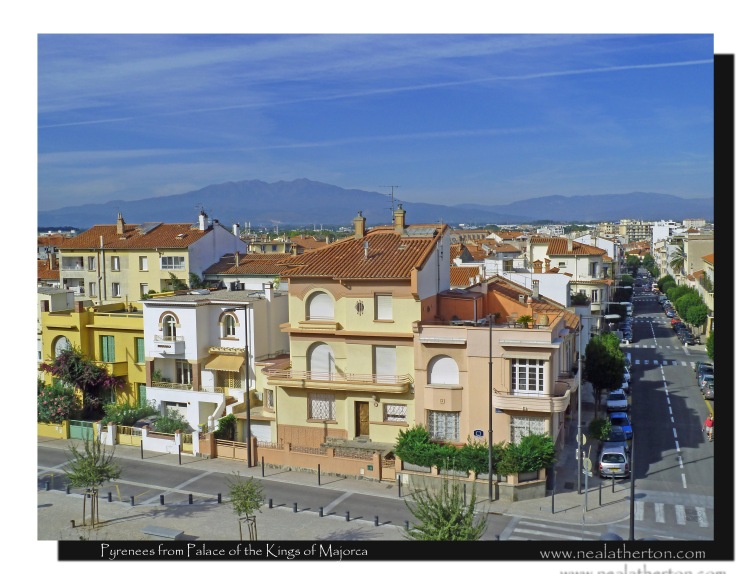
View over to the Pyrenees from Palace of the Kings Perpignan France

Recalling now that previously mentioned final visit.

That would be about ten years after our first visit when we came to Les Malassis to find the little café all shuttered up and secured. There was a small sign on the window just visible through a gap in the shutters.

As my French had improved over the years, I perceived that M. Argenson had died recently.

We were devastated at this unexpected news. I would have placed his age at about mid to late sixties but he seemed so fit and full of life, although it was clear that smoking was one of his main pleasures in life. I went to enquire after him at the chemist shop next door and they confirmed that he had indeed passed away.

It was the end of an era for us, this place had filled us with the hope and confidence that we could travel more extensively. It succeeded totally in doing that and we would never forget the kindness of M. Argenson and the sheer simple joy of this humble place that had no pretentions above its station but spread an abundance of bonhomie and offered great simple food. Our landmark café has reopened but we have never returned.

The memories are of a place in time and must stay that way.

Books of French travel guides

Cordes Sur Ciel and a whole Lot of rain

Please Enjoy my Travel, Music & Ancestry Books on Amazon – FREE on Kindle Unlimited https://bit.ly/bookneal

alt="New French Travel Guide Book Off the Autoroute"
OUT NOW on Amazon for Kindle, Kindle Unlimited, paperback & hardback

This excerpt is from my French travel book – OFF THE AUTOROUTE, the fifth in my Series of French travel memoirs. Please enjoy on Amazon including Kindle Unlimited.

It will take you on a tour of France from Calais to the South and back through Brittany and Normandy.

Arifat Bed and Breakfast in medieval Cordes

It is time to move on, and this time to a new region for us – Lot et Garonne.

Our destination was the town of Cordes Cur Ciel, and our visit coincided with the nearing completion of the astonishing bridge, the Millau Viaduct. The earthworks and operational area for the bridge extended for miles around the site. It forced a slight detour as we came down from the height we had travelled on to wind our way carefully down into the valley below. This incredible feat of engineering, one of the most astonishing in the world, spans nearly 2500 metres above the valley below. As we travelled around the construction area, we felt exceedingly small indeed, sharing the area with some enormous construction vehicles. The road deck is suspended around 250 metres above the ground. I recall watching a documentary on the construction process, marvelling at how they actually pushed the road deck out from the end of the bridge into the void to traverse the viaduct piers. It is amazing engineering and a shared design of the English architect Norman Foster. It would be a few years before we had the opportunity to travel over the viaduct, which we did heading north up to the Loire valley. Niamh does not recall it at all – she had her eyes firmly closed as I drove across. I also barely recall the view as I just kept my eyes on the road, it is a long way down if you manage to crash over the side, but on reflection I think the safety features would have prevented that.

We eventually made our way to Rodez and on to Cordes as the rain started to pour down. Little did we know that it would not stop for the entire length of our three days stay. I was attracted to a beautiful property called Aurifat situated just outside the ancient walls, with a view overlooking the valley below. Standing at a viewpoint below the property you get a real understanding of the multi floored medieval property. It sits well with the old town architecture framing the backdrop behind the house. Cordes, with its ancient narrow streets, is a special challenge for a car driver. Eventually I threaded our way through to Aurifat and carefully took the car down to a parking space. The property has changed hands since our visit and now has Dutch owners who have maintained its fine reputation. Ian Wanklyn and his wife Penelope were the charming owners at the time we visited. They greeted us hospitably and urged us to get out from the driving rain and into our cosy room for the stay.

Ian and Penelope are comfortable hosts, not intrusive, but always available to ease your way into a new area of France. They show us the kitchen that is available for the use of guests. Hopefully we can use this later but just now the torrential rain is intruding into this summer kitchen and a stout pair of wellingtons may be needed to cook my fish supper. At least I can keep the wine above water.

Sadly, the rain will not stop at all for the three days we spend at Aurifat. Our visit to Albi, that beautiful, colourful cathedral town is curtailed by our being soaked, even under a substantial umbrella. Exploring Cordes is done by dashing from shop or restaurant doorways, but you could argue the rain adds to the atmosphere of this ancient town. We manage a couple of visits to wine makers, producers who are getting increasingly concerned with the potential damage being inflicted by this extraordinary, extended downpour. We find one activity that will give pleasure when we get back home. At the end of the drive to Aurifat there is a large, mature walnut tree. Under its spreading bows we can shelter, taking the opportunity to gather as many walnuts as we can. A large boxful is filled and as long as we can dry these, and keep them dry, they will be much appreciated back home in England.

As we peer through our steamed-up car windows the region does seem to be a very interesting area, one that is crying out to be explored. We do have accept defeat on this trip however, one day we will return, and explore this region when it is no longer under water.

A stormy day on Cordes-sur-Ciel

On our final rain-soaked day we endeavour to make a final attempt to take in the fascinating architecture and character of Cordes. As the rain penetrates every part of our skin, through completely sodden clothes, it is obvious we must get inside. At least the rain is warm, hot almost and there is the possibility it will steam dry when indoors. Being after twelve noon it seems the sensible thing to find a place to eat and enjoy a fine bottle of local wine. There must be a final compensation to this somewhat ruined visit to this historical area. We shall not be beaten. Cordes sur Ciel is home to a fine gastronomic restaurant – Le Grand Ecuyer. This is the flagship restaurant of Yves Thuriès, a giant of French cuisine. This restaurant leads the way in the region and regularly entertains celebrities, prime ministers, and even English royalty. Sadly, I do not feel it will be serving us today. I am inclined not to make an inevitably large puddle in such an eminent establishment. Fortunately, Yves Thuriès also owns a bistro in Cordes. Hostellerie du Vieux Cordes – I do feel they may allow us to dry by the fire. The narrow streets, running freely with streams of water, eventually lead to this bistro. We crash through the door seeking shelter and feel very intrusive and inappropriately attired for what is, although a bistro, undoubtedly an upmarket one. Our cagoules do indeed with remarkable rapidity leave a shining expanse of water in the foyer.

‘Do you have a table for two?’ I ask, expecting to be shown the door rather than get an answer in the affirmative.

‘Of course, Monsieur’. Follow me.

For a bistro the establishment is very well presented. If this is his bistro, how fine is the main restaurant? Glad we did not risk desecrating that one. The maître d’ shows us to a large, very large, round table, sort of King Arthur style and size. Niamh I can see in the distance, opposite me on the other side of this vast structure. I cannot imagine what we look like, tiny dots at the vast table, still dripping water onto a beautiful carpet and now to cap it all a gathering cloud of steam above our heads. Oh, and my glasses are steamed up – where is the menu?

But, we are slowly starting to dry off. The food of course is cooked to order, giving us more time to disperse the water from our bodies. By the time it arrives we are almost comfortable. The food as you would expect is extraordinary, fine local produce cooked to perfection and presented with immaculate aplomb. At last, it has been worth the long journey and the endurance we have shown in the face if this almost Biblical storm of the last three days. The best though is yet to come – the dessert. Our charming waiter explains that the chocolate fondant with crème anglaise will take around thirty minutes to prepare and cook to a state of complete perfection. Although he didn’t add the last part it does apply to the dish presented to me half an hour later. We have eaten often and well of the produce found all around this wonderful country. Memorable as many dishes have been there is occasionally something that forces its way to the top of the charts as regards the best dishes you have ever eaten. This was one of those and so extraordinary fine was it that I feel on reflection it has never lost the top spot. As we all know chocolate fondant is the easiest way to crash and burn in the kitchen. It takes a special talent to get it to perfection. Now that I was almost dry, I was able to fully appreciate this moment. Cordes – we will come again even if you send another downpour on me.

During our meal the dining room had filled up with a large party of elderly diners. The ‘facilities’ here were down some steep winding stairs that we could see from our vast circular vantage point. They were well used. Still to this day Niamh and I are convinced and still smile about being convinced that we counted one less back up than went down. Will we ever stop people watching? Probably not.

There is a perverse curtain call to our stay in Cordes. As we left the town to journey on, there was an amazing sky stretching out in front of us. From the dry enclosure looking out at the torrential rain crashing onto our windscreen you could see the end of the pitch-black clouds. Beyond the cloud line was a bright blue ribbon of sky on the horizon. We reached the edge of the region and as we crossed into the Langudeoc before heading North the rain stopped. A few miles farther on and the straight edge of the cloud canopy was passed, the sun burst through, and we never saw another cloud for over a week. This bizarre few days display of natural forces gave way as if by magic to the most wonderful summer weather. Just what we expected in the Lot as well, but the visit was still memorable.

It always seems a shame to just head home, that mad dash to Calais and the ferry that so many English tourists seem to take to end their stay in France. Rather let us take our time as travel through Brittany and along the Normandy coast, reaching Calais refreshed and well satisfied with our grand tour of France.  The drive up through France to Brittany is a pleasant one, taking in some high-level pasture and occasional signs of past volcanic activity. In fact, there is a grand stopping point on the Autoroute where you can have a panoramic view of the Auvergne volcanoes. You find this by pulling into the Aire des Volcans d’Auvergne on the A71 just noreth of Clemont-Ferrand. Beats Newport Pagnall anyday. It is an expansive landscape and one to put in the memory bank for a future visit. Driving north on the western side of France the roads are relatively quiet and delays virtually unheard of.

Please Enjoy my Travel, Music & Ancestry Books on Amazon – FREE on Kindle Unlimited https://bit.ly/bookneal

Books of French travel guides

The Angels Share – Wine Tasting in Beaune France

Please Enjoy my Travel, Music & Ancestry Books on Amazon – FREE on Kindle Unlimited https://bit.ly/bookneal

Alt="Photo of Vaison in Provence France and French travel guide books on Kindle"
Tour France with me

Burgundy – The Angels Share

 Our stay in Beaune as the centre point of our introduction to Burgundy was at the Hôtel Henry II Rue du Faubourg Saint-Nicolas, 21200 Beaune and a fine place to stay it proved to be. Beaune centre was a short stroll away and this would become a town that not only would we become very familiar with but immediately it would become a favourite ville in France. Once settled in the hotel we struck out on our own to explore the ancient streets of the wine town but never as yet finding the confidence to go into the many shops filled with the wines of the region. Especially intriguing are the bottles originating from the Hospices de Beaune with their hefty price tags – we still had a great deal to learn and we needed assistance. The ancient town of Beaune is the hub of the wine trade of Burgundy. Beaune as an appellation is an excellent one in its own right but of course is surrounded by many very famous village and commune names. Beaune is a beautiful town, full of attractive and interesting architecture and you need to explore inside the ancient walls of the town. Take time to walk along the many cobbled side streets, taking slim entrance ways to seek out the numerous fascinating narrow passageways before concentrating on the main event in the centre of the town – L’Hôtel Dieu.

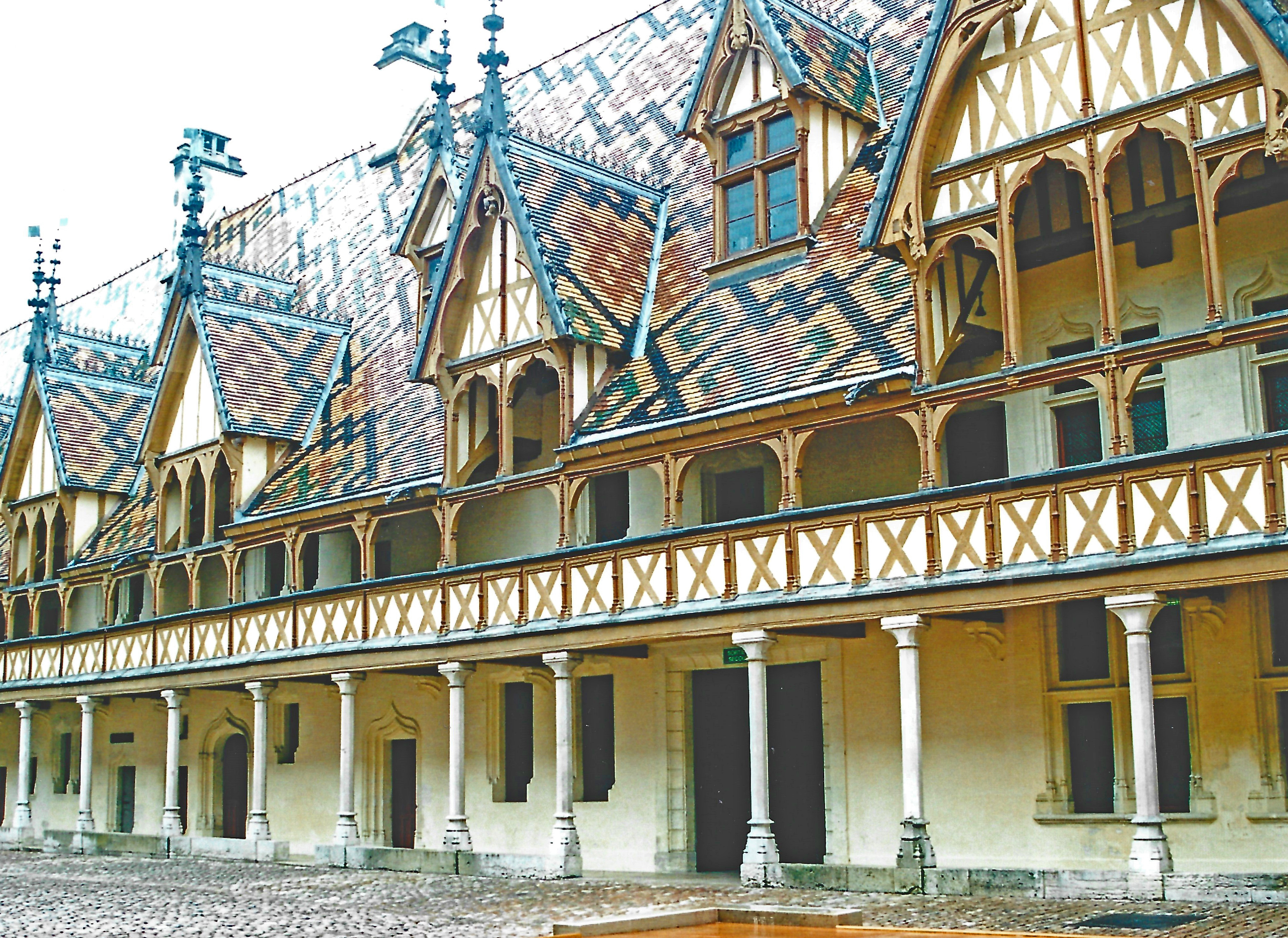
the hospice de Beaune is the scene of the yearly wine auction of Burgundy wines
Hospices de Beaune or Hôtel-Dieu de Beaune

This charitable hospital was founded in 1443 by Nicolas Rolin, chancellor of Philippe le Bon. Rolin is a name you will still see associated with winemaking in the Côte d’Or vineyards. This building is of high gothic architecture, it reflects the strong bond between Burgundy and Flanders. Its multi coloured polychrome roofs along with the golden colours of the Last Judgement altarpiece by Rogier Van der Weyden have made this standout building famous. This medieval hospital also contains a multitude of other treasures including the great “Salle des Pôvres” with its highly sculpted and decorated ceiling, a gothic chapel, the pharmacy housing a collection of pewter and earthenware, the kitchen boasting an automated rotisserie. The Hospices de Beaune charity wine auction has taken place annually here at the Hôtel since 1859, and falls on the third Sunday in November as part of a three-day festival purely devoted to the food and wines of Burgundy – a festival known as Les Trois Glorieuses. The parcels of land relating to the hospital itself are owned as a non-profit venture and the wine auction can set high prices that go to charity but also become the benchmark guide as to the prices expected for that particular year’s vintage. The three days are a joyous but highly prestigious occasion and to partake in the bidding would not be for the fainthearted. We would be wined and dined in Beaune on these next few days and also on other occasions in the future when we revisit but although I have been inside the Hospital I have not as yet had a table at the November festivities.

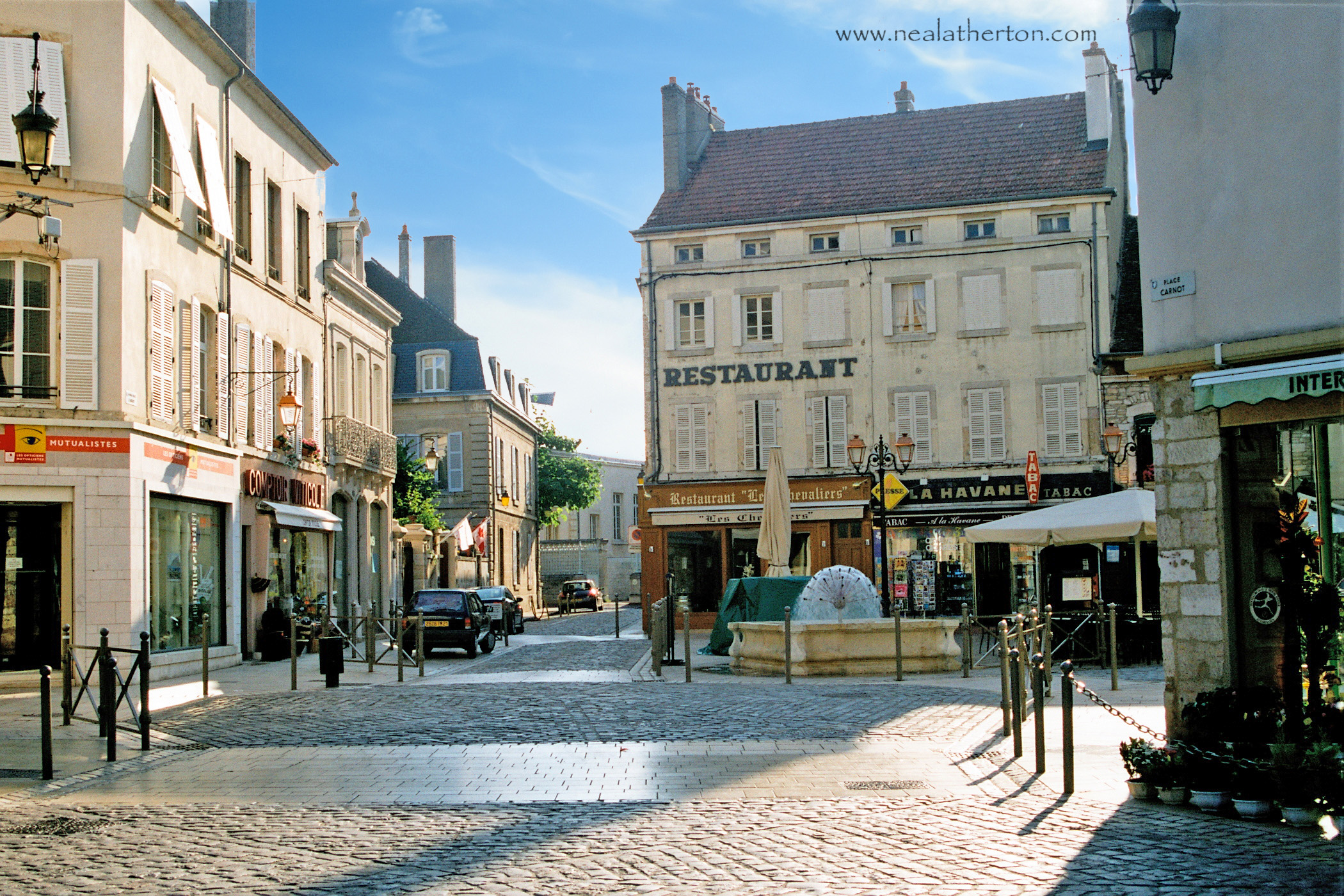
Place Carnot in Beaune Burgundy France on an early morning
Early morning in Beaune

Around the hospital are many fine wine retailers and the bottles in the window displays are a who’s who of famous names. One unusual one is the label on a bottle from a piece of land on one of the best vineyards, that of Grèves. A small parcel of that land is called L’Enfant Jesus and you will see bottles of that name in the shops. This rather colourful name came from the early wine producing monks and apparently it is derived from the expression that the wine ‘goes down like little Jesus in velvet trousers’. I can only assume that was thought up after one too many late-night drinking sessions in the local taverns or the crypt in the abbey.

Beaune in BUrgundy has old streets that are great for photography - a beautiful Burgundy wine town
Early morning stroll in the old town of Beaune Burgundy

On this visit our party group would be an eclectic one and we were to enjoy some interesting and stimulating company for the most part, but there were other parts also, believe me.

There was an older couple called John and Sylvia who were stimulating company. They have an equally interesting son who is familiar as a resident expert on the Antiques Roadshow on the BBC.

Jack and Hilary were from California and had made the long trip over to France especially to be on this tour. He was the epitome of a Silicon Valley executive and she a lady of many charitable causes, but they were easy company and Jack did not talk about computers once on the trip.

There was Roger who was undoubtedly a man that engaged in espionage in a former life, such a John le Carre character, a loner who must have had tales to tell but they remained discreetly hidden. The few words he offered were always interesting although they would never lead to a conversation, but he savoured his wine with a knowledgeable air of contentment.

Alistair was also a loner, very public school, highly educated but with an undeveloped personality that made it painful for him to engage with people. So, you wondered why he had put himself through this ordeal of a socialising group experience. He was a harmless, good natured soul, extremely polite and impeccably mannered. He latched onto me from the start and was always by my side but I didn’t mind as it eased him into the tour and he loosened up a little as time went on. He did love his wine and if you could prise it out of him had an extensive knowledge of French wines, far ahead of my limited scope.

Frank and Angela were elderly, in fact in their mid to late 80’s – a more mismatched couple it would be hard to find. I felt so sad watching this pair who had been together for so long and even at this late stage of their lives were in total torment at being bound together. Well, that is not quite true as it was Frank that was in torment. I have rarely seen a man so mentally battered and beaten by this most obnoxious of women. She was oblivious to him as she did whatever she required without any consideration for him. He meekly accepted his non-role in the relationship and took the abuse, as it has to be said did the tour guide. The poor man also latched onto me to a degree if she was not around. He thoroughly enjoyed one day of touring when his wife stayed behind, for which he and everyone else was truly thankful. His joy that day seemed to say it was the happiest of his life which was dreadfully sad to think he had probably hated the previous fifty or sixty years.

Then there was Emma and Richard and they were so memorable that I have given them a chapter to themselves later on in the book, I promise I will not refer to them again in this chapter but they were shall we say – special. There were of course many others but most kept a discreet distance with only brief interaction, it was never going to be party time for most but in the main it was a friendly collection of people that in a lot of ways had only a love of wine in common. Barriers were constantly broken down as the tour progressed although my Northern accent prevented full interaction on many occasions.

Here also were two people on the tour who stood out from the rest of the party as they were clearly not as concerned about the tastings but more focused on the technical aspects of the production and the viniculture. They were also the only people on the tour that we had encountered previously and that meeting was in fact only a few weeks earlier. On a visit to Cornwall just prior to the tour we had paid a visit to – Camel Valley Vineyards, Nanstallon, Bodmin, Cornwall, PL30 5LG. We had heard about this English vineyard (Oh, and nobody laughs anymore when you say that) from a feature on television by Rick Stein. Rick was a friend and supporter of this vineyard which is located close to his empire in Padstow. The tasting and welcome we received was a real unexpected pleasure. The wines and especially the Champagne style sparkling wines including a gorgeous rosé were as fine as any we would taste in France. The vineyards are on a gently sloping hillside, very reminiscent of France. A perfect location to attempt what most people thought impossible – produce quality wine in cold, wet England. We were more than happy to purchase a couple of cases and it was not just in sympathy to try to support an English venture. These wines were genuinely superb and could hold their own in any blind tasting, which in fact we did around our dining table with some knowledgeable friends – Camel Valley won that night.

As we were leaving the Cornish vineyard, carrying a couple of cases, walking back to our car, a man drove away from the house in an open topped sports car giving a cheery wave to us both. This was the owner, Bob Lindo, an ex-RAF pilot whose career came to a dramatic end when he was seriously injured ejecting from a mid-air collision close to Helmsley in North Yorkshire, the recovery from which he modestly downplays.  Bob started the Camel Valley vineyard about three years later with his wife Annie and the success of this venture is taken forward by his son Sam and the awards have continued to flow – even from the French. On the ferry over to France at the start of the tour I was in the same queue for a cup of tea as Bob. I said to Niamh that I knew this man, perhaps I had come across him in my career, maybe someone in IT that I had used in the past. It was not until we had got well into France that I realised who he was and in fact we had only ‘met’ him very recently. At the autoroute services he and his wife Annie were walking around outside, so I intercepted them and said that I knew who he was. After explaining how we saw each other in Cornwall he remembered the day we had visited. He was also I think a little taken aback that he had been recognised as I believe that he would rather have remained incognito as a man on a mission to spy on the French. Later, on the coach the wine guide announced that we had a couple of famous wine makers on the tour and his occupation was well and truly out in the open, but I can assure him that it was not me that informed the party in any way, I appreciated what he was trying to achieve on this visit.

Bob, on each domaine visit would ask quite technical questions and was always, as was Annie, keenly interested in walking into the vineyards and examining the soil, the terroir, learning all the time something new to put into practice if possible in English conditions. I recall one particular occasion when Bob had asked a producer something that no layman could possibly have needed to know and was met with total silence. French secrets were for the French and years of tradition and expertise were not going to be proffered easily to the cunning English. Time for a tasting as he quickly moved on, ignoring the question.

Bob and Annie were an incredibly interesting couple as well as being the most delightful company although obviously Bob was lost in his own thoughts at times as he pondered on something he had seen or discovered. The vineyard back at Camel Valley has gone from strength to strength as we have seen when returning many times over the years. Surely something of the French know how has seeped back into the English terroir from his visit to Burgundy.

The Cote D’or is the most stunning of landscapes, gently sloping rolling countryside that leads up from the plain that heads south. Miles upon miles of fertile vineyards stretch up these slopes and the higher they go, the closer to the sun, the more these parcels of land are valued and the price of the finished bottle reflects its location of birth. It is also a region that for the novice is extremely difficult to understand and purchase wine with confidence. The appellations here are fixed in time and no one is going to allow a change to the way things are done here, tradition and terroir are paramount and that includes the labelling of the bottles. Back home we are now so used to a bottle in the supermarket being labelled – chardonnay, sauvignon blanc, merlot etc… that to arrive here and be confronted by bottles that only have the name of the village and possibly the grower or négociant is to say the least very confusing. To observe the array of bottles in a shop, sorry boutique, window with some carrying astonishing prices makes any purchasing decision a leap of faith. The first visit today puts us right in the centre of that minefield, to a producer that is right at the top end of quality and one that does not need to advertise, in fact there is not even a sign outside the door.

Wine domain of Lucien Boillot in Gevrey Chambertin Burgundy
Domain Lucien Boillot in Gevrey Chambertin

In the small but internationally famous wine village of Gevrey-Chambertin we are guided discreetly along the narrow streets to an unprepossessing house and taken to a side door. I sense that really we should have been blindfolded as well but an exception has been made for les Anglais. We have arrived at – Domaine Boillot Lucien & Fils, 1 Rue Docteur Pujo, 21220 Gevrey-Chambertin but please don’t turn up without an appointment and in fact as far as I can tell they don’t even bother to have a website.

We will be shown around with great pride by a younger member of the family, Pierre Boillot, a very knowledgeable wine maker who knows intimately the parcels of land in the villages providing the grapes for his high quality wine. Villages whose names are a famous roll call of French wine such as Volnay, Pommard, Fixin, Nuits Saint Georges, Beaune and of course Gevrey Chambertin. These are all names famous around the world and all on the easy-to-follow Route des Vins that takes you around these gentle slopes. The wines for tasting here are chiefly reds, much deeper, fruitier, more complex and richer than the reds of Northern Burgundy. We have a generous and fascinating tasting, encountering wines that are at the high end of the possibilities of production from these famous lands. They taste expensive, they are not wines that will be offered on some ‘25% mix six bottles’ reduction back in a supermarket in England; these stand on their own and are sought after by connoisseurs around the world and they hold a high price. Pierre is a generous man as he makes his wine affordable to our party although the downside of that is in having to purchase younger wines that will need to be kept for some time before drinking to allow them to taste close to the very fine samples provided by Pierre in this ancient cellar deep in the village of Gevrey. I still have a bottle of his Pommard 1st Cru Les Fremiers (1999) and probably by now I should have drunk it. Not only is it a reminder of a wonderful visit but I just don’t know if it is at perfection, there is a danger it is past peak perfection so I must open it soon. Pommard is one of the best known appellations in Burgundy and you find the vineyards themselves just south of Beaune going on to Autun.

The tiny village of Pommard is a place you will drive through in the blink of an eye. This is a pleasant spot with vineyards either side of the road, lovely stone walls of the region surrounding the fields. There are some character properties to view and also the large Château de Pommard, a magnificent domaine dating from 1726. Wine tasting and other experiences are available here but it is not a degustation establishment for a simple call in when you are passing. We bid a reluctant farewell to Pierre, another step in our wine education is complete and we are learning fast. I for one have learnt that you must never go into a wine shop in Beaune unaccompanied, try and keep an expert close by you in this region. Our second visit of the day would lead us nicely into our evening meal also. The domaine we were visiting is in the village of Santenay, south west of Beaune. The journey takes you through the Montrachet villages of Puligny and Chassagne, beautiful gently unspoilt landscape and architecture.

The wine domain of Prieur Brunet in Burgundy makers of superb red wines
Domaine Prieur-Brunet

Here we stopped at – Domaine Prieur Brunet, Ch. Perruchot rue de Narosse, 21590 Santenay. It is worth pointing out that if you are following some of the addresses in the book that Prieur Brunet has been acquired by the négociant Louis Jadot and tastings and purchase at this domaine may no longer be possible. On this day the tasting was generous and long with a tour of the vineyard itself as part of the treats on offer. At the side of the domaine property there is a huge mural on the gable end of a building showing the extent of the domaine and a view into the cellar where a tasting is being enjoyed. We too would now enjoy such a tasting in a characterful exposed stone walled room with old wooden barrels providing a backdrop. We are seated at a long oak table and provided with information about the domaine and the wines on offer but it is the tasting we are interested in and it soon gets underway. The Santenay reds are a little lighter than the Gevrey Chambertin examples of the morning and it is here that we first get a real sense of what the whites of Burgundy have to offer and their chardonnay white Burgundy is honey rich and mellow. The presentation of the tasting is a little technical in structure, there is a desire to help you to appreciate how the wine is produced, an explanation of the inevitable terroir and certainly a sense once more of the family tradition. We are learning a lot and the confidence this type of visit will give us holds us in good stead in the years to come.

It was here that Bob made his first serious attempt to interrogate the owners with some searching questions that obviously were not coming from any casual drinker of Burgundy. He got a reluctant answer to a couple of them but they got increasingly technical and the owner became protective and defensive and the subject was changed to something a little more simple like the bouquet of the wine. Bob was not to be discouraged and headed off into the fields to make a study of the vines and the soil. He is a very enthusiastic wine producer and eager to keep learning and I am sure he took a lot away from his visit to Burgundy and his wines now stand shoulder to shoulder with excellent wines from France.

We have not yet finished with Prieur Brunet as tonight we are to dine at their restaurant in Santenay – Restaurant Le Terroir en Côte d’Or, 19, Place du Jet d’eau 21590 Santenay. The restaurant today perhaps has no actual connection with the domaine especially after the Jadot takeover but on our visit the food was a showcase for the wines of Prieur Brunet and would be long remembered, although for Niamh it was an evening of discovery she would rather forget. The restaurant is housed in a fine old stone building in the village and very attractive it is, immaculately furnished inside with crisp white tablecloths and shining cutlery and glasses. Outside there is a tempting terrace that looks out onto the village square with a large fountain dominating the space. You can look through the spray of water to the vineyards gently sloping on the hillside beyond.  As Jane Austen would say: ‘It is happily situated’. I can be quite specific about our menu tonight as it was so enjoyable I have kept a record of it:

Salade de saumon cru marine a l’huile d’olive

Filet de loup de mer son lit de fin legumes, sauce chardonnay (Prieur Brunet)

Assiette de fromage: delice de Bourgogne, epoisse, citeaux

Parfait glace au marc de Bourgogne

The Prieur Brunet wines complemented the meal superbly and it was a lovely, relaxed evening in a setting that enhanced the whole occasion, a real taste of Burgundian hospitality.  Sadly, Niamh found out that she had an allergy to samphire and spent an uncomfortable night with a stomach cramp reaction starting immediately she ate the samphire as an accompaniment to the fish and these symptoms got progressively worse until morning. It was nothing too serious, but a lesson learnt to avoid this particular vegetable in the future. She was up and ready for more wine tasting in the morning however.

The domain of Maison Champy is a wine producer located by the old walls in Beaune Burgundy
Maison Champy by the ancient walls in Beaune

Our last morning in Beaune was a real treat and a privileged visit to one of Beaune’s well known wine houses located in an atmospheric side street just by the ancient town walls – Maison Champy, 5 Rue du Grenier À Sel, 21200 Beaune. Champy has a boutique in the centre of Beaune close by the L’Hôtel Dieu but we were able to go to their site in town where they have cellars under the ancient streets. Maison Champy have been wine producers in the region since 1720 and the cellars as we will see certainly reflect that history and tradition in the old town. Champy has access to some of the finest sites in the Cote d’Or and Cote de Nuits. The list of named wines available from their cellar are from the top quality villages in the region. We were in expert hands here and this morning would really add to our knowledge and understanding of this most complex of wine regions. The tasting room is dominated by a very large old wooden barrel stood on its end and into which two copper bowls for spitting the wine are secured – I have to say our party does not waste the wine and these are never used. Our host for the tasting was an immaculately dressed young lady who knew her subject down to the finest detail. The French take their wine and the presentation of it very seriously in these grand old wine houses. By contrast in the countryside you may get the vigneron himself breaking away from his work in the fields, dusting himself down and grabbing a few bottles to happily give you a degustation.

Here in Beaune at these important maisons of wine everything is gleaming and crisp, our young host presents herself as befitting the status of the wines she will show us. Hanging on her every word our party enjoys a superb tasting and it does seem that the soft and delicate tones of her French accent actually elevate the wine in your mouth to another level – maybe I am being a bit romantic about that but the wines are extremely fine, at the top of the range in quality. The prices as expected reflect that but there is no way that people are not going to leave without a bottle or two. I feel sorry for our American friends who cannot take very much back with them, but they purchase a fine bottle to pack into their suitcase for home. We content ourselves with two wines – a 2001 Chablis Premier cru Cote de Lechet and expensively, a treat for our friends around the dining table, is a 2001 Corton Grand Cru. The reds of course are relying on the pinot noir grape and back in the UK we tend to associate that with some fairly unremarkable and relatively cheap imports from around the world. The level of quality that the French in Burgundy elevate it to is a totally different wine and these wines available in Maison Champy are never going to be a cheap import. The tradition and terroir are there for all to appreciate and once again it is a chance to see the difference between villages that are producing the same grapes and even the difference between parcels of land in the same village.  It is also an opportunity to really grasp how age affects a wine and the effect of weather conditions in any particular year – we are learning a lot and it is all very interesting and I want to learn more and so we will.

Very old vintages from the 18th Century in the wine house of Maison Champy in Beaune - Pommard Chambertin Volnay
Vintage wines in the old cellars of Maison Champy in the old town of Beaune

Our visit here is not restricted to a tasting and we are handed over by the young lady to a man who is dressed a little less beautifully – we are off to the cellars deep below the cobbled streets and this is a rare privilege and one of the benefits of being on a guided tour in this more inaccessible region. The cellars here at Champy are truly astonishing and steeped in the long history of this wine house. It seems that nothing has ever changed down here, the wooden storage racks that appear to have fossilized to stone are from the 18th century. The walls are musty and full of spreading wine mould. There are cases of wine all along the passageways and hidden in dark alcoves beneath the low ceilings. The really astonishing part is looking at the loose bottles down here in the cellars. Some of these are very old vintages and it is not surprising to see many bottles still available from between the wars. Actually when you start to explore further down the passages these bottles are in fact relatively young. We come across an 1898 Volnay, 1875 Pommard and oldest of all a Chambertin from 1858 – this is a real treat to see and we are all in awe at what is down here. There are old 20th century vintages set in antique wooden racks. These bottles are completely encased in dust and mould and would require much attention and relabelling to get ready for sales to someone who would have to be a very serious collector with bottomless pockets. As we emerge back above into the light we all feel a long way removed from being home and selecting a bottle in the supermarket or wine store. We have seen a totally different side to wine and its production and indeed what can be done with the noble grape.

under the streets in Beaune are old cellars located at Maison Champy in Burgundy
The ancient cellars under the streets of Beaune at Maison Champy

Life will never be the same again but I will continue to refuse to become a wine snob which you could so easily do. It is time to leave Beaune and move on to Beaujolais where we will stay in the village of Villié-Morgon and the Hotel Villon, finding more new gems in an area that is relatively underrepresented in the UK other than the Beaujolais Nouveau that of course everyone knows.

Enjoy the rest of our tour of French Vinyards on Amazon – available also for Kindle Unlimited

The full story of our Wine touring around French Vineyards on Amazon

A Photographic stroll around Paris Restaurants Cafes and locations

Please Enjoy my Travel, Music & Ancestry Books on Amazon – FREE on Kindle Unlimited https://bit.ly/bookneal

Restaurant on Rue St Andre des Arts Paris
Rue de Rivoli Paris
La Conciergerie · This former prison, now a museum is on the Ile de la Cité, a short walk from Notre-Dame Cathedral
Le Consulat Restaurant Montmartre Paris
Polidor Restaurant Paris – a favourite haunt of Hemingway and used as a location in Midnight in Paris

Tokens of love left on the Pont des Arts Paris
Alt="The Rue des Riosiers on a busy Sunday in the Marais district Paris France"
Rue des Rosiers in the Marias Paris

A few shots taken over the last few years. Paris always draws you back. – CLICK ON PHOTO FOR FULL VIEW

Please Enjoy my Travel, Music & Ancestry Books on Amazon – FREE on Kindle Unlimited https://bit.ly/bookneal

Come to Paris with my Dream of Paris Memoir

Flavigny-sur-Ozerain and the filming of the movie Chocolat in Burgundy

Please Enjoy my Travel, Music & Ancestry Books on Amazon – FREE on Kindle Unlimited https://bit.ly/bookneal

Taken from my French Travel book OFF the AUTOROUTE

alt="New French Travel Guide Book Off the Autoroute"
OUT NOW on Amazon for Kindle, Kindle Unlimited, paperback & hardback
Alt="Photo of Flavigny Chocolat film village for French travel guide books"
Flavigny-sur-Ozerain – L’Ange Souriant Chambres D’Hotes

Chocolat

This destination is one of our favourites – Northern Burgundy. It is a much neglected part of France from a tourist standpoint. To the north is Champagne with its landscape of gently rolling vine covered hillsides. The towns of Champagne are steeped in wine making history and the money coming into the area keeps it looking expensively maintained. It is an area that will always delight but just to the south is a less travelled region that is more warts and all in its presentation. The towns are just that little more untouched and authentic, the countryside rural and pure, not quite manicured to within an inch of its life as in Champagne. It is a region that produces fine wine, wine that other than Chablis rarely reached the supermarkets of the UK. These wines are well worth finding when your car has an empty boot. They are astonishingly good value.

We are going to start this leg of our road trip in a small village in the French department of Côte-d’Or, in Bourgogne-Franche-Comté. When you are asked to name one or two films set in France then the usual suspects come to mind. ‘A Good Year’, ‘Midnight in Paris’, ‘Mr Bean’s Holiday’. If I ever asked the female friends of my wife then they always seemed to come up with ‘Chocolat’, the film based on the novel by English Author Joanne Harris. Starring Johnny Depp, Juliet Binoche and Judi Dench it was a popular addition to the genre. I have to say at the time of our travels I had never seen it of knew anything of the storyline. I certainly was not aware of the film location in France. Flavigny-sur-Ozerain is the setting for Chocolat and that is the village where our bed and breakfast accommodation is located. Somebody told me that film fact by the way, because you would not be aware of it when you are staying there. This rural village is just that and resolutely determined to stay one. There are no indications that it has a claim to fame, no signposts designating the places featured in the film. Certainly, there are no souvenir shops. I doubt you could even buy a bar of Chocolat. This would never be allowed to pass in England. If even an advert is filmed in the smallest of towns or villages in England they would certainly make sure you knew about it. You are absolutely not going to get the T-Shirt in Flavigny-sur-Ozerain.

I cannot say I am disappointed at that. I like my locations in France to stand on their own, keeping their individual charm. Flavigny does not disappoint on first view of the village from the Northern approach road. It looks the quintessential Plus Belle Village de France as you take it in from a distance. I pull the car over on the rise with the village beyond emerging out of the lush green countryside. The dominant feature as is the case in most French villages, however small, is the church spire. Abbaye Saint Joseph de Clairval is a particular stand out example and I should have realized, features in the film. It is a promising first impression.

Entering the village, we make our way slowly along the main street and cannot miss our clearly signed accommodation – L’Ange Souriant on Rue Voltaire. I am writing this in Covid lockdown times and of course most things are closed anyway but I suspect that this establishment is no longer trading which is a shame. It would be one of the most enjoyable places we stayed at in France, despite its modest pretentions. As I have mentioned this an extremely famous village, Hollywood superstar famous. Strangely no one seems to have told it. From entering the village, we have not encountered a soul. The first person we see is our host and then again that is not straight away by any means. She is not around when we arrive, so we have to wait, explore a few side streets winding around the property. Disturbing the slumbers of a couple of cats is the best we can achieve in bonding with the locals. Finally, the lady we are waiting for comes around the corner with her three young children. The school run accomplished she warmly greets us and apologises for not being here for our arrival. She sets the tone for our visit, and we are immediately part of the family.

Her home follows the usual style of furnishing in rural France. In our bedroom large solid chunky furniture dominates our space. Throughout Burgundy and other parts of France it seems that furniture is handed down from generation to generation. Dark wood fixtures may be well out of fashion in England but not here in France and it is always oversized. It is an extremely clean and well cared for space though and the overall atmosphere is homely and generous. Having unpacked we are welcomed into the family space, the owners three children doing their homework. As always in France little excuse is needed to offer a guest a glass of wine and our delightful host continues that tradition with a lovely light Burgundy.

Soon it is time to go in search of food, a typical Burgundy auberge perhaps in another picture-perfect village. We head out through the village gates and into the expanse of countryside beyond. The light is already gently fading with the sun just obscured by the cloud on the horizon. It is a gorgeous view and completely tranquil. As we drive down the narrow lanes and pass-through various villages it becomes readily apparent just how tranquil it actually is. Apart from the odd cat and assorted cattle in a field there is no other sign of life. Despite it being dusk very few lights are flickering in the villages and although there may be an auberge sign or two gently swaying in the breeze the attached restaurants are resolutely closed. So too are any village shops. Except one that we eventually stumble upon after driving around for around an hour. Our French evening meal feast is a couple of slightly past their best chocolate croissants and a bar of chocolate all washed down with a cheeky little half bottle of sauvignon blanc of dubious parentage. Still, being able to gorge on this feast back at the village sat by the church in the deserted town square, peace all around, it is not a bad end to the day.

Flavigny-sur-Ozerain – A quiet corner of Northern Burgundy

We explore a little more on the following morning, but Flavigny is just a pleasant, quiet Burgundian village. There is no ‘Chocolat’ tourist trail, no souvenir shops where you can buy your ‘Chocolat’ Chocolate. It is a village were the local life goes on at its slow unconcerned pace. We saw a man tinkering with a car down a side street at what I presume passes as the local garage. An old lady wanders across the church square to talk to a neighbour. That is about it really. The French do not really do celebrity transformations of their villages and that is the same story throughout Burgundy and much of France. As you tour the Burgundian countryside you pass through so many lovely villages, many are incredibly famous throughout the world. The wine villages around Beaune such as Pommard, Aloxe-Corton, Gevry Chambertain, Vosne-Romanie and so on are names to conjure with. However, when you arrive at these villages there will be just a simple village sign as there is on entering any village in France. These villages have remained small and undeveloped and if you are expecting any sort of fanfare announcing their important status then you will be disappointed. In fact if anything they discourage any additional attention. I for one am happy with that and the countryside of Burgundy remains very unspoilt and is much as it has always been. The only drawback is that because they do not overly put themselves out for the hungry tourist you can find even in summer if a restaurant only opens Wednesday to Sunday, lunch only, then those are the hours and even if there are coachloads of ready customers those hours will not change. Bring a sandwich!

Alt="Photo of Burgundy village cycle for French travel guidebooks"
Cycle by the riverside in Noyers Burgundy France

Flavigny does have its charm even if you are a disappointed ‘Chocolat’ tourist, which I am not. The old walls and gateways to the village are well worth seeking out as is the area around the church. Its charm as a filming location is obvious and although a stroll around the village will be uneventful you will encounter one or two villagers and the welcome is friendly. At the entrance to the village is the one claim to fame that the villagers will acknowledge with genuine pride – the Anise of Flavigny shop and manufacturers. It is in the Benedictine Abbey in Flavigny that this tasty little treat has been made since 1591. Always produced according to the same ancient recipe, each individual aniseed is still patiently coated in thin layers of a secret delicately flavoured syrup. To the villagers sharing a sweet with a hidden aniseed at its heart is symbolic of love itself. Having a pedigree going back through more than four centuries of history, this is one of the oldest brands in France. They do last a long time so a couple of their attractive tins for the winter are a welcome addition to any store cupboard or the car glove box. One thing however, even in this shop, you are not going to find and that is a bar of Chocolat Chocolate or a Aniseed Chocolat here in Flavigny. There are no souvenirs to be had of the film location. All the better for it really, we enjoyed the quiet and to wander round the village with my camera was a photographer’s dream – no cars, no people.

Our stay at our chambres d’hôtes here in Flavigny was extremely pleasant and we bid adieu to our host and her charming children following another copious breakfast. At least this was a regular source of food for at least one of our daily meals here in rural Northern Burgundy. Flavigny is a charming village but please bring a packed lunch if you are not coming in July or August.

Please Enjoy my Travel, Music & Ancestry Books on Amazon – FREE on Kindle Unlimited https://bit.ly/bookneal

Historic Vézelay in Northern Burgundy

Alt="Photo of street scene in Vezalay France"
Street Scene in Vezelay France

Please Enjoy my Travel, Music & Ancestry Books on Amazon – FREE on Kindle Unlimited https://bit.ly/bookneal

village scene in Provence France with book covers of five french travel books and barcode to amazon kindle
Available in Print or for Kindle on Amazon

Historically, Vézelay is one of the most important religious sites in all of France. Back at the time of the inception of the Basilica it was arguably the foremost site of faith in the country. Vézelay in fact was chosen as the venue for the preaching of the second crusade in 1146 but rather fell out of favour after a certain understandable increase in scepticism surrounding the provenance of some of the relics held in the completed Basilica.

stone arch pillars in cathedral with stone floor and cross
Interior of Vezealay Cathedral Burgundy France

An early morning visit to the Basilica is recommended. With very few people around it is an excellent time to take in this astonishing structure – as the French visitors are heard to say continually – ‘incroyable’ architecture. It really is difficult, no, it is impossible to get your head around how these medieval craftsmen managed to build such a technically difficult, immense structure, all those many centuries ago. I said to Niamh that you could just imagine on build ‘day one’ the foreman supervising the laying of one of the large stones at the base saying:

‘Come on men – soon get this finished’.

The Basilica is a staggering feat of endurance, technical skill, and tenacity.

The cavernous interior makes excellent use of the available light with a monumental sense of space and radiance. It appears from its almost as new condition to have been built recently rather than in the1100’s. Except in the crypt that is, and Niamh wouldn’t go down there. In this enclosed subterranean space, you do get a sense of the ancient rather than the modern.

The Basilica is a quiet place, one where several people are sitting on a pew in solitude, absorbed in reflective contemplation. Occasionally a service will be prepared and if you time it correctly a small choir will gather. Always there will be a couple of nuns at the entrance to greet you, hoping for a small donation towards the upkeep of the Basilica. The square in front of the magnificent front doors is a noticeably quiet and peaceful area to sit before, or after, the tourists take over the village. Vézelay is very much a village with two distinct faces. To be there early and later in the day is a considerable contrast to the daytime when coachloads of tourists are deposited at the base of the village, leaving them to wind their way up in pilgrimage to the Basilica.

One morning just after dawn, making our way up the steep incline, we were engaged in conversation by the lady owner representing the viniculteur of a small domain who produced wine just outside the village. We promised to return later – 8 am is too early even for us for a wine tasting!

Also, on the way up to the basilica we admired a window display of pottery from an artisan in St Pere, a small village located in the valley below Vézelay. Later that morning we headed over to St Pere to take a closer look.

Going inside the young lady’s studio we could not see any pottery at all on display, just the potter working in a cramped mezzanine with all her unfinished or broken clay pots and tools scattered randomly around the room. She greeted us warmly, then took us down a rickety staircase to a lower level. It was there that she had a delightfully set out display, in and out of which her agile cat was walking perilously close to the expensive pieces! We genuinely liked what we saw and bought a green jug and small pot that would go well with our other decorative pieces back home. We said our goodbyes and headed on as we wanted to explore as much as we could of the local area today.

St Pere also has a large church given the size of village. Next to it is an even older one that was burned down many centuries ago in some religious wars, the interior then being used as a graveyard within the ruined walls. It reminded me of some similar ruined churches that we had seen in Southern Ireland. Very strange and atmospheric, not a place to have a picnic in at night, I think!

We went on via the D100 to Chatel-Censoir. Here in the town square, there was a small market in lively full swing. The roasting chicken on the spit was very tempting for lunch but we resisted and wandered down to the quiet canal side, a gentle mist still rising from the still water as the day warmed up. It was a surprise to come across a man selling wine and offering wine tasting from a small tent. He was on the opposite bank, completely on his own. It reminded me of some of those sketches in Monty Python where the most unexpected thing is for no apparent reason placed in a familiar mundane setting.

Our newfound host was very friendly and smoothly, without much resistance from ourselves, led us into trying a few whites, especially a Saint Bris, Coteaux d’Auxerre and a Lugny Macon, all very fine. We happily bought a mixed case from him.

He had observed Niamh looking at a few corkscrews on his display, but we thought them a little light in construction. We do put them to heavy usage. We had been in search of a good new one and looked at many examples particularly in the exclusive wine establishments in Beaune. Excellent quality ones were awfully expensive there. He then smiled, broke off from packing our case of wine and said he had a ‘petit cadeaux’ for Niamh. He produced a lovely corkscrew, with wooden inlay, presented in a wallet and attractively boxed. This was extraordinarily kind as it was just the quality we had been looking at in Beaune and usually at a retail price of between 30 or 40 euros. We left incredibly pleased with an excellent tasting, good wine purchases and a remarkably generous gift. This lovely corkscrew I still use (almost every day), a favourite possession.

We made our way back to Vézelay for lunch. It was rather late for the usual French two-hour affair, so we simply ate on the terrace of our hotel where they offered a basic lunchtime menu. It was extremely pleasant sitting in the sunshine with a sandwich (large one) and a croque monsieur, allied with a cold beer.

Priest walks down a path next to a church by a lawn with buildings in background and a blue cloudy sky
A priest walks by Vezelay Basilica Burgundy

Next day we ate rather more formally but with plenty of entertainment. One of those special times when you find people who make you glad your paths have crossed. We settled on a restaurant at a period French townhouse near to the top of the incline leading to the basilica.

That Sunday we were enjoying lunch seated in the warm sunshine on the busy terrace. The food was good, not especially memorable, but the lady of a certain age waiting on the tables was unforgettable. I gathered that she was the matriarch of the family and determined to play her part. Dressed as if in a Monet painting, with an expansive straw hat adorned with paint brushes and flowers, topping a quite extraordinary ensemble, she floated around the terrace. Sorry, I meant to say she staggered. Her comments to guests were quite vocal, when she was not singing that is. Every dish she presented to the table came with an exaggerated flourish. What was unavoidably apparent was that as she went back to the kitchen via the grand hallway of the house, she clearly poured herself another glass of Chardonnay. After a while this was taking quite a toll on her capabilities. Somewhere around our dessert course she had disappeared, presumably caught by her daughter in a big net.

Memorable.

village scene in Provence France with book covers of five french travel books and barcode to amazon kindle
Available in Print or for Kindle on Amazon