Carole King – Tapestry

Please Enjoy my Travel, Music & Ancestry Books on Amazon – FREE on Kindle Unlimited https://bit.ly/bookneal
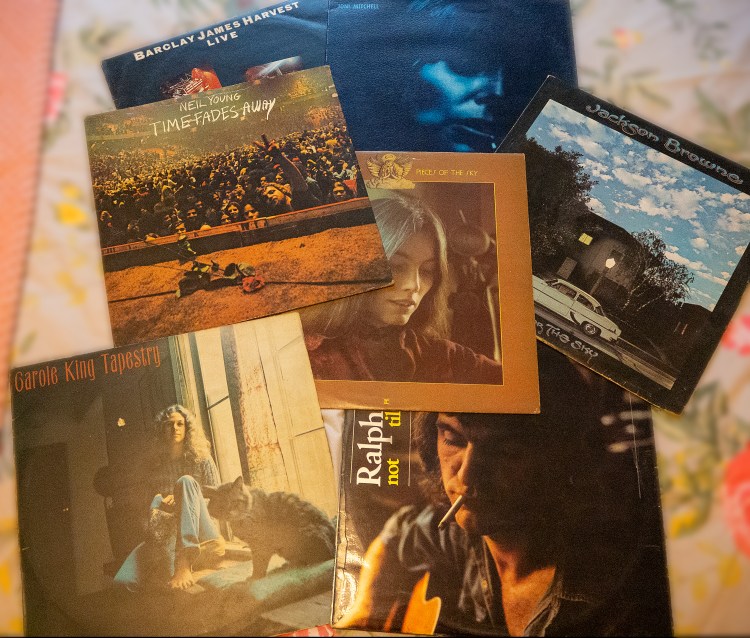
Alt='My LP vinyl collection, Carole King, Jackson Browne. Neil Young' Joni Mitchell, Emmylou Harris, Paul Simon"
My musical loves – a Vinyl collection

Carole King – Tapestry       1971

I was not one for spending money, of which I had little, on music. Music came in and out of my life, but sport was my main interest. I do recall though cycling around the whole town, visiting every newsagent, to try to buy a copy of a music magazine that was offering full lyrics of the latest hits. A girl I adored as a ten-year-old loved the Walker Brothers and I thought she would be truly impressed if I knew the lyrics. I failed to get a copy as all were sold out – so back to football instead.

An older brother of a friend had a singles collection. Mainly Beatles, Creedance Clearwater Revival and Diana Ross and various Motown singles. I quite liked the CCR but again the Beatles passed me by and Motown was really not for me.

My good friend Derek in the Fifth form played me Simon & Garfunkel’s Sounds of Silence LP. They would become my favourite artists, especially Paul Simon, in the next few years. He had an S & G poster on his wall which I found a bit strange. I liked the music but surely there are more important things in life. Others in the fifth form observed that the Bookends album was rubbish and the earlier Paul Simon Songbook proved he couldn’t sing. So, naïve chap that I was, who was I to argue with my contemporary social and music commentators. So back to cricket instead.

Next year in the sixth form I found that the curriculum demanded the drinking of much coffee and eating of biscuits. Actual lessons were few and far between. We had our own exclusive form room, a room into which one of the girls had installed a record player. I recall very little of what was played but it was the girl’s domain and their choices dominated. We boys were too tight with money to buy any music anyhow.

One day, that day, I experienced my musical awakening. It was the start of a lifetime love of music, and I am thankful for that day and this girl student of impeccable taste.

What was this?

I never knew you could be so moved by a piece of music. I was spellbound. This was Carole King – Tapestry. Newly released – it was like nothing I had ever heard before. These were the words I was looking for but what wonderful music accompanied the words. It set the pattern for everything that followed in my musical education.

Carole King was a hugely successful songwriter but had modest success in her own right as a performer. Many, many hits that are so familiar to us were written by her – but who knew? Now, she had brought all her talents together to produce this masterpiece, an album that fifty years on has never dated. One of her great earlier songs that was a hit for others, ‘Will you still Love me Tomorrow’ is on the album but otherwise it showcases where she has arrived at musically and as a performer.

Whether my head was turned by another new life changing interest, or it may have just been the fact that education seemed in short supply, I left school shortly afterwards. Rather, I along with several others were asked to leave. You see, we had all decided to apply for the same job and the headmaster was asked for references for us. He declined, but desired we remove ourselves from his sight. We didn’t get the job either.

I did not get a ‘job working construction’ but rather one comfortably sat a desk, pen in hand. Many years later after a short break away I retired from the same firm. It paid £9.50 a week rising after the first week to £10 as I had done so well! LPs were around £2.10 at the time. My first purchase with my pay packet was not a new cricket bat but Carole King’s Tapestry from Ames Record Store. I still have it and I still regularly play the album although streamed rather than through a needle.

So, what was it about this album that struck such a cord with an impressionable 16-year-old. Indeed, why does its appeal still endure.

I loved the words, the poetry of her writing. True, Carole King does not write with the same depth as a Jackson Browne, Leonard Cohen or Joni Mitchell. So, in some ways it should not make such an impact on me. But, to me these expressions of love, loss and relationships were a window into a new soon to come adult world. If this is what I had to face, then I needed to know. It held out the prospect of hard to make choices and disappointments along the way. However, it was all going to be OK, there would be that relationship that was worth the pain of getting there. Then when you feel it is getting too difficult you will always have a ‘Friend’. ‘You’ve got a Friend’ was perfect for a young boy having just gone through torturous exams and facing the choice of enduring an education that was just going nowhere – or heading into the unknown world. Yes, of course, look around and see your friends are there and a great life lies ahead with them. It is that balance she achieves of realism at our life but also that it can be better that shines through and makes this album such a joy.

Musically it is near perfection. A collection of the finest musicians plays around the album in complete synch with the artist. King’s voice is powerful, yet fragile, poised on breaking with emotion. It finds its full expression with one of the great moments of recorded music. On ‘’Natural Woman’ she reaches the point where her emotions are stretched as she sings the phrase ‘Close to me’. Her voice trembles and breaks and the emotion conveyed is breath-taking. Surely a one take wonder, impossible to repeat. Pure magic.

Her piano playing is exclusively hers, loose though melodic at the same time, always with the tension that she is stretching for the right note. She always finds it. Overall, the musical mix and balance achieved by Lou Adler in producing make an album without one jarring note or over intrusion by any part of the band. There are some truly sublime, gorgeous melodies. The short (just over two minutes) ‘Home Again’ is beautiful and the words life affirming. The whole album is full of inspired melodies.

I suggest if by any chance you have not heard this album (is that possible?) then find a quiet place, headphones on, eyes closed and enjoy. Do not try to multitask, it deserves and must be listened to without distraction.

Sadly, Carole King I never saw in concert. She was one of the few artists I admire that escaped my ticket obtaining ability. I treasure though the BBC ‘In Concert’ performance from the time period, including the complimentary performance with her by James Taylor.

As I say this was my first purchase. My mother always was of the opinion that all modern artists were degenerate or worse. The Tapestry cover is simple, and the dominant feature really is Carole’s cat. Mother felt that implied sinister forces at work. But no Carole King was no witch but she certainly was inspired from somewhere. My first album but still hovering around my top three of all time.

Please Enjoy my Travel, Music & Ancestry Books on Amazon – FREE on Kindle Unlimited https://bit.ly/bookneal
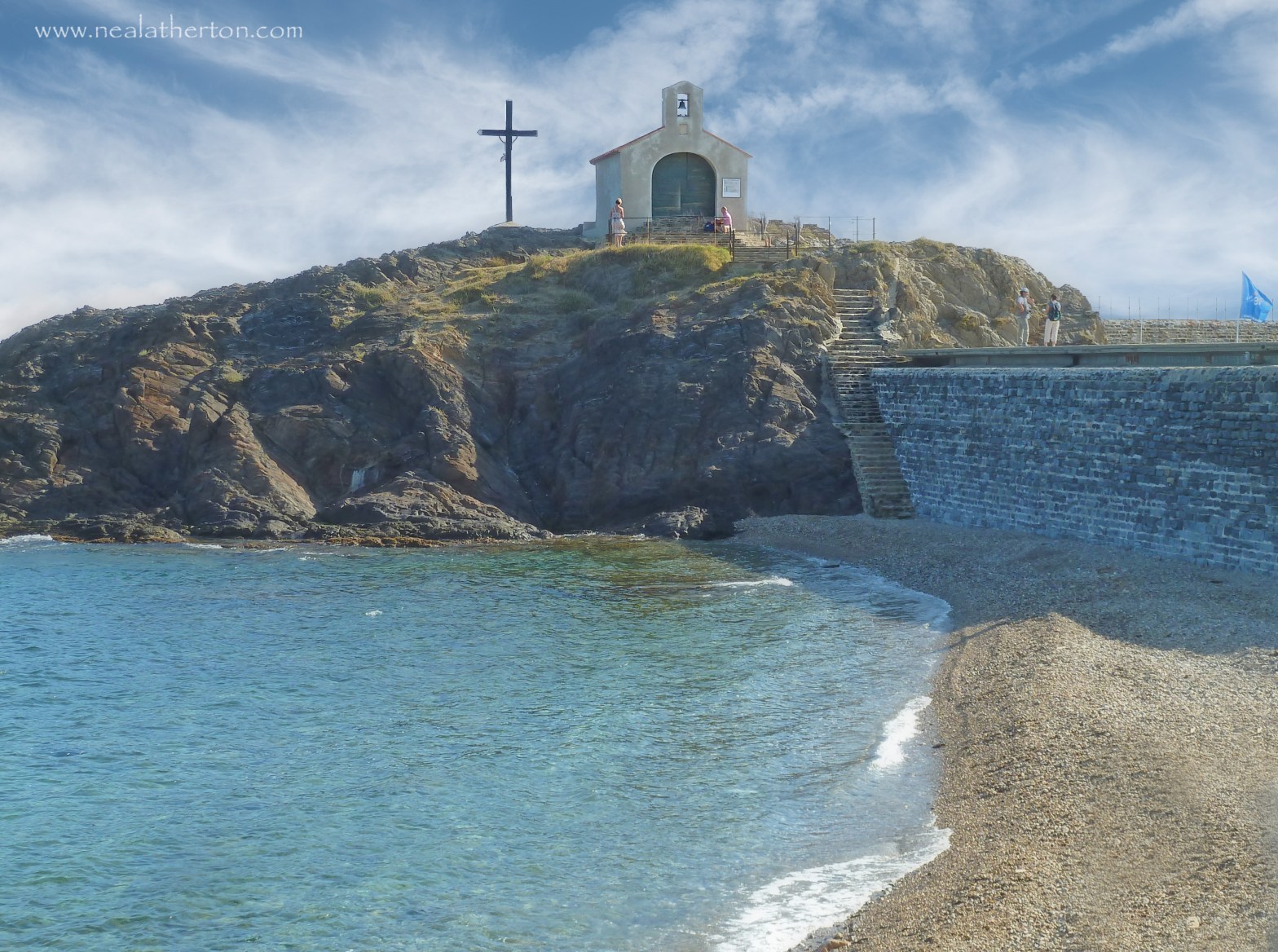
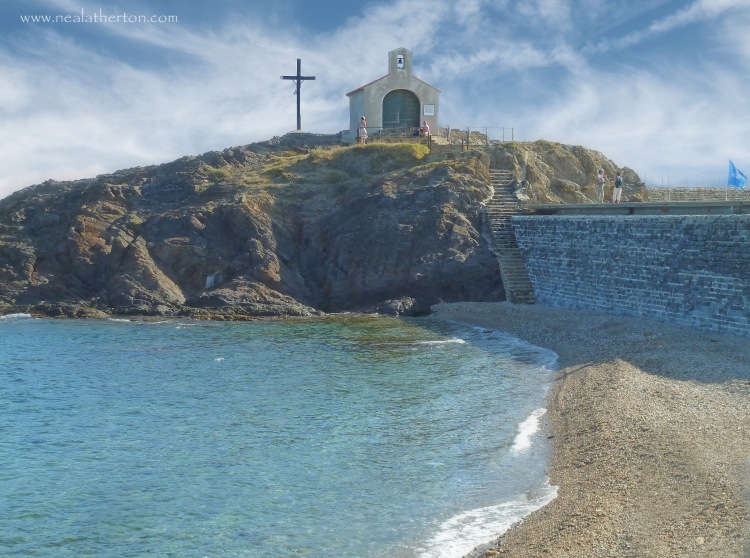
Hôtel Restaurant les Templiers and photography of Collioure France

Please Enjoy my Travel, Music & Ancestry Books on Amazon – FREE on Kindle Unlimited https://bit.ly/bookneal
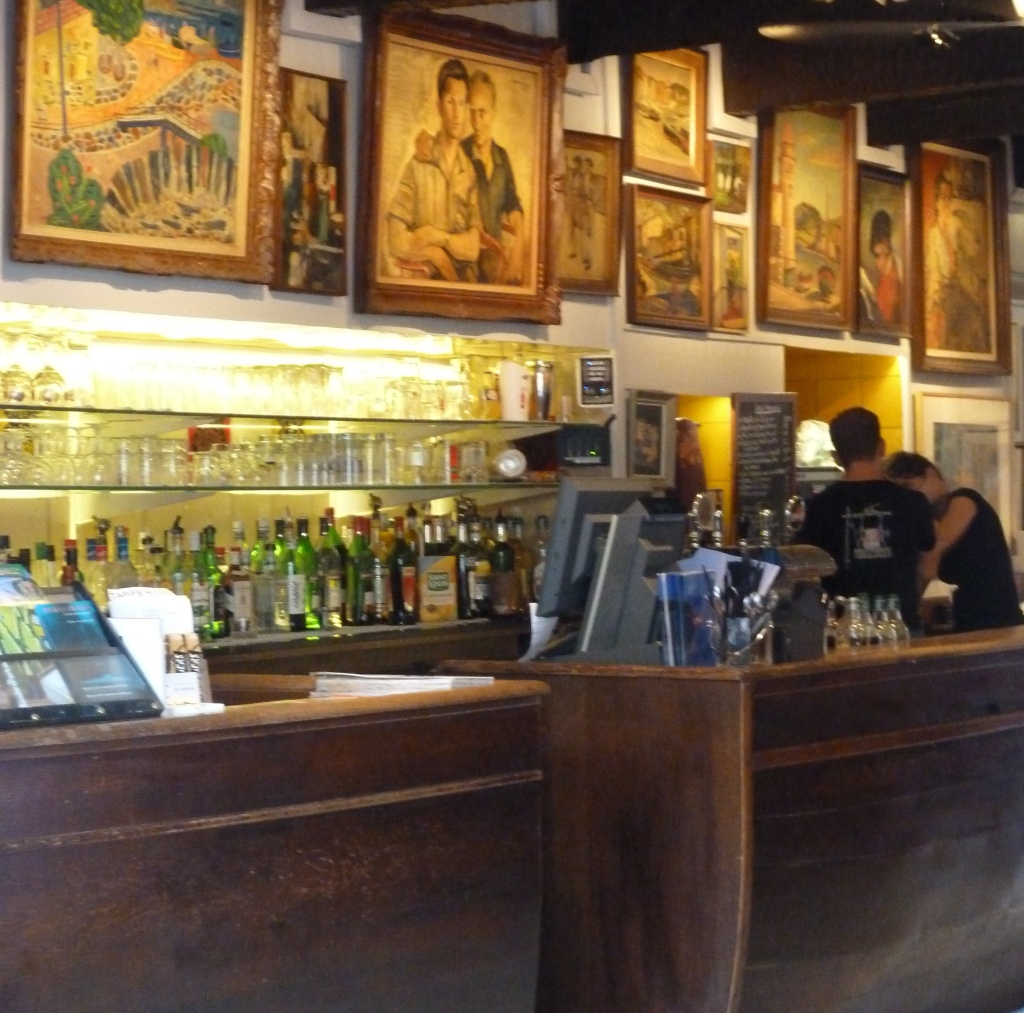
Hotel restaurant Les Templiers Collioure France – Interior view of the artwork.

On this mild clear evening the sun is going down, the scene is enlightened by the lights of the harbour front cafés and bars and the spot lights focused on Collioure’s church, Notre-Dame-des-Anges, a former converted lighthouse. Behind the church is the small Chapelle Saint Vincent on a rocky outcrop.

Alt="On the small island in Collioure Harbour is Chapelle Saint Vincent"
Chapelle Saint Vincent Collioure

There is of course in this gorgeous setting the natural moonlight sparkling on the sea and reflected on the brightly coloured fishing boats that are such a feature of the harbour at Collioure. These small boats have inspired so many artists over the years being painted and photographed so often that they are synonymous with this beautiful harbour. In the full light of day we will see them at their best later in the week. Artists and artisans such as Andre Derain, Henri Matisse, Pablo Picasso, Charles Rennie Mackintosh along with many others have been inspired by the light and views on offer here in Collioure. Inside the Restaurant/Bar Templiers which has a particularly attractive terrace on Avenue Camille Pelleton there are copies or art works adorning the walls by Picasso, Matisse, Dali and others. The restaurant had the originals left to them by these famous artists but some of these were stolen years ago so very understandably no originals are to be seen on display today.

Artists at work in the harbour at Collioure FRance

On the quayside leading down the Avenue there are many modern day artists painting the very same scenes, some to very good effect, others perhaps are a little dubiously talented. It all makes for a lovely peaceful and atmospheric scene though.

Alt="Picture of Collioure Harbour and church for French travel guide books"
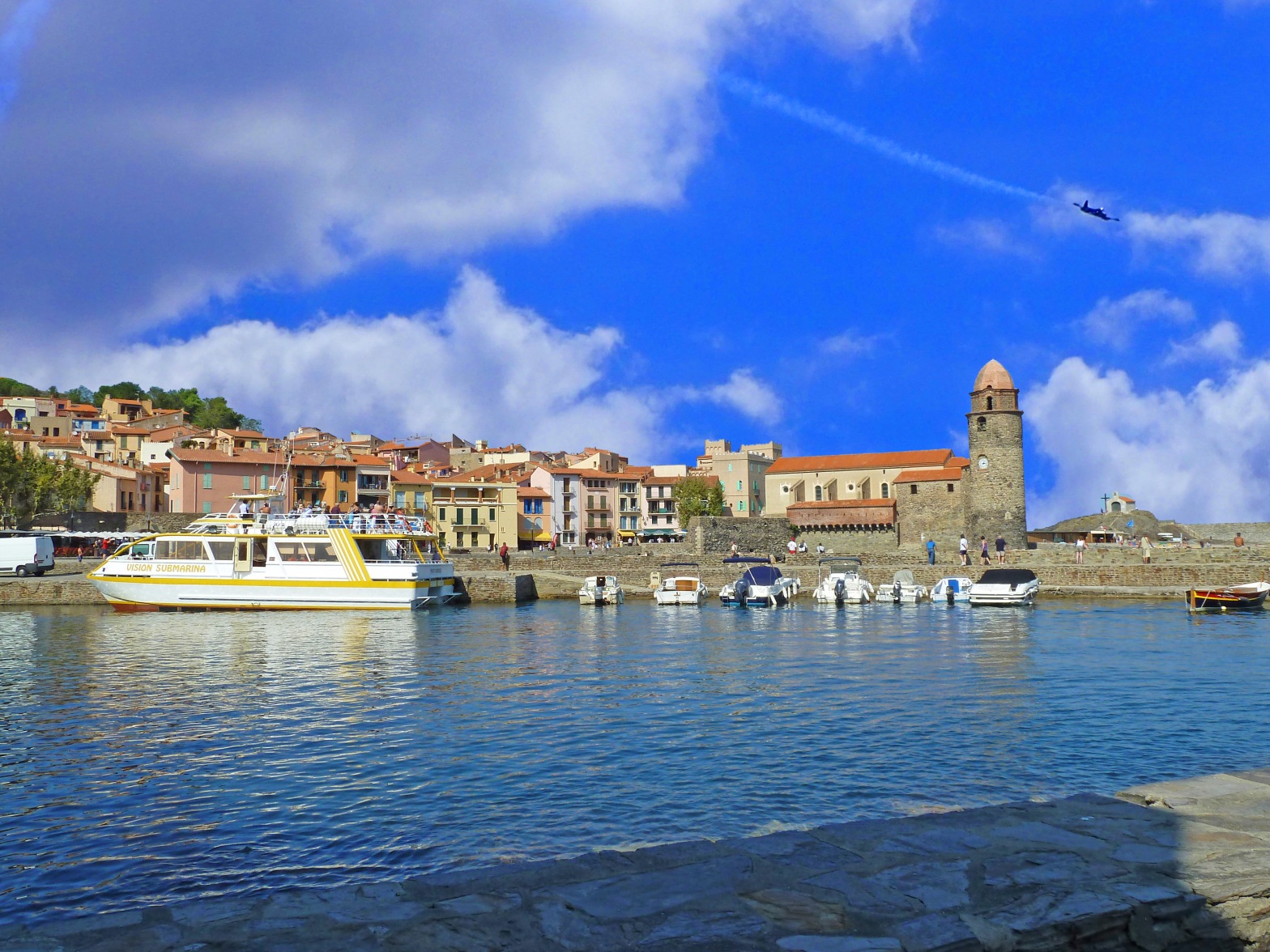
The beautiful harbour looking across to the Church Collioure France

Along the front of the small half-moon shaped beach that has the church as its focal point there are many brightly lit cafés and most of these have a terrace spilling out right up to the beach, the clinking of glasses an ever present relaxing sound. The view from one of these tables is I feel as good as it gets and it is one that has to be savoured over a latte or a beer or a lovely chilled rosé wine.

Alt="A charming quiet backstreet in the fishing village of Collioure South of France"
Quiet back street in Collioure
Collioure Harbour

alt="New French Travel Guide Book Off the Autoroute"
OUT NOW on Amazon for Kindle, Kindle Unlimited, paperback & hardback

Lavender Fields at their best in a Provencal Summer

Please Enjoy my Travel, Music & Ancestry Books on Amazon – FREE on Kindle Unlimited https://bit.ly/bookneal

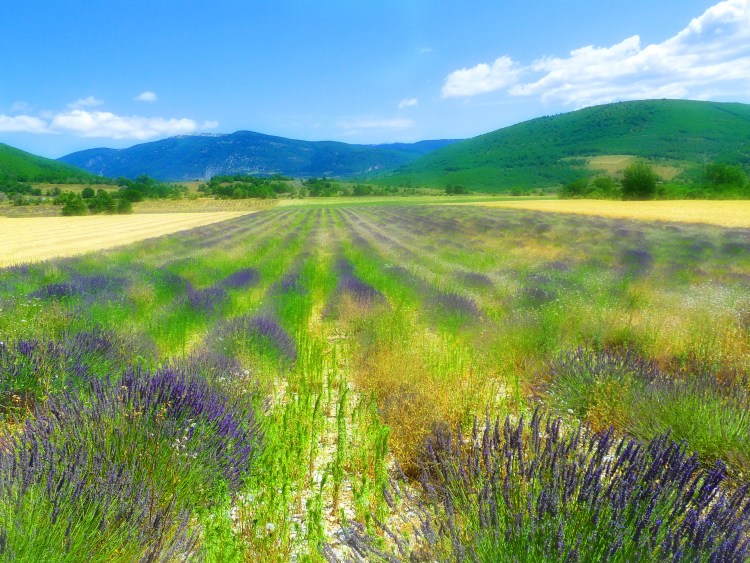
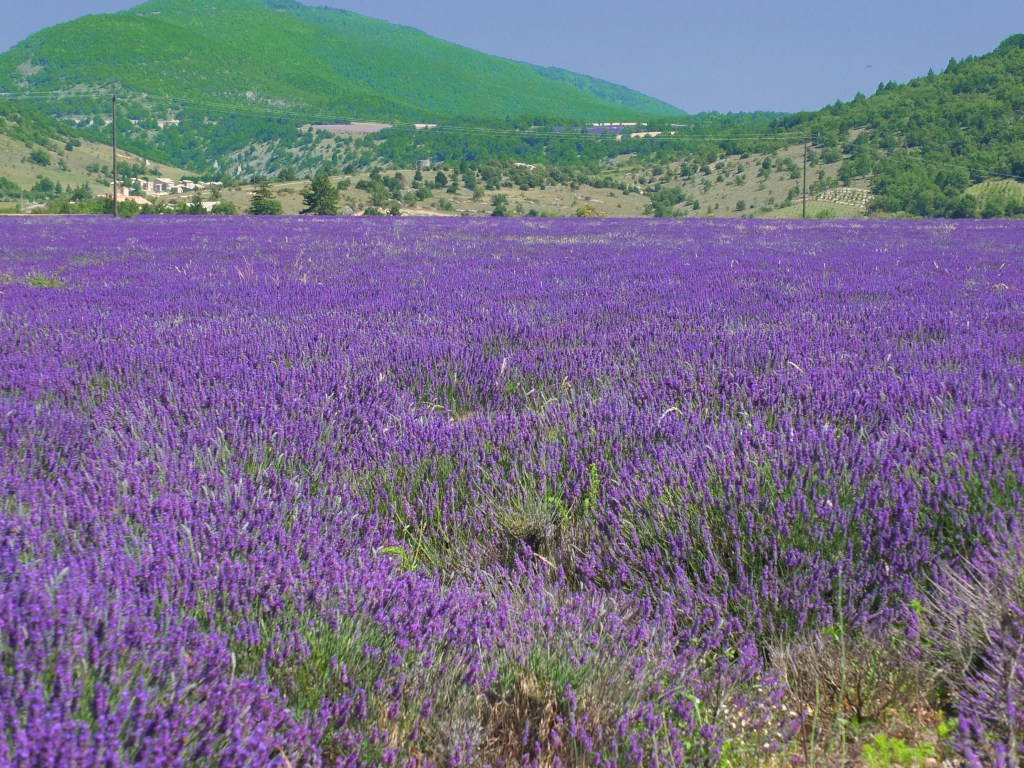
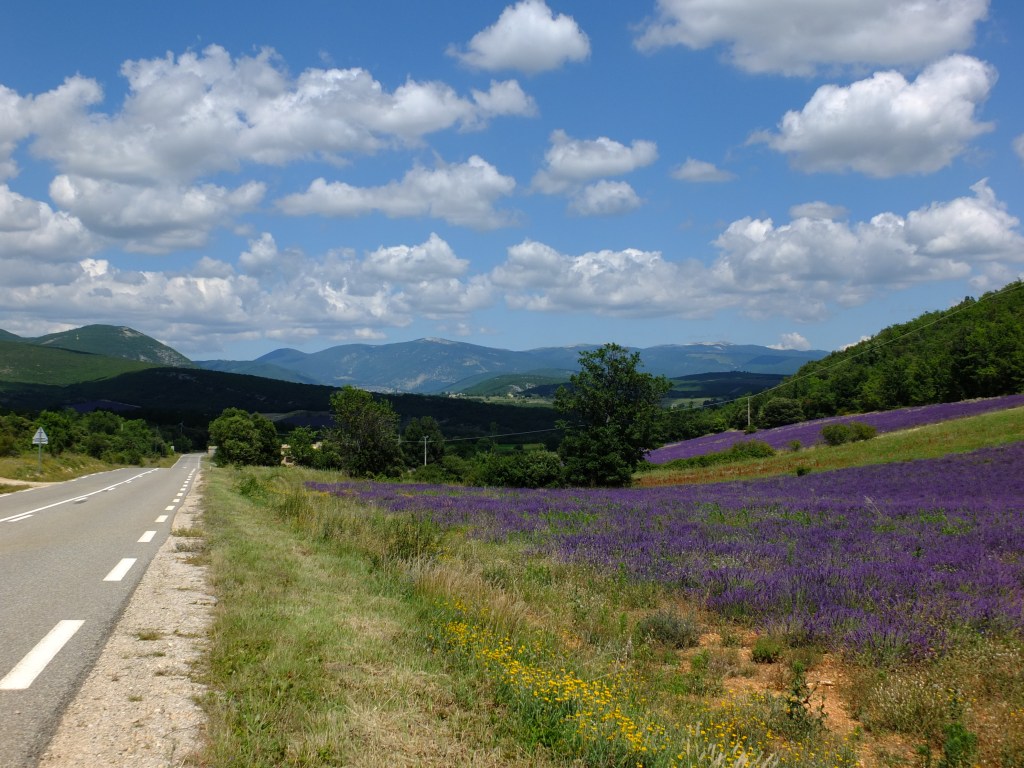
Travellers have their own favourite areas of Provence where they appreciate the vast fields of lavender. For me the finest spot is close to Banon. In fact anywhere around that village whether you head towards Forqualquier, as in this shot, or north of the village back across towards the famous area around Sault, you will not be disappointed.

Lavender fields near Banon Provence
Alt="photo of Lavender fields Banon Provence France for French travel guide books for Kindle Unlimited"
Lavender Fields near Banon Provence France

A NEW French Journey by Photography – Take a tour

Please Enjoy my Travel, Music & Ancestry Books on Amazon – FREE on Kindle Unlimited https://bit.ly/bookneal

Abbesses Metro station Paris France

All the photography was taken by myself on our visits to Paris and the French regions. I hope you enjoy them and please look up my stories of our travels on Amazon.

My new book is a tour around France starting in Normandy. I hope you will come with me and be inspired to travel a similar path. I hope it will inspire you to travel to France or at least enjoy it in your imagination from home.

Neal is an established and extensively published French Travel writer with an aim is to impart his passion for France to his readers. Neal has travelled extensively in France with his family and friends and acted as ‘tour’ guide to others over the years.
Neal lived and worked in Lancashire, England and found the joy of travel later in life after a conservative travel upbringing that stretched only as far as stopping the car falling into the sea at the English coastline.
He now lives in Somerset close to his granddaughter and family and on the wonderful South West coastline that we enjoy so much. Neal loves the English game of Cricket, which he plans to write about soon, golf, soccer and photography. He has a great love of History and that is reflected in his writing.

Hôtel Restaurant les Templiers Collioure France

Please Enjoy my Travel, Music & Ancestry Books on Amazon – FREE on Kindle Unlimited https://bit.ly/bookneal
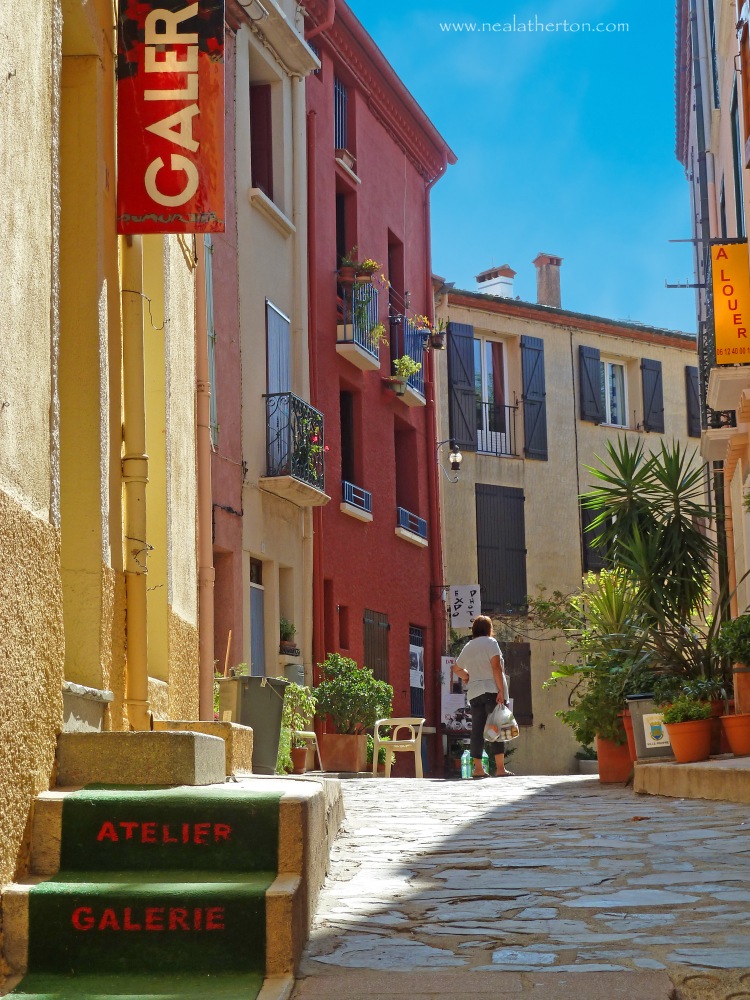
Hotel restaurant Les Templiers Collioure France – Interior view of the artwork.

On this mild clear evening the sun is going down, the scene is enlightened by the lights of the harbour front cafés and bars and the spot lights focused on Collioure’s church, Notre-Dame-des-Anges, a former converted lighthouse. There is of course in this gorgeous setting the natural moonlight sparkling on the sea and reflected on the brightly coloured fishing boats that are such a feature of the harbour at Collioure. These small boats have inspired so many artists over the years being painted and photographed so often that they are synonymous with this beautiful harbour. In the full light of day we will see them at their best later in the week. Artists and artisans such as Andre Derain, Henri Matisse, Pablo Picasso, Charles Rennie Mackintosh along with many others have been inspired by the light and views on offer here in Collioure. Inside the Restaurant/Bar Templiers which has a particularly attractive terrace on Avenue Camille Pelleton there are copies or art works adorning the walls by Picasso, Matisse, Dali and others. The restaurant had the originals left to them by these famous artists but some of these were stolen years ago so very understandably no originals are to be seen on display today.

Artists at work in the harbour at Collioure FRance

On the quayside leading down the Avenue there are many modern day artists painting the very same scenes, some to very good effect, others perhaps are a little dubiously talented. It all makes for a lovely peaceful and atmospheric scene though.

Alt="Picture of Collioure Harbour and church for French travel guide books"
The beautiful harbour looking across to the Church Collioure France

Along the front of the small half-moon shaped beach that has the church as its focal point there are many brightly lit cafés and most of these have a terrace spilling out right up to the beach, the clinking of glasses an ever present relaxing sound. The view from one of these tables is I feel as good as it gets and it is one that has to be savoured over a latte or a beer or a lovely chilled rosé wine.

Collioure Harbour

alt="New French Travel Guide Book Off the Autoroute"
OUT NOW on Amazon for Kindle, Kindle Unlimited, paperback & hardback

Chocolat filmed in the quietest film location village in Burgundy

Please Enjoy my Travel, Music & Ancestry Books on Amazon – FREE on Kindle Unlimited https://bit.ly/bookneal

Taken from my NEW book released on July 7th

alt="New French Travel Guide Book Off the Autoroute"
OUT NOW on Amazon for Kindle, Kindle Unlimited, paperback & hardback
Alt="Photo of Flavigny Chocolat film village for French travel guide books"
Flavigny-sur-Ozerain – L’Ange Souriant Chambres D’Hotes

Chocolat

This destination is one of our favourites – Northern Burgundy. It is a much neglected part of France from a tourist standpoint. To the north is Champagne with its landscape of gently rolling vine covered hillsides. The towns of Champagne are steeped in wine making history and the money coming into the area keeps it looking expensively maintained. It is an area that will always delight but just to the south is a less travelled region that is more warts and all in its presentation. The towns are just that little more untouched and authentic, the countryside rural and pure, not quite manicured to within an inch of its life as in Champagne. It is a region that produces fine wine, wine that other than Chablis rarely reached the supermarkets of the UK. These wines are well worth finding when your car has an empty boot. They are astonishingly good value.

We are going to start this leg of our road trip in a small village in the French department of Côte-d’Or, in Bourgogne-Franche-Comté. When you are asked to name one or two films set in France then the usual suspects come to mind. ‘A Good Year’, ‘Midnight in Paris’, ‘Mr Bean’s Holiday’. If I ever asked the female friends of my wife then they always seemed to come up with ‘Chocolat’, the film based on the novel by English Author Joanne Harris. Starring Johnny Depp, Juliet Binoche and Judi Dench it was a popular addition to the genre. I have to say at the time of our travels I had never seen it of knew anything of the storyline. I certainly was not aware of the film location in France. Flavigny-sur-Ozerain is the setting for Chocolat and that is the village where our bed and breakfast accommodation is located. Somebody told me that film fact by the way, because you would not be aware of it when you are staying there. This rural village is just that and resolutely determined to stay one. There are no indications that it has a claim to fame, no signposts designating the places featured in the film. Certainly, there are no souvenir shops. I doubt you could even buy a bar of Chocolat. This would never be allowed to pass in England. If even an advert is filmed in the smallest of towns or villages in England they would certainly make sure you knew about it. You are absolutely not going to get the T-Shirt in Flavigny-sur-Ozerain.

I cannot say I am disappointed at that. I like my locations in France to stand on their own, keeping their individual charm. Flavigny does not disappoint on first view of the village from the Northern approach road. It looks the quintessential Plus Belle Village de France as you take it in from a distance. I pull the car over on the rise with the village beyond emerging out of the lush green countryside. The dominant feature as is the case in most French villages, however small, is the church spire. Abbaye Saint Joseph de Clairval is a particular stand out example and I should have realized, features in the film. It is a promising first impression.

Entering the village, we make our way slowly along the main street and cannot miss our clearly signed accommodation – L’Ange Souriant on Rue Voltaire. I am writing this in Covid lockdown times and of course most things are closed anyway but I suspect that this establishment is no longer trading which is a shame. It would be one of the most enjoyable places we stayed at in France, despite its modest pretentions. As I have mentioned this an extremely famous village, Hollywood superstar famous. Strangely no one seems to have told it. From entering the village, we have not encountered a soul. The first person we see is our host and then again that is not straight away by any means. She is not around when we arrive, so we have to wait, explore a few side streets winding around the property. Disturbing the slumbers of a couple of cats is the best we can achieve in bonding with the locals. Finally, the lady we are waiting for comes around the corner with her three young children. The school run accomplished she warmly greets us and apologises for not being here for our arrival. She sets the tone for our visit, and we are immediately part of the family.

Her home follows the usual style of furnishing in rural France. In our bedroom large solid chunky furniture dominates our space. Throughout Burgundy and other parts of France it seems that furniture is handed down from generation to generation. Dark wood fixtures may be well out of fashion in England but not here in France and it is always oversized. It is an extremely clean and well cared for space though and the overall atmosphere is homely and generous. Having unpacked we are welcomed into the family space, the owners three children doing their homework. As always in France little excuse is needed to offer a guest a glass of wine and our delightful host continues that tradition with a lovely light Burgundy.

Soon it is time to go in search of food, a typical Burgundy auberge perhaps in another picture-perfect village. We head out through the village gates and into the expanse of countryside beyond. The light is already gently fading with the sun just obscured by the cloud on the horizon. It is a gorgeous view and completely tranquil. As we drive down the narrow lanes and pass-through various villages it becomes readily apparent just how tranquil it actually is. Apart from the odd cat and assorted cattle in a field there is no other sign of life. Despite it being dusk very few lights are flickering in the villages and although there may be an auberge sign or two gently swaying in the breeze the attached restaurants are resolutely closed. So too are any village shops. Except one that we eventually stumble upon after driving around for around an hour. Our French evening meal feast is a couple of slightly past their best chocolate croissants and a bar of chocolate all washed down with a cheeky little half bottle of sauvignon blanc of dubious parentage. Still, being able to gorge on this feast back at the village sat by the church in the deserted town square, peace all around, it is not a bad end to the day.

Flavigny-sur-Ozerain – A quiet corner of Northern Burgundy

We explore a little more on the following morning, but Flavigny is just a pleasant, quiet Burgundian village. There is no ‘Chocolat’ tourist trail, no souvenir shops where you can buy your ‘Chocolat’ Chocolate. It is a village were the local life goes on at its slow unconcerned pace. We saw a man tinkering with a car down a side street at what I presume passes as the local garage. An old lady wanders across the church square to talk to a neighbour. That is about it really. The French do not really do celebrity transformations of their villages and that is the same story throughout Burgundy and much of France. As you tour the Burgundian countryside you pass through so many lovely villages, many are incredibly famous throughout the world. The wine villages around Beaune such as Pommard, Aloxe-Corton, Gevry Chambertain, Vosne-Romanie and so on are names to conjure with. However, when you arrive at these villages there will be just a simple village sign as there is on entering any village in France. These villages have remained small and undeveloped and if you are expecting any sort of fanfare announcing their important status then you will be disappointed. In fact if anything they discourage any additional attention. I for one am happy with that and the countryside of Burgundy remains very unspoilt and is much as it has always been. The only drawback is that because they do not overly put themselves out for the hungry tourist you can find even in summer if a restaurant only opens Wednesday to Sunday, lunch only, then those are the hours and even if there are coachloads of ready customers those hours will not change. Bring a sandwich!

Alt="Photo of Burgundy village cycle for French travel guidebooks"
Cycle by the riverside in Noyers Burgundy France

Flavigny does have its charm even if you are a disappointed ‘Chocolat’ tourist, which I am not. The old walls and gateways to the village are well worth seeking out as is the area around the church. Its charm as a filming location is obvious and although a stroll around the village will be uneventful you will encounter one or two villagers and the welcome is friendly. At the entrance to the village is the one claim to fame that the villagers will acknowledge with genuine pride – the Anise of Flavigny shop and manufacturers. It is in the Benedictine Abbey in Flavigny that this tasty little treat has been made since 1591. Always produced according to the same ancient recipe, each individual aniseed is still patiently coated in thin layers of a secret delicately flavoured syrup. To the villagers sharing a sweet with a hidden aniseed at its heart is symbolic of love itself. Having a pedigree going back through more than four centuries of history, this is one of the oldest brands in France. They do last a long time so a couple of their attractive tins for the winter are a welcome addition to any store cupboard or the car glove box. One thing however, even in this shop, you are not going to find and that is a bar of Chocolat Chocolate or a Aniseed Chocolat here in Flavigny. There are no souvenirs to be had of the film location. All the better for it really, we enjoyed the quiet and to wander round the village with my camera was a photographer’s dream – no cars, no people.

Our stay at our chambres d’hôtes here in Flavigny was extremely pleasant and we bid adieu to our host and her charming children following another copious breakfast. At least this was a regular source of food for at least one of our daily meals here in rural Northern Burgundy. Flavigny is a charming village but please bring a packed lunch if you are not coming in July or August.

Please Enjoy my Travel, Music & Ancestry Books on Amazon – FREE on Kindle Unlimited https://bit.ly/bookneal

NEW FRENCH TRAVEL BOOK OUT NOW – D-Day and the American Cemetery near Omaha Beach

Please enjoy this excerpt from my New Book – these are my thoughts from a poignant visit to the American Cemetery overlooking Omaha Beach.

It is poignant especially because of being situated where these young men fell.

I hope you enjoy this recollection but sadly we still today are filling places like this as young lives are destroyed in Europe.

We look forward to the end of war and a peaceful world.

Rows of crosses give a moving and stark reminder of the events of D-Day at the American Cemetery Omaha Beach

Please Enjoy my Travel, Music & Ancestry Books on Amazon – FREE on Kindle Unlimited https://bit.ly/bookneal
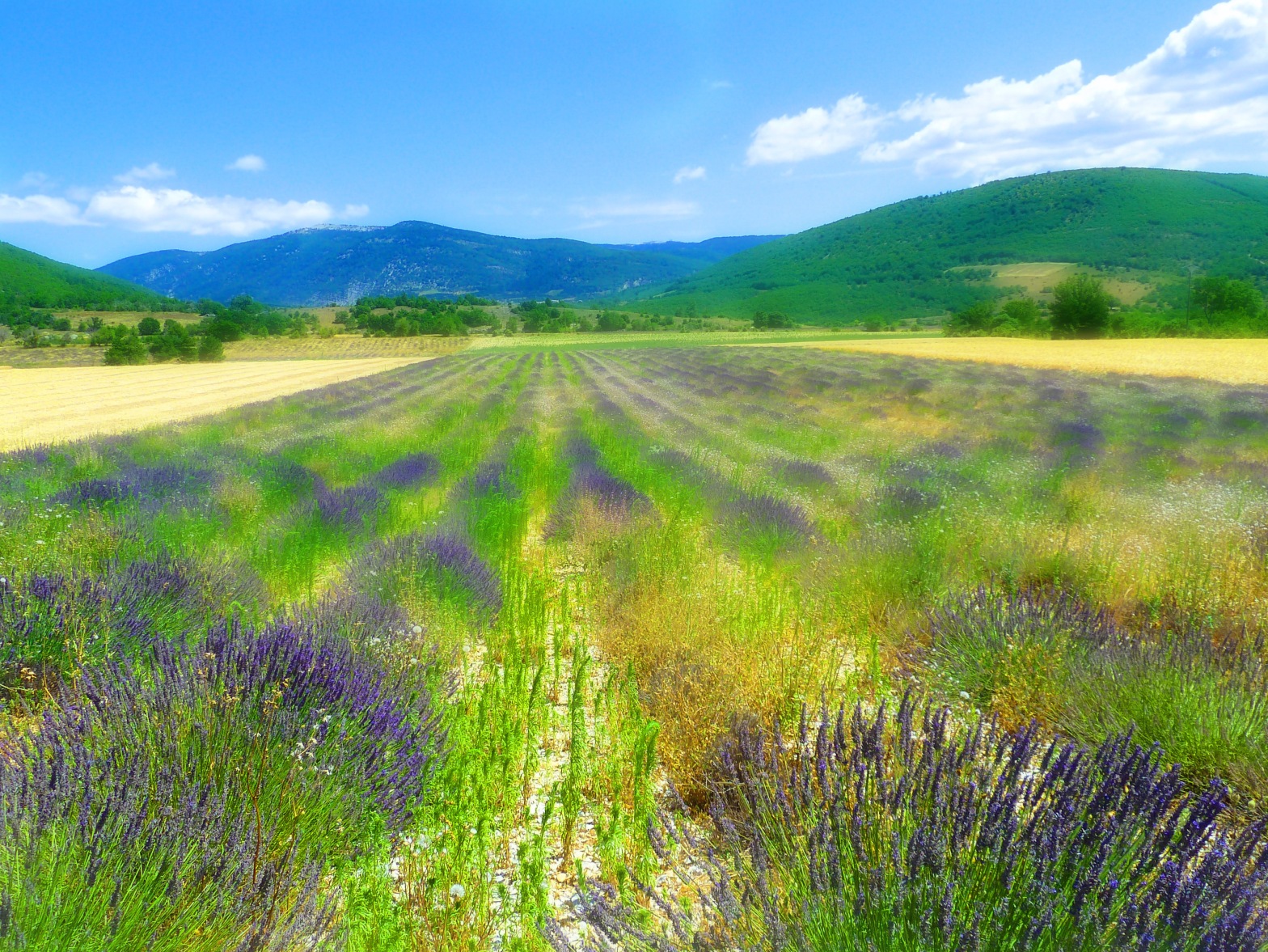
Despite my love of history and the interest I have in the time period in France that covers the occupation and the D-Day landings it is not my intention to go over all the story. That has been well told many times by far better historians and relatively recently with the fascination with the 75th anniversary of the landings. All my writings are done with a desire to inspire you to visit the places we have loved over the years. What I hope to achieve is give you a sense of the atmosphere and the way these sites have an impact on us as visitors. With the war sites in Normandy the feeling that these are places we have loved is perhaps not the correct expression. You can love Provence. You can love Paris. You cannot love a cemetery at a place where so many lost their lives. You can however be moved.

The Normandy American Cemetery and Memorial in France, Cemetiere Americain,  is located in Colleville-sur-Mer, on the site of the temporary American Saint Laurent Cemetery. This was  established by the U.S. First Army just three days after D-Day on the 8th of  June, 1944. By definition of its location it was the first American cemetery on European soil laid out in World War II.

The approach to the cemetery and memorial is quite unusual and unexpected. As you get close to Colleville-sur-mer on the D514 you come upon a roundabout that is well tended and rather than being on a well-used coastal  road you feel in another place altogether. You could be at the approach to a upmarket Golf and Country Club, reminiscent of where the Masters is played in Atlanta, USA. What this sudden change in the landscape impels you to do is to turn left and not to carry on. You cannot just drive past this place, a site that is the most visited memorial site for Americans in the world. Turn left you must do through the wooded area where you can park your car and take what is one of the most extraordinary walks you will ever make.

There is a new visitor centre here now, opened in 2007, but that was some three years after our visit. The new centre tells the story of D-Day and Omaha Beach and gives the visitor a place to reflect and hear the recollections of many participants bringing those dreadful days to life once again. On our visit we just had the cemetery and memorial to contemplate but be assured that was more than sufficient to bring those days back into vivid perspective.

As you walk across into the cemetery you are confronted by row upon row of stark, brilliant white crosses. Every one perfectly laid out in unison so that whichever way you look down the rows they are in line, stood to attention. Initially this is just too much to take in and you sort of want to turn away and try not to look. We found ourselves drawn over to the memorial at the head of the cemetery and facing down a long straight manicured lawn that leads the eye between the two sides of the grave site. In front of the memorial is a reflective pool. There is not a sound, even the birds seem to have caught the mood and are silent.

The memorial is made up of a semi-circular colonnade that has a large inscription running around the upper curved part. Attached at either side of the memorial there is a loggia, and these contain large maps and narratives of the D-Day military operations and the subsequent breakout into the Normandy countryside. At the centre of the semi-circular structure is a bronze statue, “Spirit of American Youth Rising from the Waves.” You cannot help but reflect that sadly the place is dedicated to and contains the generation of American youth whose rise ended so abruptly and tragically just yards from this statue.

On the Walls of the Missing, constructed in a semi-circular garden to the east side of this memorial you will find inscribed 1,557 names of those who never had a last resting place. Some have been found and identified in the years following the construction of this memorial and those are marked by a Rosette against their names.

The cemetery site in front of you covers over 170 acres and contains the graves of 9,385 of American military dead, most of whom lost their lives in the D-Day landings and the operations that followed as the Allies broke out from the beachhead. The whole cemetery spread out before you is so impeccably laid out that it is somewhat dreamlike. Can this be real? In many ways it should not work as a memorial, it is too pristine and so far from the bloody horrors of those landings. Yet, it is that starkness, that total contrast with the events themselves that cause you to be so moved by the experience. It stuns you into silence. I have never been a place with so many other people and not been aware of any sound. No one speaks; they just silently walk through the paths, occasionally looking at the graves but not too often.

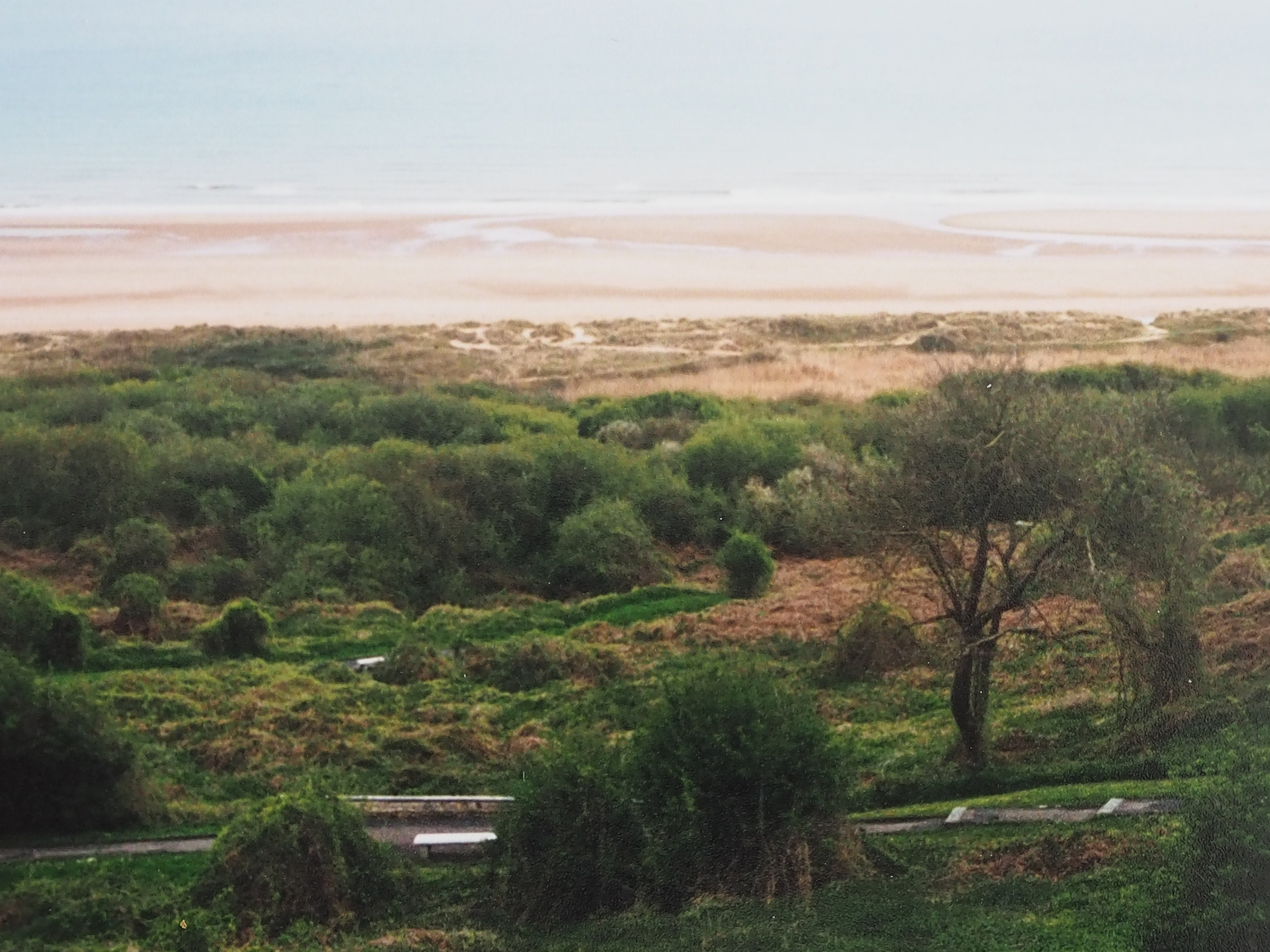
There is one more place that you have to visit and to do so you have to leave the flawless cemetery behind you and step through to an observation point overlooking Omaha beach. At its centre there is an orientation table that gives a battle view on a map of the scene as it was on the 6th of June 1944. The cemetery was very affecting, but it is here overlooking the beach that you feel the emotion of this poignant site. As you look out down to the beach over the grassy knolls you get a sense of the actually deadly dangers those young men faced. The beach is not wide but it is wide enough to know that it would seem a very long way to a soldier running towards a machine gun at the site of this observation point. It is then that it finally hits you that the men in those graves behind you are buried within yards of where they fell. This is as far as they got. It is that realisation which moves you to tears.

alt="Photo of American Landing zone at Omaha Beach Normandy"
The American landing zone on Omaha Beach Normandy

This American Cemetery at Colleville-sur-Mer, is a place that I would say affected me almost as much as anywhere else I have visited. The only other memorial site that I find more intensely moving is The Mémorial des Martyrs de la Déportation at the eastern tip of the Île de la Cité in Paris behind Notre Dame. That one in Paris has a personal resonance for me so it should and does have a deep effect on me whenever I visit Paris. Unlike Paris the Normandy Cemetery does not have a personal connection to me but it is a place that stirs the emotions, and I will never forget it.

This chapter is taken from my new book – OFF THE AUTOROUTE – OUT NOW

alt="New French Travel Guide Book Off the Autoroute"
OUT NOW on Amazon for Kindle, Kindle Unlimited, paperback & hardback

Tommy Simpson and our Ascent of Mont Ventoux

Alt="Photo of Mont Ventoux Provence France for French Travel Guide Books"
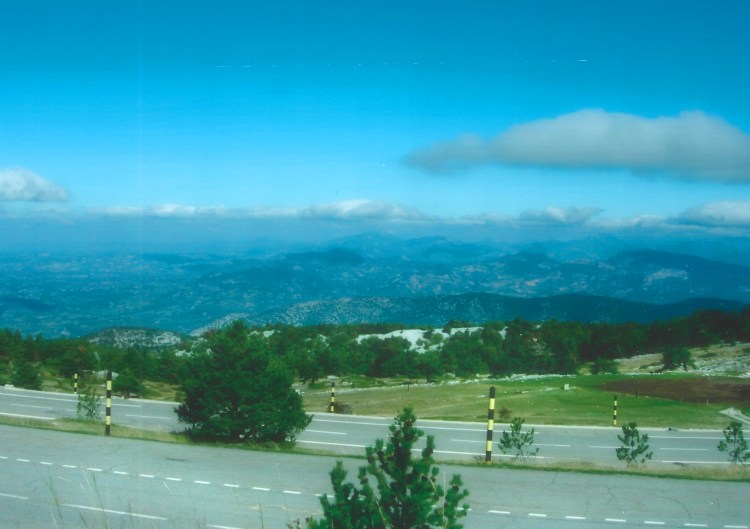
Mont Ventoux from outside of the village of Bonnieux Provence France

From early on in my life I have always had a fascination about the career and a sadness about the death of the British cyclist Tommy Simpson. In my youth I was a keen cyclist, but I never cycled competitively. I had one of those ‘Can you remember where you were when JFK was shot?’ moments in 1967 when Simpson died that July day during the Tour de France on his ascent of Mt Ventoux. I do remember exactly where I was when Kennedy died. I was in a fish and chip shop in Darwen, Lancashire – my hometown. I clearly remember my parents and everyone around being very shocked.

I vividly recall when Simpson passed away. I was in Blackpool, Lancashire on one of our ubiquitous summer holidays. I was listening in my earpiece to a cricket commentary on my transistor radio when a newsflash interrupted this very English scene flowing around in my head. I think importantly for me though it was the death of Tommy Simpson that was the first one in my life to really registered on my consciousness – how could such an athlete just die?

Simpson, the accounts of the time say may have contributed to his demise due to his response to the extreme pressure to succeed that surrounds the Tour de France, this pressure of course continues to this day. Sadly, it was ever thus that ways were being found to enhance a rider’s performance in the Tour. It was concluded that he also had done so, and this had made him unknowingly go beyond the limits of endurance, a point of no return. Due to having been quite debilitating ill in the previous days of the Tour a tragedy was the inevitable consequence. Whatever the truth of his possible stimulant use I feel it should not overshadow his achievements. His death should not be used as just an example of what was wrong with the ‘Tour’, a name used to fight the ongoing battle cycling has faced for so long. Rather it should be a time to give credit to him for the heroic efforts he made to establish himself as a major figure from an unfashionable background – surely the success in recent years means British cycling owes a debt to him for inspiring the generations following him.

He was an immensely popular figure. In England he was revered as an athlete which was unusual for the somewhat minority spectator sport of cycling. What I am saying really is that he was not a soccer playing superstar but through strength of character and that determination to win he had broken through the barrier into much wider popularity. He certainly had with me. I had followed his career avidly and for that reason his death was a massive event in my life. The modern comparison for my son would be the death of Ayrton Senna.

When travelling in Provence I had always looked up at Mt Ventoux, you must do as you cannot miss it, always thinking that I must go up there and pay my respects. Simpson’s memorial is constructed where he fell, just one kilometre from the summit on the route going up from the village of Bèdoin. I decided it was high time that I made the pilgrimage and so we set out first of all for Malaucène.

Malaucène market Provence France – a village at the base of Mont Ventoux, a start of the climb on the Tour de France

We did not go up Ventoux straightaway as there was a morning market in the town and we spent an hour or so browsing around. As usual we were unable to resist the temptation to buy. After a coffee in the market square, we finally set off to start to make our way up Ventoux via the route D974. The road is quite steep even in the initial stages leading from Malaucène, a summit route also used on the Tour. We reached a service station appearing like an Alps chalet, but we passed it by and pressed on towards the summit and our goal for the day. Even early on in our climb up the mountain by car it is clear that to do this on a racing cycle must require a certain quantity of superhuman strength – and a touch of madness. Without condoning it you can see that many would resort to assistance from whatever source available to try to deal with this immense pressure placed on them by the Tour de France. I cannot comprehend how anyone can attempt this at all but on this day there are a few amateur cyclists, some equipped with oxygen, attempting to emulate their heroes from the Tour. I am not sure how sensible it is to try – but try they must.

Alt="Photo of ascent of Mont Ventoux Provence France"
Ascending Mont Ventoux – we never made the summit

Our car is new, a Skoda Octavia top of the range diesel model with the larger engine and has never missed a beat in all the time I have owned it as a company car. It has taken us the nearly one thousand miles from the North of England with ease and for the last week we have toured around the area without it offering complaint. The car is in the peak of condition. We round some zig zag bends and bizarrely at a couple of points I have the sensation of going downhill. I have had this feeling occur also in the English Lakes at higher altitude when your car seems to be almost cruising uphill with minimum power being applied. I am sure there must be a scientific explanation of this phenomenon. We carry on climbing quite slowly as I need to concentrate as we hesitantly reach somewhere around 4500 feet in altitude.

It is around this point on the climb, near the summit and then close to our objective of Tommy Simpson’s memorial that something very strange starts to happen with our vehicle. The car becomes very unresponsive and does not gain any further height with ease, becoming extremely sluggish. You sense that the engine has the signs of overheating and I half expect to see some smoke coming from under the bonnet. This is a quite disconcerting sensation, but worse follows in that it now appears to be that most of the mechanics of the car are starting to shut down and not responding to my control. This was quite scary as we were at a high altitude with serious drops going down from the side of the road. I did not feel I was in control of the vehicle even though I was only progressing the car at an exceptionally low speed. I decided to ease the car over to the mountain face side of the road and it did so very reluctantly. I must admit I was shaking and extremely stressed by this, as was Niamh.

There was no possibility of me trying to continue up the mountain road as my nerves were completely shot. It was essential in view of what was going on with the mechanics of the car that we try to get back down the mountain safely. Sadly, I would be thwarted in getting up to Simpson’s memorial, but discretion is as they say the better part of valour. I tell Niamh to get out of the car while I try to attempt to turn the vehicle around to head back down the mountain road. I have visually checked the engine etc. and nothing seems on face value to be mechanically amiss with the vehicle. The car really does not want to move but eventually I do manage after about a twenty-point turn to safely get it pointing in the opposite direction and Niamh reluctantly gets back in.

We start to retrace our steps down Ventoux and come immediately to a sharp turn. I brake and there is absolutely no response from the pedals. Fortunately, at this gentler part of the decent we are not going too fast and I negotiate the bend which then straightens out to a long steeper descent. Again, I try the brakes and – nothing! I manically pull on the hand brake and point the car to the mountainside and eventually bring it to a stop in a small ditch by the side of the road. Our nerves have been through the wringer and back again. At this point we both get out and now see our car as a demented enemy, no longer the faithful friend that has served us so well thus far. The only plan I can think of is that we bide our time and let the car completely cool down and then hesitantly and conservatively try again. This is what we do and when I am happy that we have left it long enough we get back inside.

Heading cautiously down the long descent the brakes are not perfect by any means, but they seem as if they will get us back to Malaucène if I take considerable care. We slowly but surely do this, and it was an incredible relief to get back down and park in the commune, get out and have a double expresso and mop each other’s brow. I had been thwarted in my plan for the day but worst of all we had got ourselves into a profoundly serious position on that climb. We felt that it could easily, so easily have ended with a far worse result. I have no explanation as to what occurred with the car on that mountain road. The altitude inducing a reaction in the car to that height was the only thing that I could put it down to.

What made it completely bizarre was that when we got back in the car and travelled all the way back to Mazan where we were staying, the vehicle drove and responded perfectly as it always had done previously. I could not take it to a garage as there was nothing to look at – it was fine. It drove perfectly for the rest of the week and on the long journey back to England. It was indeed time for a bottle of wine or two. I never got to Tommy Simpson’s memorial and reaching it is still on my ‘to do list.’ I will get there, probably without Niamh. I will pay my respects to my childhood cycling hero, but I will do it with profound respect for this dangerous mountain and I will do it with care and talk kindly to my car on the way up.

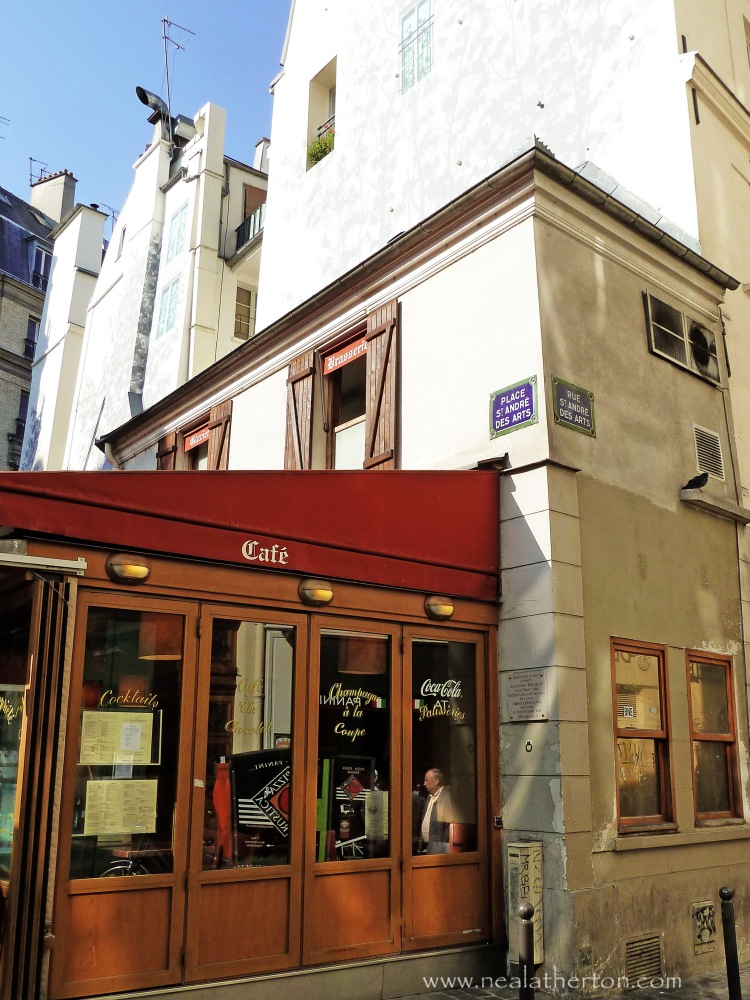
A Tempting Paris lunch spot St Andre Bistro restaurant

Bistro St Andre on the left bank in Paris, France. The stroll from St Michel across towards St Germain takes you down Rue St Andre and it is a very interesting quarter of Paris. Enjoy some narrow side streets and covered arcades. For architecture lovers there is plenty of interest and don’t forget to look up. Of course you will never go hungry here.

Please Enjoy my Travel, Music & Ancestry Books on Amazon – FREE on Kindle Unlimited https://bit.ly/bookneal

Alt=Photo of Paris bistro restaurant St Andre"
Bistro St Andre on the left bank. The stroll from St Michel across towards St Germain takes you down Rue St Andre and it is a very interesting quarter of Paris.

Come with me to Paris with my French Travel books

Discovering my family in Victorian Preston Lancashire

Please Enjoy my Travel, Music & Ancestry Books on Amazon – FREE on Kindle Unlimited https://bit.ly/bookneal

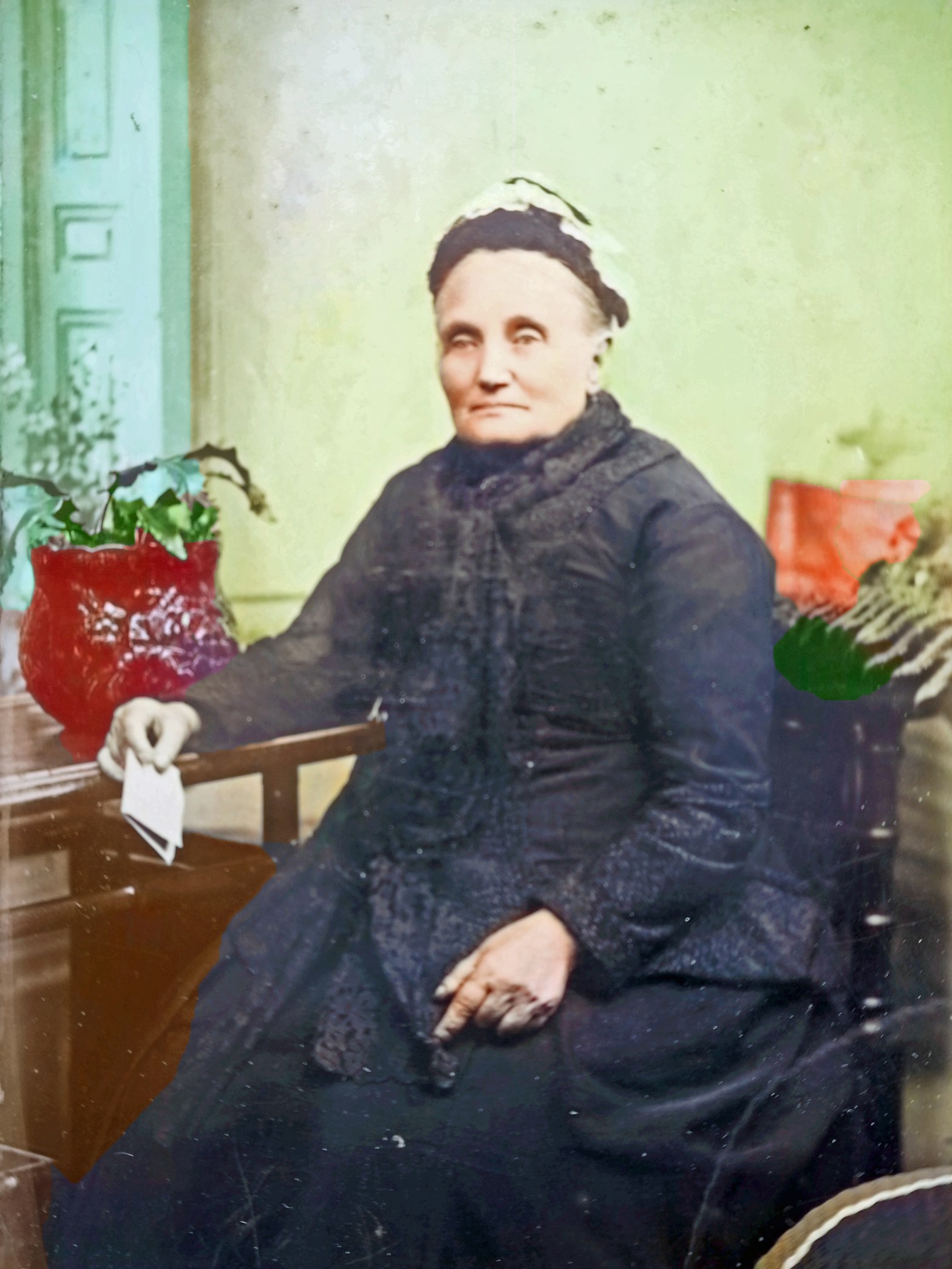
Margaret Eccles (Staniford, Etchells) in 1891

This photo always intrigued me. It was in a collection that once belonged to my great grandfather John Richard Parker who was from Preston. He was a notable footballer in the 1890’s and had a good career as a mill manager. He was an active participant in local life including the Preston guild. The photos were nearly all from professional studios in Preston alongside some football portraits from a Chorley studio. The only one from outside the area of the Preston family was this one.

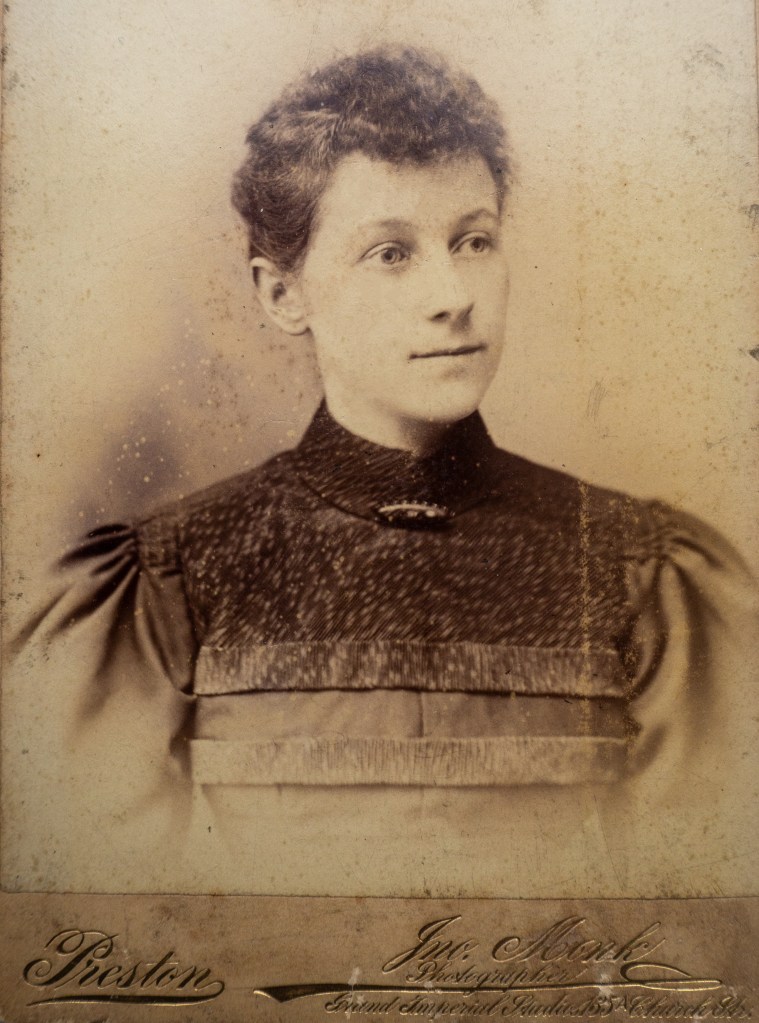
The lady seemingly in mourning dress and holding a keepsake letter is my g/g/g grandmother Margaret Eccles born in Preston in 1826. It was remarkable to have a connection to that era. My g/grandfather John Richard I met and knew for a few years until his death in 1966. So, in sense I had a direct connection back to pre-Victorian times as John Richard certainly met this lady as she oversaw him courting her granddaughter Elizabeth Nightingale, a girl she looked after during the child’s teenage years. Sadly about two years after this photo was taken Margaret died just before the marriage of her young granddaughter.

Elizabeth Nightingale my Great grandmother and Margaret Eccles (Staniford, Etchells) granddaughter

My interest was further aroused by a posting online of a photo from the same Darwen studio of Lindsey. I had discovered during my family history research that Margaret’s son Bartholomew had settled in Darwen with his wife and family. He did well for himself and his sons and daughter made good progress in Darwen society. It was a far cry from the poverty surrounding the mills of Preston and a vast contrast to the life my other side of the family was leading at the time in the slums of central Darwen. It was presumably Bartholomew that arranged for the portrait of his mother to be taken.

Margaret had a long life but suffered much tragedy. She comes across as a strong person, one the family could rely on and she seems to have gone to great lengths to give the family a chance in life. In this she succeeded. Many members of her extended family must have relied on Margaret’s steady and determined efforts to look after their interests. As you pursue your family research you get a sense of and indeed make judgements on the character of your relatives from afar. Margaret comes across as someone I really wished I had met; she seems to exude a warm and loving character.

Margaret was married to Edward Staniford in Preston in 1845 and they had four children.

My next direct ancestor in line was their daughter Mary born in 1848. Edward worked in the cotton industry of course but unusually he became a policeman and the family lived in the police house in Cuerden Green near Bamber Bridge until his early death in 1858. Margaret, now without an income and head of the family moved them back to Deepdale Mill Street in Preston where she found employment as a heald knitter. Her two young daughters also go into the cotton mills of Preston. Her firstborn daughter Ellen marries George Isaac Willacy and their daughter who attended their wedding in the autumn of 1867 is born early in 1868. George is 17, about six years younger than Ellen. I sense they were taken to the alter at speed to maintain family honour. Young Hannah is looked after by her mother for the first part of her life before the ever-willing Margaret looks after her granddaughter as she also will for the children of her other daughter Mary. There is no indication in the 1871 or 1881 census that Ellen lives with George Willacy. They are found in separate houses, Ellen and Hannah are with her now married sister Mary’s family but George is elsewhere. He lists his employment as iron moulder but seems to have tried to pursue a career as a musician as did others involved with the Willacys. Ellen and George did though find time for each other. Ellen gives birth to six more children and they are baptized with George Willacy being named as the father. Tragically, all six die a short time after birth – imagine the pain of the mother. Hannah Willacy is the only survivor. Despite this dysfunctional, unsuccessful marriage the Stanifords are close to the Willacy family.

Margaret embarks on her second and clearly happy marriage in 1878 to a man who also seems to exude warmth down the years, Benjamin Etchells from Failsworth in Manchester. Benjamin has been of interest in my family story despite not being in my blood line. This interest was reawakened very much by a contact from a lady who also although not of his blood line had his daughter enter her own family story. This led to a much broader understanding of the life and times of not just Benjamin and Hannah but also my own extended ancestors. In fact I was also shown a photo from this extended family taken in the same studio with the very same plant pot which helped to date my photo.

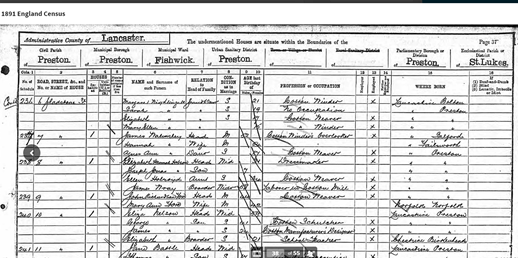
She would have known Benjamin and Hannah for some years, they were neighbours in Gladstone Street, Preston. By 1881 they are living at Benjamin’s house with young Hannah Willacy at 6 Gladstone Street, Preston. At number 8 is Mary, my g/g/grandmother with her five girls including my g/grandmother Elizabeth. The youngest is two years old and Mary is eight months pregnant with another girl who would be named Hannah after Benjamin’s daughter and her aunt living next door but one.

It is now that tragedy strikes. Margaret’s daughter Mary gives birth to Hannah Nightingale but sadly dies in childbirth leaving five girls motherless. At this time her husband is not in the family home and he goes on to remarry a Blackburn woman with a chequered past, the estranged wife of the celebrated local poet William Billington, a quite extraordinary course to follow. How they met is a mystery but they end up marrying and living in Burnley. Margaret takes all the children into the home she shares with Benjamin although her son Robert and wife Annie in Darwen will care for the two-year-old Alice as they had no children. New born Hannah is christened at St.Lukes Preston with her father shown as having the unusual occupation of a Kasher, someone who renders meat to be Kosher by extracting as much blood as possible from the carcase. There seems to be Jewish heritage thread through the Etchells, Willacys and Nightingales but one that tantalisingly stays out of reach of provability. The names of children seem to indicate this but all their ceremonies of life are in the established church.

The crowded house at number 6 suffers a further devasting blow in the summer as Benjamin Etchells dies. Margaret is now on her own once again with a house full of children. One consolation for Margaret is that Benjamin leaves a substantial sum for the time and she is now as the census will state ‘living on her own means’. At least she can concentrate on doing her best for the children and it would seem that Benjamin has made arrangements for the extended family to take an active interest in the family. Also the young baby Hannah Nightingale dies before her first birthday. A double tragedy as her mother died to give her life.

Benjamin’s daughter Hannah Etchells moved with her widowed father to Preston and cared for him before his marriage to Margaret. She marries James William Walmsley in 1878 the same year that his father married Margaret. After Benjamin’s death they move with their four children next door to Margaret and no doubt the closeness of the families help Margaret bring up the girls. The Etchells must also have looked out for the interests of young Alice in Darwen as she is set up as a confectioner/baker in Failsworth, the home town of Benjamin.

Margaret Eccles and Hannah Willacy in 1891 Preston
Margaret Eccles in 1891 with grandchildren

The two Hannahs fair well in life, Benjamin’s daughter has a successful life with a good man in James Walmsley. The four children in the family are in fact stepchildren to her as James has been married and widowed twice before. His two previous wives had both died in childbirth, an unimaginable tragedy. Hannah is clearly loved by the children and the feelings must have been mutual. In her old age and after losing her husband in 1897 she is cared for by her stepson Thomas in Chorley. A nice touch is that they refer to her as mother in the census of 1911, not stepmother.

Young Hannah Willacy, the granddaughter of Margaret Etchells stays with Margaret until her death. She was a clever girl. At 13 she is a school monitor which in Victorian times was a pupil who was given extra lessons to take a class herself and improve the teaching in the school. She goes on to become a teacher and marries in her 30’s Thomas Bleasdale and they live in Great Harwood where Hannah teaches. She, like Hannah Etchells does not have children of her own but they leave a fine legacy of care for the children in their immediate family. My grandmother Elizabeth would have a great love and affection for these two women as she made her way into adulthood.

The families of Etchells/Staniford seem to stay close to the Walmsley family that Hannah Etchells marries into. This seems clear from looking at the family lives in Darwen where two of Margaret’s sons Bartholomew and Richard live and members of the Walmsley family also make their home. Margaret’s granddaughter Margaret Ann Staniford marries William Thomas Leach in Darwen. The Leach family are printers and in fact publish the local newspaper and did so right up to my generation. John Walmsley and his son also work in the printing trade and it is most likely that they would have been employed by the Leach operation in Darwen. Their paths seem to cross often in this story and one would hope that they all assisted in making life as comfortable as possible in industrial Darwen. It seems so, the influence of Benjamin Etchells I conclude was a beneficial one for these families and Margaret Eccles his widow and my great grandmother certainly played a vital role in caring for her extended family. It is so interesting to put flesh on the bones of a story, this one inspired by a single photo but the story behind gives so much more value to that studio portrait from so long ago.

More Family stories in my book on Amazon – Kindle & Kindle Unlimited